
[论文解读] BinsFormer: Revisiting Adaptive Bins for Monocular Depth Estimation
BinsFormer 引入基于 Transformer 的自适应 bin 生成,用于单目深度估计,在分类-回归框架中,具有多尺度细化和辅助场景理解任务,在 KITTI、NYU 和 SUN RGB-D 上实现了最先进的结果。
Monocular depth estimation is a fundamental task in computer vision and has drawn increasing attention. Recently, some methods reformulate it as a classification-regression task to boost the model performance, where continuous depth is estimated via a linear combination of predicted probability distributions and discrete bins. In this paper, we present a novel framework called BinsFormer, tailored for the classification-regression-based depth estimation. It mainly focuses on two crucial components in the specific task: 1) proper generation of adaptive bins and 2) sufficient interaction between probability distribution and bins predictions. To specify, we employ the Transformer decoder to generate bins, novelly viewing it as a direct set-to-set prediction problem. We further integrate a multi-scale decoder structure to achieve a comprehensive understanding of spatial geometry information and estimate depth maps in a coarse-to-fine manner. Moreover, an extra scene understanding query is proposed to improve the estimation accuracy, which turns out that models can implicitly learn useful information from an auxiliary environment classification task. Extensive experiments on the KITTI, NYU, and SUN RGB-D datasets demonstrate that BinsFormer surpasses state-of-the-art monocular depth estimation methods with prominent margins. Code and pretrained models will be made publicly available at \url{https://github.com/zhyever/Monocular-Depth-Estimation-Toolbox}.
研究动机与目标
- 在将单目深度估计表述为具有自适应 Bin 的分类-回归问题时,激发并提升其性能。
- 通过一个单独的 Transformer 解码器生成自适应 Bin 中心,将其视为一个集合到集合的预测问题。
- 通过多尺度解码器实现全局与局部特征的强交互,以获得从粗到细的深度图。
- 引入一个辅助场景理解任务来引导 Bin 生成并提高深度精度。
- 展示在 KITTI、NYU-Depth-v2 和 SUN RGB-D 数据集上的 state-of-the-art 性能,并展示良好的跨数据集泛化能力。
提出的方法
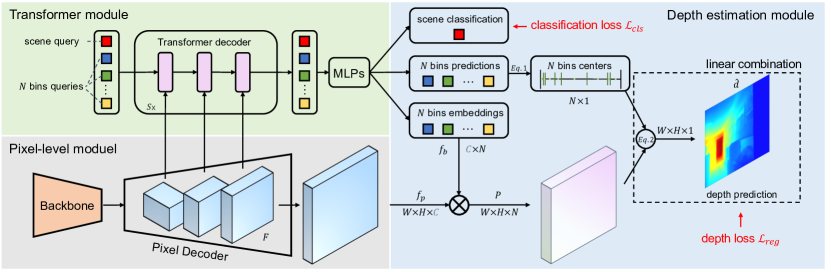
- 使用像素级模块提取多尺度图像特征和每个像素的表示。
- 采用 Transformer 解码器作为集合到集合的预测器,独立于每个像素特征输出 N 个 Bin 的长度和 N 个 Bin 的嵌入。
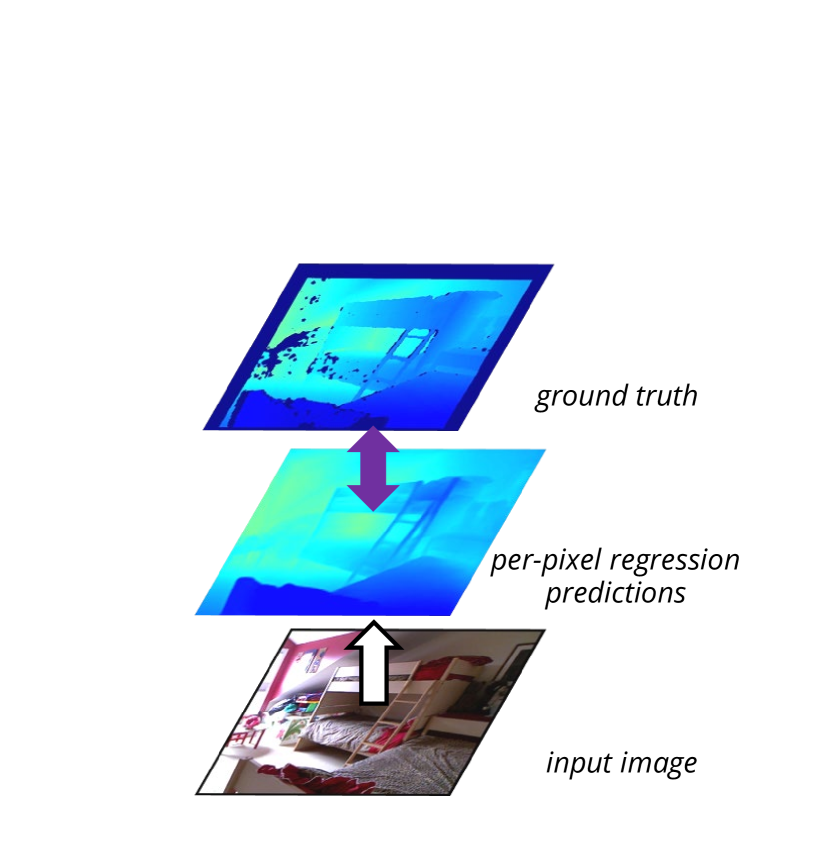
- 通过像素嵌入与 Bin 嵌入的点积匹配计算每个像素对 Bin 的概率分布,然后将深度预测为这些概率与 Bin 中心的线性组合。
- 通过简单的后处理函数从预测的 Bin 长度生成 Bin 中心,将长度映射到深度值。
- 在 Transformer 中引入一个辅助场景理解查询,以通过场景分类损失隐式监督 Bin 生成。
- 引入多尺度预测细化策略,使每个尺度都输入到 Transformer,实现带有尺度加权损失的粗到细的深度细化。
实验结果
研究问题
- RQ1由 Transformer 解码器生成的自适应 Bin 是否能在分类-回归框架中提升单目深度估计?
- RQ2将 Bin 生成与像素表示分离并采用多尺度细化是否能提升深度精度以及全局-局部的一致性?
- RQ3辅助场景理解任务是否为 Bin 生成和深度预测提供了有益的监督?
- RQ4BinsFormer 与 KITTI、NYU-Depth-v2 和 SUN RGB-D 上的最先进方法相比表现如何,以及跨数据集泛化能力如何?
主要发现
- BinsFormer 在 KITTI、NYU-Depth-v2 和 SUN RGB-D 数据集上,在多种骨干网络(例如 Swin 变体、ResNet 骨干网络)上实现了最先进或具竞争力的性能。
- 独立的基于 Transformer 的 Bin 生成器和像素级模块实现了全局与局部信息的有效交互,降低大面积深度误差。
- 在最多使用三个尺度的特征时,多尺度细化能提升深度估计,超过该尺度后的增益递减。
- 辅助场景分类任务有助于 Bin 生成,带来可衡量的改进,训练开销极小。
- 在各项评估中,BinsFormer 展现出强大的跨数据集泛化能力,特别是在以 NYU-Depth-v2 训练时显著提升 SUN RGB-D 的结果。
阅读本论文
在 Nubint 阅读器中打开原文,边读边就任意段落提问。
在 Nubint 中阅读本论文本解读由 AI 根据论文原文生成,引用前请核对原文。