
[论文解读] Boosting Adversarial Attacks by Leveraging Decision Boundary Information
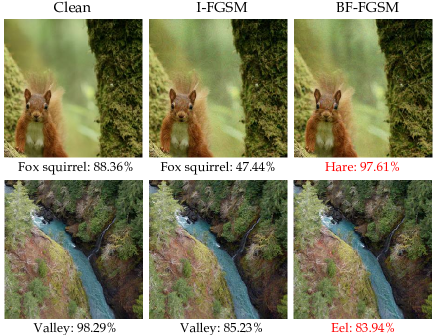
本文提出边界拟合攻击(Boundary Fitting Attack, BFA),一种新型的基于迁移的对抗性攻击方法,通过利用替代模型决策边界附近边界点的梯度信息,提升对抗样本的迁移性。通过平均多个边界点的梯度,BFA 生成更具有效性的对抗方向,能够更高效地穿越受害模型的决策边界,实现最先进水平的攻击成功率——在普通 CNN 上提升 5.6%,在防御 CNN 上提升 14.9%,当使用 CNN 作为替代模型时,对 Transformer 模型的攻击成功率也达到 58.2%。
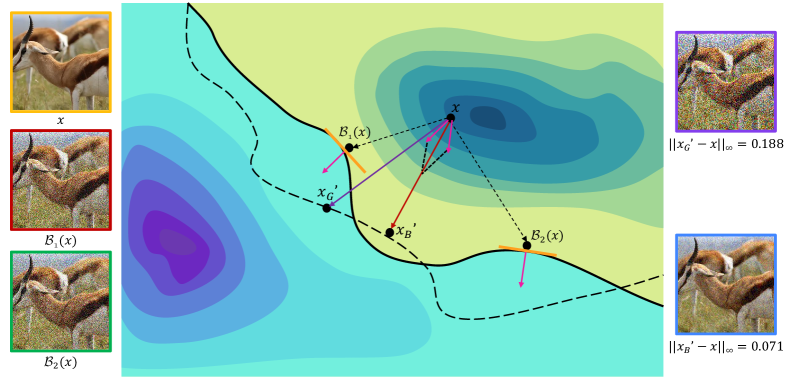
Due to the gap between a substitute model and a victim model, the gradient-based noise generated from a substitute model may have low transferability for a victim model since their gradients are different. Inspired by the fact that the decision boundaries of different models do not differ much, we conduct experiments and discover that the gradients of different models are more similar on the decision boundary than in the original position. Moreover, since the decision boundary in the vicinity of an input image is flat along most directions, we conjecture that the boundary gradients can help find an effective direction to cross the decision boundary of the victim models. Based on it, we propose a Boundary Fitting Attack to improve transferability. Specifically, we introduce a method to obtain a set of boundary points and leverage the gradient information of these points to update the adversarial examples. Notably, our method can be combined with existing gradient-based methods. Extensive experiments prove the effectiveness of our method, i.e., improving the success rate by 5.6% against normally trained CNNs and 14.9% against defense CNNs on average compared to state-of-the-art transfer-based attacks. Further we compare transformers with CNNs, the results indicate that transformers are more robust than CNNs. However, our method still outperforms existing methods when attacking transformers. Specifically, when using CNNs as substitute models, our method obtains an average attack success rate of 58.2%, which is 10.8% higher than other state-of-the-art transfer-based attacks.
研究动机与目标
- 为解决由替代模型生成的对抗样本在模型梯度差异下迁移性受限的问题。
- 探究决策边界梯度是否在不同模型之间比原始输入梯度更相似,从而提升迁移性。
- 开发一种方法,通过利用决策边界的平坦性与几何特性,提升对抗攻击的成功率。
- 评估 Transformer 模型与 CNN 模型在基于迁移的攻击下的鲁棒性,并提升对两类架构的攻击有效性。
- 为利用边界梯度平均作为寻找更具迁移性的对抗方向的策略,提供理论与实证支持。
提出的方法
- 通过沿随机方向扰动输入图像,直到模型预测发生变化,从而采样多个靠近决策边界的边界点。
- 在这些边界点上计算梯度,并对梯度进行平均,生成更精确的对抗更新方向,使其更契合受害模型的决策边界。
- 该方法与现有基于梯度的攻击方法(如 FGSM、MI-FGSM)兼容,可无缝集成至标准攻击流程中。
- 收缩因子 γ 控制边界搜索过程中的步长,以在边界接近度与计算效率之间取得平衡。
- 采样边界点的数量 N 经调优以优化迁移性,发现 N=20 在性能与成本之间提供了最佳权衡。
- 该方法引入了“决策边界距离”作为模型鲁棒性的代理指标,距离越大表示沿自然方向的鲁棒性越高。
实验结果
研究问题
- RQ1不同模型在决策边界处的梯度是否比在原始输入位置更相似?
- RQ2能否通过利用边界梯度信息,提升对抗样本在不同模型间的迁移性?
- RQ3决策边界的平坦性是否能通过边界梯度导出更有效的对抗方向?
- RQ4基于迁移的攻击在 CNN 与 Transformer 之间的性能表现如何?本方法能否提升对两类模型的攻击成功率?
- RQ5为最大化迁移性,超参数(如收缩因子 γ、边界点数量 N)的最优配置是什么?
主要发现
- 所提出的边界拟合攻击相较于最先进水平的基于迁移的攻击方法,在正常训练的 CNN 上平均攻击成功率提升 5.6%,在防御 CNN 上提升 14.9%。
- 当使用 CNN 作为替代模型时,该方法在攻击 Transformer 模型上实现了 58.2% 的平均攻击成功率,较其他最先进方法高出 10.8%。
- 当从 Transformer 模型迁移攻击 CNN 模型时,该方法在 CNN 上实现了 78.1% 的平均成功率,优于其他方法 13.6%。
- 在引入 SIM 后,该方法在从 Transformer 攻击 CNN 时达到 82.6% 的平均成功率,展现出极强的迁移能力。
- 实验结果证实,边界梯度在不同模型之间比原始梯度更相似,支持了该方法的核心假设。
- 消融实验表明,γ=0.6 与 N=20 在性能与计算成本之间提供了最优平衡。
阅读本论文
在 Nubint 阅读器中打开原文,边读边就任意段落提问。
在 Nubint 中阅读本论文本解读由 AI 根据论文原文生成,引用前请核对原文。