
[论文解读] Boosting Consistency in Story Visualization with Rich-Contextual Conditional Diffusion Models
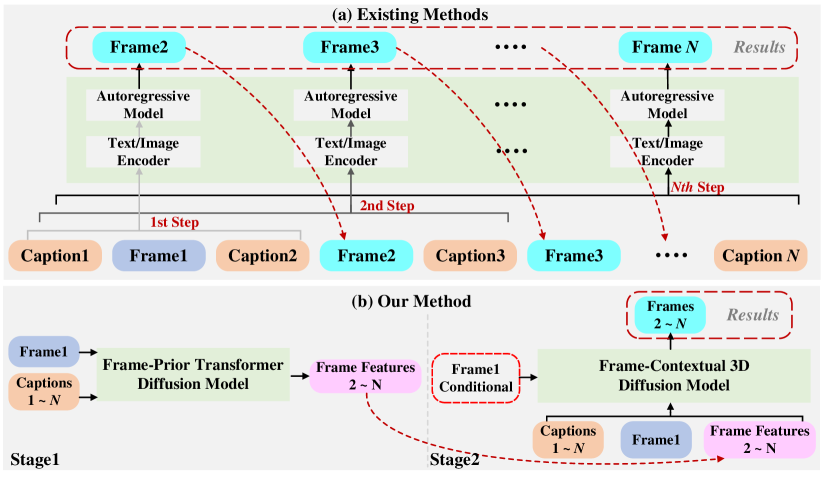
RCDMs 引入一个两阶段框架,使用框架先验 Transformer 扩散模型加上框架上下文 3D 扩散模型,以在故事可视化中实现语义和时间的一致性,从而实现一次前向推断生成。
Recent research showcases the considerable potential of conditional diffusion models for generating consistent stories. However, current methods, which predominantly generate stories in an autoregressive and excessively caption-dependent manner, often underrate the contextual consistency and relevance of frames during sequential generation. To address this, we propose a novel Rich-contextual Conditional Diffusion Models (RCDMs), a two-stage approach designed to enhance story generation's semantic consistency and temporal consistency. Specifically, in the first stage, the frame-prior transformer diffusion model is presented to predict the frame semantic embedding of the unknown clip by aligning the semantic correlations between the captions and frames of the known clip. The second stage establishes a robust model with rich contextual conditions, including reference images of the known clip, the predicted frame semantic embedding of the unknown clip, and text embeddings of all captions. By jointly injecting these rich contextual conditions at the image and feature levels, RCDMs can generate semantic and temporal consistency stories. Moreover, RCDMs can generate consistent stories with a single forward inference compared to autoregressive models. Our qualitative and quantitative results demonstrate that our proposed RCDMs outperform in challenging scenarios. The code and model will be available at https://github.com/muzishen/RCDMs.
研究动机与目标
- 解决自回归故事可视化方法在上下文和时间一致性方面的薄弱问题。
- 提出一个框架先验 Transformer 扩散模型,用于从已知帧和字幕预测未知片段帧的嵌入。
- 开发一个框架上下文 3D 扩散模型,联合利用图像级和特征级丰富上下文条件以生成连贯的故事。
- 在 FlintstonesSV 和 PororoSV 数据集上显示出对现有方法的定量与定性改进。
提出的方法
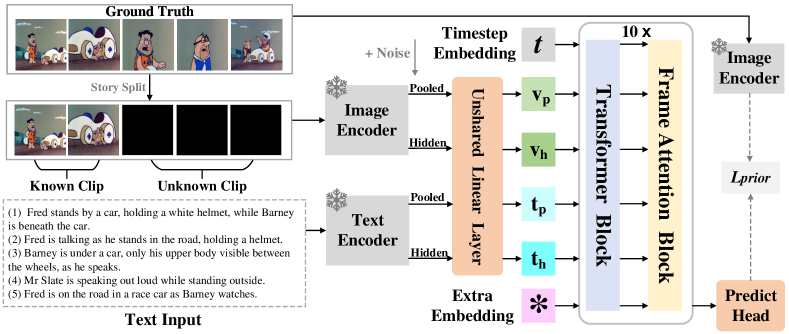
- 阶段 1:框架先验 Transformer 扩散模型利用已知片段帧和全部字幕预测未知帧的语义嵌入。
- 阶段 2:框架上下文 3D 扩散模型在图像级(已知片段图像)和特征级(帧嵌入、所有字幕)条件下生成帧。
- 使用一个冻结的基于 CLIP 的图像编码器和一个冻结的文本编码器;采用帧注意力块来捕捉时间动态。
- 通过多模态交互模块和语义叠加模块注入图像级和特征级条件。
- 以两阶段目标进行训练,在采样阶段应用无分类器引导。
实验结果
研究问题
- RQ1框架级语义先验如何提升跨帧在故事可视化中的一致性?
- RQ2在图像级和特征级都进行丰富条件化,是否能比仅字幕或自回归方法获得更好的语义与时间一致性?
- RQ3与自回归扩散方法相比,两阶段的 RCDM 是否实现更快或等效的推理?
- RQ4各模块(IC、MIM、SSM、stage1 prior)对整体性能的贡献是什么?
主要发现
- RCDMs 在 FlintstonesSV 和 PororoSV 上的 FID、Char-Acc、Char-F1 均优于现有方法。
- 框架先验阶段提升帧语义一致性并增强下游角色与场景的一致性。
- 图像级条件化和多模态交互模块显著优于仅字幕的方法。
- RCDMs 能以一次前向推断生成连贯的故事,在速度上优于自回归基线。
- 用户研究显示 RCDMs 的视觉质量感知、文本-图像相关性和时间一致性更高。
阅读本论文
在 Nubint 阅读器中打开原文,边读边就任意段落提问。
在 Nubint 中阅读本论文本解读由 AI 根据论文原文生成,引用前请核对原文。