
[论文解读] Boosting galactic outflows with enhanced resolution
论文表明将分辨率提高以解析星系风中的局部气体冷却长度,可以增强多相结构与能量学,从而提升远离星系的质量、金属和能量装载因子。
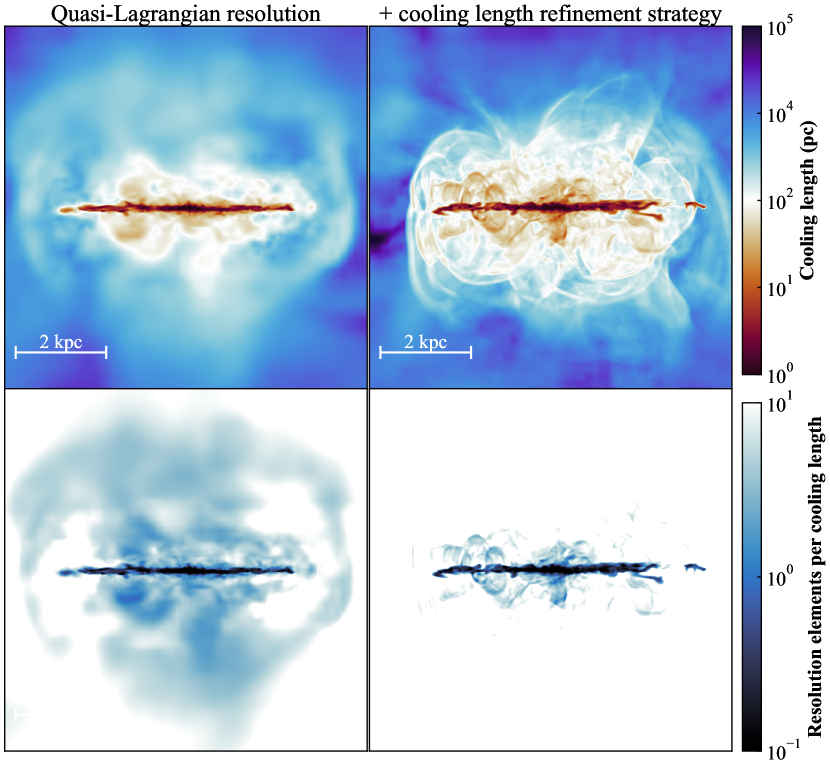
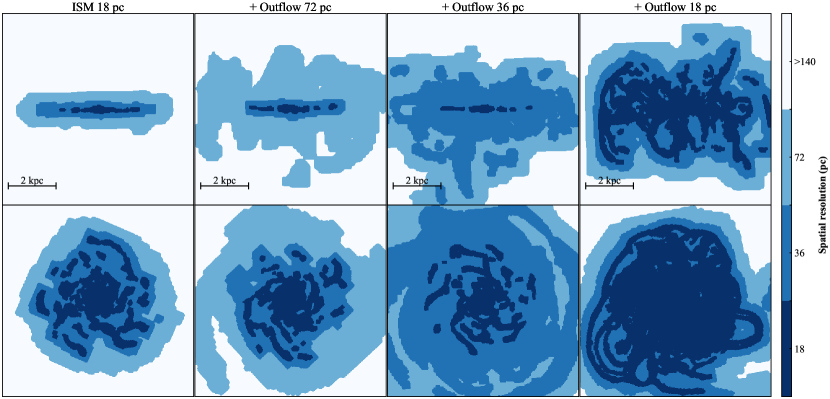
We study how better resolving the cooling length of galactic outflows affect their energetics. We perform radiative-hydrodynamical galaxy formation simulations of an isolated dwarf galaxy ($M_{\star}=10^{8}\, \mathrm{M}_\odot$) with the Ramses-RTZ code, accounting for non-equilibrium cooling and chemistry coupled to radiative transfer. Our simulations reach a spatial resolution of $18 \, \mathrm{pc}$ in the interstellar medium (ISM) using a traditional quasi-Lagrangian scheme. We further implement a new adaptive mesh refinement (AMR) strategy to resolve the local gas cooling length, allowing us to gradually increase the resolution in the stellar-feedback-powered outflows, from $\geq 200 \, \mathrm{pc}$ to $18 \, \mathrm{pc}$. The propagation of outflows into the inner circumgalactic medium (CGM) is significantly modified by this additional resolution, but the ISM, star formation and feedback remain by and large the same. With increasing resolution in the diffuse gas, the hot outflowing phase ($T > 8 imes 10^{4} \, \mathrm{K}$) systematically reaches overall higher temperatures and stays hotter for longer as it propagates outwards. This leads to two-fold increases in the time-averaged mass and metal outflow loading factors away from the galaxy ($r=5\, \mathrm{kpc}$), a five-fold increase in the average energy loading factor, and a $\approx$50 per cent increase in the number of sightlines with $N_{ ext{OVI}} \geq 10^{13}\, \mathrm{cm}^{-2}$. Such a significant boost to the energetics of outflows without new feedback mechanisms or channels strongly motivates future studies quantifying the efficiency with which better-resolved multiphase outflows regulate galactic star formation in a cosmological context.
研究动机与目标
- 理解解析局部气体冷却长度如何影响星系风的能量学。
- 量化分辨率增加对风相结构(冷、 warm、热)的变化。
- 确定分辨率对千秒差距尺度上质量、金属和能量装载因子的影响。
- 通过更高分辨率的风中离子化示踪体(如 O VI)评估观测含义。
提出的方法
- 对一个孤立的矮星系进行放射-流体动力学模拟,使用 ramses-rtz。
- 求解非平衡冷却与化学反应,并耦合到在飞行中的辐射传输,覆盖 60+ 种离子物种。
- 实现新的自适应网格细化,目标为局部气体冷却长度,将风从 >200 pc 精细化到 18 pc。
- 在不同分辨率下保持一致的恒星形成与反馈预算,以隔离分辨率效应。
- 在多个高度(如 r=5 kpc)比较风的性质,并通过 PDFs 分析相分布。
- 在初始放松期后约 500 Myr 的时间平均诊断。
实验结果
研究问题
- RQ1解析 diffuse outflowing gas 的局部冷却长度分辨率如何影响风的能量学与相结构?
- RQ2随着分辨率的提高,质量、金属和能量装载因子有何定量变化?
- RQ3更好的冷却长度分辨率是否改变内部 CGM 的观测性离子化示踪体,如 O VI?
- RQ4是否可以在不改变矮星系的恒星形成与反馈历史的前提下实现更高分辨率?
主要发现
- 改进的冷却长度分辨率产生更具多相性的风,其中包含更冷的致密部分和更热的弥散部分。
- 在 5 kpc 处的时间平均质量装载因子在高分辨率下对弥散性气体几乎翻倍。
- 在 5 kpc 处的时间平均金属装载因子增加的幅度与质量装载因子相当。
- 改进的风分辨率使平均能量装载因子增加约五倍。
- 视线中 N(O VI) >= 1e13 cm^-2 的视线比例增加约 50%。
- 各分辨率下的 ISM 性质与全球恒星形成率基本保持不变, isolating 了对风能量学的影响。
阅读本论文
在 Nubint 阅读器中打开原文,边读边就任意段落提问。
在 Nubint 中阅读本论文本解读由 AI 根据论文原文生成,引用前请核对原文。