
[论文解读] Brain Captioning: Decoding human brain activity into images and text
简要结论:本文提出了一种方法,利用多模态语言模型(GIT)将 fMRI 大脑活动解码为文本标题,并通过潜在扩散管道在预测文本和深度/初始视觉线索引导下重构出合理的图像。相较于先前在 NSD COCO 刺激上的工作,本文在标题生成指标上有改进,在图像质量指标上具有竞争力。
Every day, the human brain processes an immense volume of visual information, relying on intricate neural mechanisms to perceive and interpret these stimuli. Recent breakthroughs in functional magnetic resonance imaging (fMRI) have enabled scientists to extract visual information from human brain activity patterns. In this study, we present an innovative method for decoding brain activity into meaningful images and captions, with a specific focus on brain captioning due to its enhanced flexibility as compared to brain decoding into images. Our approach takes advantage of cutting-edge image captioning models and incorporates a unique image reconstruction pipeline that utilizes latent diffusion models and depth estimation. We utilized the Natural Scenes Dataset, a comprehensive fMRI dataset from eight subjects who viewed images from the COCO dataset. We employed the Generative Image-to-text Transformer (GIT) as our backbone for captioning and propose a new image reconstruction pipeline based on latent diffusion models. The method involves training regularized linear regression models between brain activity and extracted features. Additionally, we incorporated depth maps from the ControlNet model to further guide the reconstruction process. We evaluate our methods using quantitative metrics for both generated captions and images. Our brain captioning approach outperforms existing methods, while our image reconstruction pipeline generates plausible images with improved spatial relationships. In conclusion, we demonstrate significant progress in brain decoding, showcasing the enormous potential of integrating vision and language to better understand human cognition. Our approach provides a flexible platform for future research, with potential applications in various fields, including neural art, style transfer, and portable devices.
研究动机与目标
- Motivate shifting brain decoding from reconstructing images to generating captions to capture higher-level scene semantics.
- Develop a brain-to-features mapping that leverages a multimodal captioning model (GIT) to produce captions from fMRI-derived features.
- Introduce an image reconstruction pipeline that uses predicted text, initial guesses, and depth maps to generate plausible images via latent diffusion models.
- Evaluate the approach against baselines using text-based metrics (METEOR, CLIP, SentenceTransformer) and image-based metrics (PixCorr, SSIM, AlexNet/Inception/CLIP, FID).
- Demonstrate the feasibility and potential applications of brain captioning and multimodal decoding for neuroscience and AI applications.
提出的方法
- Use NSD data with eight subjects; focus on subj01 and subj02; map fMRI to image features via regularized linear regression with cross-validated regularization (alpha = 50,000).
- Employ GIT (Generative Image-to-text Transformer) as the captioning backbone to generate captions from predicted image features.
- Normalize predicted features to match the distribution of image features before decoding captions.
- Construct an image reconstruction pipeline by first generating an initial guess image via a frozen VDVAE latent representation mapped from brain activity, then estimate depth maps and map them to VDVAE latents;
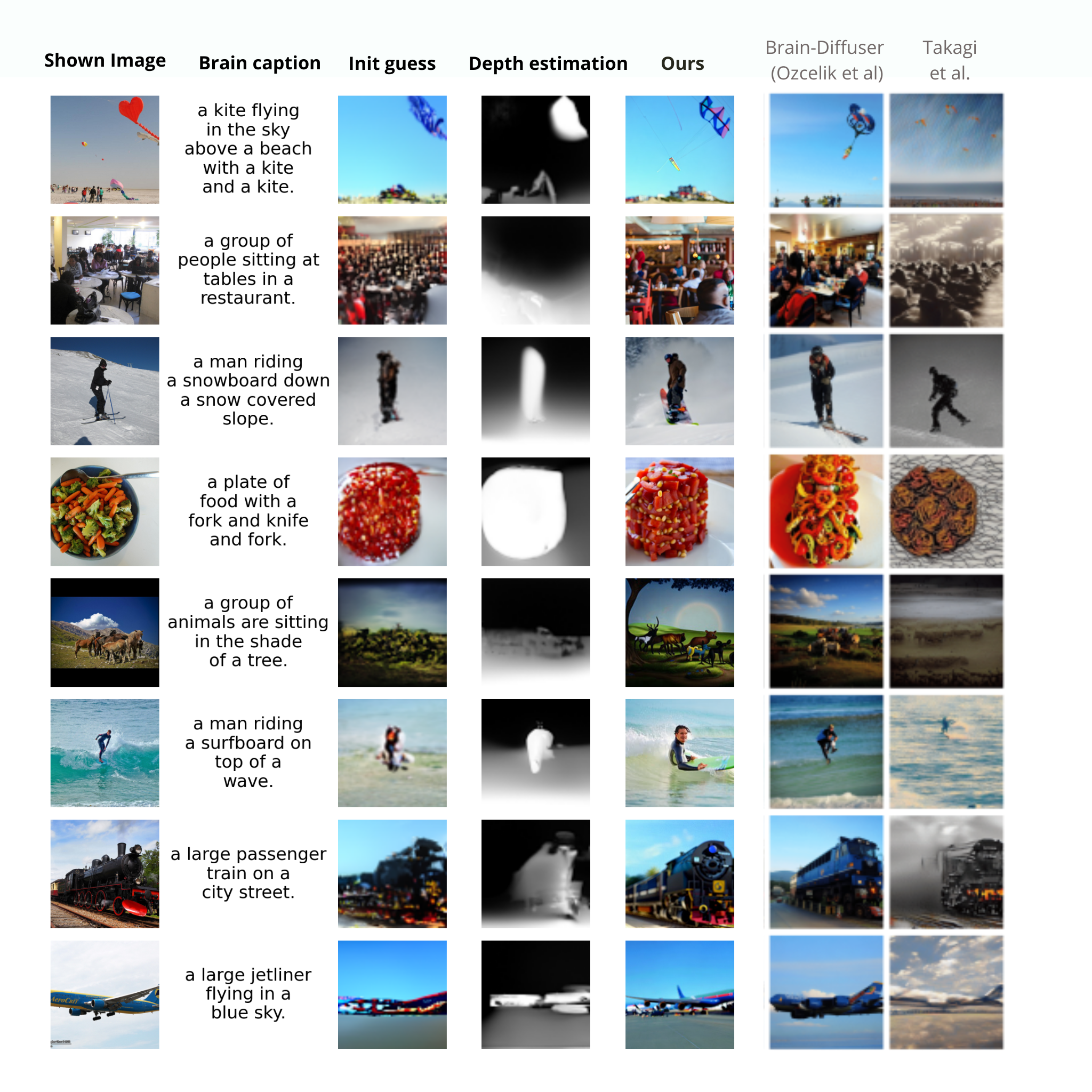
- Condition Stable Diffusion v2 with ControlNet using predicted text, initial guess, and depth information to produce final reconstructions with 30 steps and guidance scale 9 (control net weight 0.8).
- During training, learn ridge regressions from brain activity to latent representations of image features and VDVAE depth/initial latent spaces; use renormalization to align distributions between brain-driven predictions and target latent spaces.

实验结果
研究问题
- RQ1Can brain activity be decoded to produce meaningful image captions rather than direct image reconstructions?
- RQ2How well can fMRI-derived features, mapped to a captioning model’s latent space, generate human- or COCO-style captions?
- RQ3Does incorporating initial guess images and depth information improve the plausibility and spatial relationships of diffusion-based reconstructions?
- RQ4How do caption-based and image-based metrics compare to baseline brain decoding approaches on NSD-COCO stimuli?
- RQ5What are the limitations and potential applications of brain captioning for neuroscience and AI domains?
主要发现
- The proposed brain captioning method outperforms the baseline CNN+LSTM approach on text-based metrics for both subjects (e.g., METEOR, CLIP similarity, SentenceTransformer similarity).
- Brain-captioned outputs achieve higher CLIP and sentence-based scores for brain captions compared with baselines and prior works.
- The image reconstruction pipeline with depth maps and an initial VDVAE-based guess yields competitive low-level image metrics (PixCorr, SSIM) and strong performance in early CNN/inception layers, with some trade-offs in high-level metrics due to caption errors propagating through the pipeline.
- Quantitative results show the proposed method achieving higher scores than baselines across several metrics, indicating effective decoding of brain activity into semantically meaningful captions and plausible reconstructions.
- Qualitative results indicate captions capture main scene content; remaining errors often involve specific object details or scene phrasing, which may reflect limitations of the captioning model or brain-to-feature mapping.
阅读本论文
在 Nubint 阅读器中打开原文,边读边就任意段落提问。
在 Nubint 中阅读本论文本解读由 AI 根据论文原文生成,引用前请核对原文。