
[论文解读] BUFFALO/Flashlights: Constraints on the abundance of lensed supergiant stars in the Spock galaxy at redshift 1
该论文利用强引力透镜弧中的微引力透镜事件,约束了斯波克星系在红移 z ≈ 1 处透镜化超巨星的丰度。通过使用 72 个透镜星系的 214 个多重像对 MACS J0416.1-2403 星系团进行建模,作者表明四个观测到的暂现源与超巨星的微引力透镜现象一致,这意味着:要么在赫夫雷尔斯-戴维森极限之外的星数密度小于 400 颗星每平方千秒差距,要么在 10⁵ 至 6×10⁵ L☉ 之间的星数密度约为 9000 颗星每平方千秒差距,且詹姆斯·韦布空间望远镜(JWST)预计每张 F200W 暴露可探测到约 5 颗此类恒星。
We present a constraint on the abundance of supergiant (SG) stars at redshift z approx. 1, based on recent observations of a strongly lensed arc at this redshift. First we derive a free-form model of MACS J0416.1-2403 using data from the BUFFALO program. The new lens model is based on 72 multiply lensed galaxies that produce 214 multiple images, making it the largest sample of spectroscopically confirmed lensed galaxies on this cluster. The larger coverage in BUFFALO allows us to measure the shear up to the outskirts of the cluster, and extend the range of lensing constraints up to ~ 1 Mpc from the central region, providing a mass estimate up to this radius. As an application, we make predictions for the number of high-redshift multiply-lensed galaxies detected in future observations with JWST. Then we focus on a previously known lensed galaxy at z=1.0054, nicknamed Spock, which contains four previously reported transients. We interpret these transients as microcaustic crossings of SG stars and compute the probability of such events. Based on simplifications regarding the stellar evolution, we find that microlensing (by stars in the intracluster medium) of SG stars at z=1.0054 can fully explain these events. The inferred abundance of SG stars is consistent with either (1) a number density of stars with bolometric luminosities beyond the Humphreys-Davidson (HD) limit (L ~ $6 imes10^5 L_{\odot}$) that is below 400 stars per sq. kpc, or (2) the absence of stars beyond the HD limit but with a SG number density of ~ 9000 per sq. kpc for stars with luminosities between $10^5$ and $6 imes10^5$. This is equivalent to one SG star per 10x10 pc$^2$. We finally make predictions for future observations with JWST's NIRcam. We find that in observations made with the F200W filter that reach 29 mag AB, if cool red SG stars exist at z~1 beyond the HD limit, they should be easily detected in this arc
研究动机与目标
- 利用微引力透镜事件,约束斯波克星系中 z ≈ 1 处超巨星的星数密度。
- 检验高红移处红超巨星的赫夫雷尔斯-戴维森光度极限的存在性与演化。
- 利用 72 个多重透镜星系和 214 个多重像,改进 MACS J0416.1-2403 的透镜模型,以获得更精确的质量与剪切约束。
- 预测 JWST 的 NIRCam 在 F200W 滤镜下对高红移超巨星的可探测性。
- 确定观测到的暂现源是否与超巨星微引力透镜现象一致,包括考虑颜色依赖的解释。
提出的方法
- 利用 72 个多重透镜星系及其 214 个多重像,构建 MACS J0416.1-2403 的自由形式透镜模型,将质量约束扩展至距离星系团中心约 1 Mpc 的范围。
- 使用 BAGPIPES 进行测光建模,拟合克鲁帕初始质量函数,并约束斯波克星系的内在恒星种群性质。
- 将四个暂现源的微引力透镜光变曲线解释为超巨星微焦线穿过事件,假设放大率恒定且恒星温度范围为 3500 K 至 30,000 K。
- 在两种情景下计算观测到此类事件的概率:恒星光度超过 HD 极限(L_max ≈ 6×10⁵ L☉)或光度低于该极限但高于 10⁵ L☉。
- 利用事件到临界曲线的距离作为 HD 极限一致性的检验,假设至少一个临界曲线被良好建模。
- 基于恒星光度、温度和表面密度,预测 JWST F200W 深度,估算每张曝光可探测到约 5 颗可探测的超巨星。
实验结果
研究问题
- RQ1在 z ≈ 1 处,斯波克星系中赫夫雷尔斯-戴维森光度极限之外的超巨星最大星数密度是多少?
- RQ2斯波克弧中观测到的微引力透镜暂现源是否可完全由超巨星微引力透镜解释?
- RQ3斯波克星系的金属丰度如何影响预期的光度函数与 HD 极限?
- RQ4未来使用 F200W 滤镜的 JWST 观测中,预计可探测到多少颗可探测的超巨星?
- RQ5观测到的微引力透镜事件与临界曲线之间的分离距离是否与 HD 极限的存在一致?
主要发现
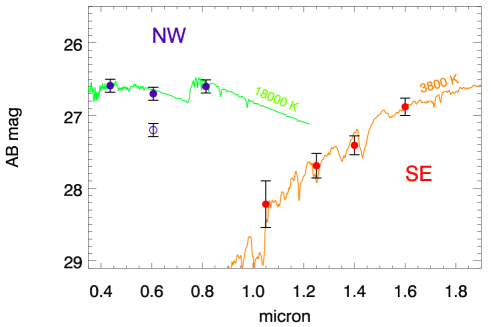
- 斯波克弧中观测到的微引力透镜暂现源完全与超巨星微引力透镜现象一致,其中西北侧的 S2 事件可能源于一颗蓝超巨星,而东南侧事件则可能源于一颗红超巨星。
- 如果在 z ≈ 1 处存在光度超过 HD 极限(L_max ≈ 6×10⁵ L☉)的恒星,其星数密度必须小于 400 颗星每平方千秒差距,以避免过度产生可探测事件。
- 另一种情景(即不存在超过 HD 极限的恒星)则要求光度在 10⁵ 至 6×10⁵ L☉ 之间的星数密度约为 9000 颗星每平方千秒差距,相当于每 10×10 pc² 中约有一颗恒星。
- 斯波克星系的金属丰度可能为超太阳系,这可能因辐射驱动风导致的质量损失增强,从而收紧 HD 极限。
- 微引力透镜事件与临界曲线之间的观测距离与 HD 极限的存在一致,前提是至少一个临界曲线被良好建模。
- 预计使用 F200W 滤镜达到 29 mag AB 深度的 JWST 观测,每张曝光沿斯波克弧可探测到约 5 颗超巨星,具体取决于恒星温度与光度。

阅读本论文
在 Nubint 阅读器中打开原文,边读边就任意段落提问。
在 Nubint 中阅读本论文本解读由 AI 根据论文原文生成,引用前请核对原文。