
[论文解读] Building Accurate Translation-Tailored LLMs with Language Aware Instruction Tuning
本文提出一种两阶段微调方法,以增强面向翻译任务的大型语言模型在语言感知指令遵循方面的能力,通过使用指令冲突样本并结合反似然损失,减少非目标语言的翻译输出。该方法在零样本翻译基准上实现了53.3%的非目标比例平均降低,SacreBLEU得分提升5.7分。
Translation-tailored Large language models (LLMs) exhibit remarkable translation capabilities, even competing with supervised-trained commercial translation systems. However, off-target translation remains an unsolved problem, especially for low-resource languages, hindering us from developing accurate LLMs-based translation models. To mitigate the off-target translation problem and enhance the performance of LLMs on translation, recent works have either designed advanced prompting strategies to highlight the functionality of translation instructions or exploited the in-context learning ability of LLMs by feeding few-shot demonstrations. However, these methods essentially do not improve LLM's ability to follow translation instructions, especially the language direction information. In this work, we design a two-stage fine-tuning algorithm to improve the instruction-following ability (especially the translation direction) of LLMs. Specifically, we first tune LLMs with the maximum likelihood estimation loss on the translation dataset to elicit the basic translation capabilities. In the second stage, we construct instruction-conflicting samples by randomly replacing the translation directions with a wrong one within the instruction, and then introduce an extra unlikelihood loss to learn those samples. Experiments on IWSLT and WMT benchmarks upon the LLaMA model spanning 16 zero-shot directions show that, compared to the competitive baseline -- translation-finetuned LLama, our method could effectively reduce the off-target translation ratio (averagely -53.3\%), thus improving translation quality with average +5.7 SacreBLEU and +16.4 BLEURT. Analysis shows that our method could preserve the model's general task performance on AlpacaEval. Code and models will be released at \url{https://github.com/alphadl/LanguageAware_Tuning}.
研究动机与目标
- 解决零样本翻译设置中持续存在的非目标翻译问题,尤其针对低资源语言。
- 指出标准大型语言模型预训练无法正确遵循翻译方向指令,原因是指令编码能力较弱。
- 在不损害通用或监督翻译性能的前提下,提升大型语言模型——特别是针对语言方向——的指令遵循能力。
- 开发一种增强模型对指令内容敏感度的方法,尤其针对冲突的翻译方向。
- 在减少类似幻觉的非目标输出的同时,保持在零样本和监督翻译方向上的强性能。
提出的方法
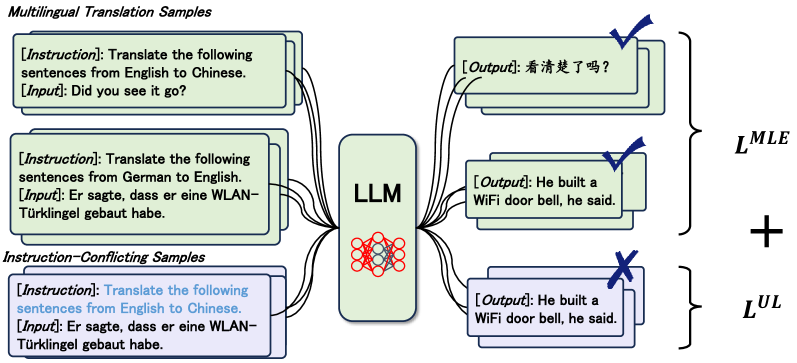
- 第一阶段微调在多语言翻译数据上使用最大似然估计(MLE)对LLaMA进行训练,以解锁其基本翻译能力。
- 第二阶段训练通过将指令中的正确翻译方向随机替换为错误方向,引入指令冲突样本。
- 对这些冲突样本应用反似然损失,以抑制模型生成与指令相矛盾的序列。
- 模型联合使用MLE损失(在正确样本上)和反似然损失(在冲突样本上),并引入平衡超参数α。
- 在生成过程中强调指令标记,使模型对语言方向提示更加敏感。
- 该方法应用于LLaMA,并在IWSLT和WMT基准上评估了16个零样本翻译方向。
实验结果
研究问题
- RQ1标准指令微调在零样本设置下,对大型语言模型正确遵循翻译方向指令的引导能力在多大程度上失效?
- RQ2在指令冲突样本上引入反似然训练,能否有效提升模型避免非目标翻译的能力?
- RQ3所提出的方法是否在监督翻译方向或通用指令遵循任务上造成性能下降或保持不变?
- RQ4该方法在减少多样化的低资源和零样本语言对中的非目标翻译比例方面效果如何?
- RQ5反似然损失机制能否有效适配以增强多语言翻译任务中的指令遵循能力?
主要发现
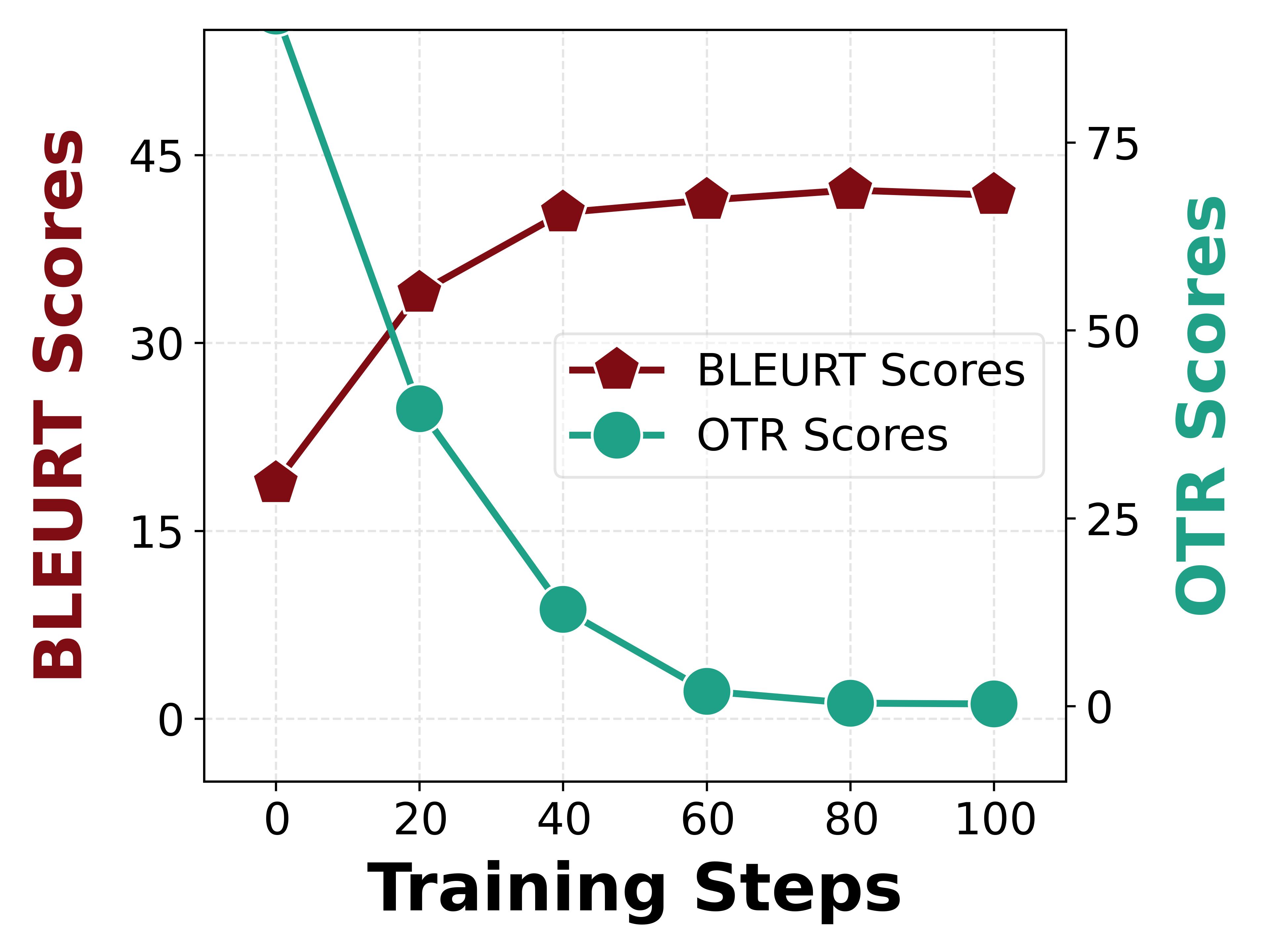
- 在16个零样本方向上,该方法将非目标翻译比例平均降低53.3%,其中IWSLT上降低92.2%,WMT上降低29.9%。
- 在基准测试中,翻译质量平均提升+5.7 SacreBLEU和+16.4 BLEURT,其中IWSLT上分别提升+23.0/+12.4 BLEURT和+5.2/+6.1 SacreBLEU,WMT上分别提升+23.0/+12.4 BLEURT和+5.2/+6.1 SacreBLEU。
- 模型在监督翻译方向上保持了强劲性能,表明其在域内能力未出现退化。
- 该方法保持了通用指令遵循能力,AlpacaEval得分稳定,表明对更广泛任务无负面影响。
- 该方法在多样化的语言对中表现稳健,包括低资源语言,即使在De→Fr等复杂案例中也实现了持续改进。
- 反似然损失有效抑制了与指令冲突的序列生成,尤其当指令明确指定错误方向时效果更显著。
阅读本论文
在 Nubint 阅读器中打开原文,边读边就任意段落提问。
在 Nubint 中阅读本论文本解读由 AI 根据论文原文生成,引用前请核对原文。