
[论文解读] BuildingsBench: A Large-Scale Dataset of 900K Buildings and Benchmark for Short-Term Load Forecasting
BuildingsBench 引入 Buildings-900K,这是近百万建模的模拟建筑数据集,以及用于零-shot STLF 与实际建筑转移学习的评测平台。
Short-term forecasting of residential and commercial building energy consumption is widely used in power systems and continues to grow in importance. Data-driven short-term load forecasting (STLF), although promising, has suffered from a lack of open, large-scale datasets with high building diversity. This has hindered exploring the pretrain-then-fine-tune paradigm for STLF. To help address this, we present BuildingsBench, which consists of: 1) Buildings-900K, a large-scale dataset of 900K simulated buildings representing the U.S. building stock; and 2) an evaluation platform with over 1,900 real residential and commercial buildings from 7 open datasets. BuildingsBench benchmarks two under-explored tasks: zero-shot STLF, where a pretrained model is evaluated on unseen buildings without fine-tuning, and transfer learning, where a pretrained model is fine-tuned on a target building. The main finding of our benchmark analysis is that synthetically pretrained models generalize surprisingly well to real commercial buildings. An exploration of the effect of increasing dataset size and diversity on zero-shot commercial building performance reveals a power-law with diminishing returns. We also show that fine-tuning pretrained models on real commercial and residential buildings improves performance for a majority of target buildings. We hope that BuildingsBench encourages and facilitates future research on generalizable STLF. All datasets and code can be accessed from https://github.com/NREL/BuildingsBench.
研究动机与目标
- 证明大规模合成数据对预训练短期负荷预测(STLF)模型在住宅与商业建筑中的价值。
- 提供一个开放的评测平台,结合模拟数据与真实数据集,用于零-shot STLF 与转移学习。
- 分析从合成预训练到真实建筑的泛化,以及在目标数据上微调的好处。
- 探究数据集规模、模型规模与架构对零-shot 与转移学习性能的影响。
提出的方法
- 引入 Buildings-900K,这是基于 NREL End-Use Load Profiles(EULP)推导的一个包含 900K 个建筑模型的模拟数据集,覆盖住宅与商业类型。
- 采用一个概率性短期负荷预测公式,在给定 168 小时历史和协变量的条件下,预测 24 小时后负荷的分布。
- 在 Buildings-900K 上以 10^9 负荷-小时进行预训练 Transformer 型时序模型(高斯型与分词型),再在真实数据集上评估零-shot 与转移学习。
- 提供一个真实建筑评测套件,包含来自七个开放数据集的超过 1,900 栋建筑(BuildingsBench)。
- 基准基线包括持久性基线、LightGBM、线性/ DLinear/ RNN 变体,以及带微调与不带微调的基于 Transformer 的预测模型。
- 使用点预报与不确定性评估的 NRMSE 与排序概率分数(RPS)来衡量性能。
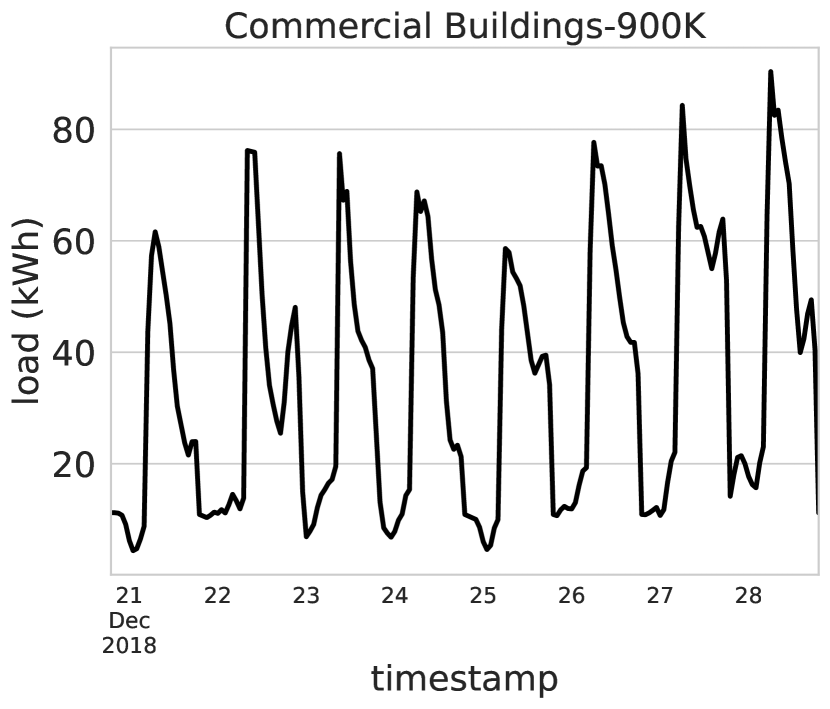
实验结果
研究问题
- RQ1预训练在 Buildings-900K 上的模型是否能推广到真实建筑,尤其是商业建筑?
- RQ2在有限的真实数据上对预训练模型进行微调是否能提升目标建筑的性能?
- RQ3预训练数据集的规模与模型规模如何影响零-shot 性能及对真实数据的泛化?
- RQ4与连续负荷相比,使用分词化负荷进行大规模 STLF 预训练是否更具优势?
- RQ5将地理空间与建筑类型协变量纳入预测对准确性有何影响?
主要发现
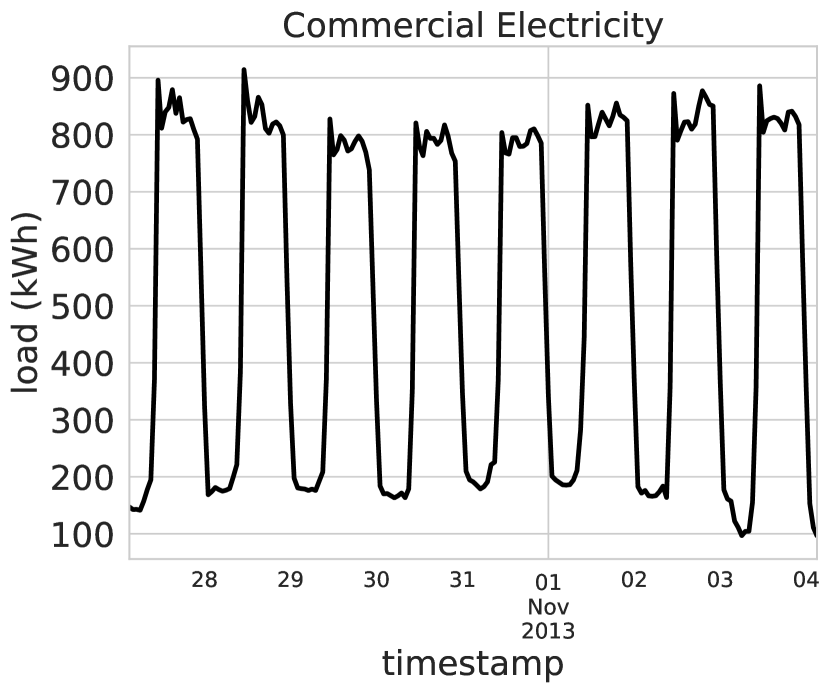
- 在 Buildings-900K 上进行预训练对真实商业建筑的零-shot STLF 能力表现强劲,但对住宅建筑存在一定的 sim-to-real 差距。
- 在真实数据的 6 个月内对预训练的 Transformer 进行微调,可以提升商业与住宅建筑的 STLF,商业场景尤为显著。
- 商业建筑的零-shot 性能呈现幂律关系,数据集规模增大时回报递减;住宅建筑的表现受限,原因是 sim-to-real 的不一致性较高。
- Transformer-M 型在微调后获得最大收益,接近或达到大型预训练基线;而极大型模型在零-shot 设置下可能趋于饱和。
- 分词化负荷表示(Tokens)在训练稳定性方面表现良好,但总体准确性通常不及高斯 Transformer,尽管量化能有效压缩数据。
- 地理空间协变量对准确性有温和的提升,表明对位置有一定的感知有助于泛化。
阅读本论文
在 Nubint 阅读器中打开原文,边读边就任意段落提问。
在 Nubint 中阅读本论文本解读由 AI 根据论文原文生成,引用前请核对原文。