
[论文解读] Calibrated Language Models Must Hallucinate
论文证明经过校准的语言模型在无事实等同的情况下,最小化需要就任意事实进行幻觉的下界与未见事实的分数相关,且即使在理想训练数据下也如此,并讨论训练后缓解、事实性与系统性幻觉的含义。
Recent language models generate false but plausible-sounding text with surprising frequency. Such "hallucinations" are an obstacle to the usability of language-based AI systems and can harm people who rely upon their outputs. This work shows that there is an inherent statistical lower-bound on the rate that pretrained language models hallucinate certain types of facts, having nothing to do with the transformer LM architecture or data quality. For "arbitrary" facts whose veracity cannot be determined from the training data, we show that hallucinations must occur at a certain rate for language models that satisfy a statistical calibration condition appropriate for generative language models. Specifically, if the maximum probability of any fact is bounded, we show that the probability of generating a hallucination is close to the fraction of facts that occur exactly once in the training data (a "Good-Turing" estimate), even assuming ideal training data without errors. One conclusion is that models pretrained to be sufficiently good predictors (i.e., calibrated) may require post-training to mitigate hallucinations on the type of arbitrary facts that tend to appear once in the training set. However, our analysis also suggests that there is no statistical reason that pretraining will lead to hallucination on facts that tend to appear more than once in the training data (like references to publications such as articles and books, whose hallucinations have been particularly notable and problematic) or on systematic facts (like arithmetic calculations). Therefore, different architectures and learning algorithms may mitigate these latter types of hallucinations.
研究动机与目标
- 从统计角度在语义校准下为生成模型的幻觉发生提供动机。
- 为开放域事实与任意事实项定义一个适用的生成校准框架。
- 推导幻觉率相对于未见事实和校准质量的下界。
- 讨论对不同事实类型(任意与系统性)以及训练后缓解的含义。
提出的方法
- 将语言建模为从语言分布独立同分布采样的训练数据生成的文档分布。
- 将事实项定义为具有一项信息的任意信息片段,简化为每个文档只有一个事实。
- 使用Good-Turing(单一事实)估计来界定未观测事实的缺失质量。
- 引入带自适应分箱的生成校准概念来测量错校准。
- 在单一事实估计与校准项的基础上证明幻觉率的概率下界。
实验结果
研究问题
- RQ1校准语言模型必须以多小的比率来对任意事实进行幻觉?
- RQ2在语义校准下未观测事实的缺失质量与幻觉率之间有什么关系?
- RQ3校准质量如何影响推导出的幻觉下界?
- RQ4这些下界是否可推广到多种事实类型和对世界分布的正则性条件?
- RQ5通过训练后缓解与体系结构变更在减少幻觉方面各自的含义是什么?
主要发现
- 经过校准的预测者在任意事实上的幻觉率与训练数据中未观测事实的分数相关。
- 单一事实(Good-Turing)估计可作为未观测事实缺失质量的下界,因此在正则性假设下也为幻觉率的下界。
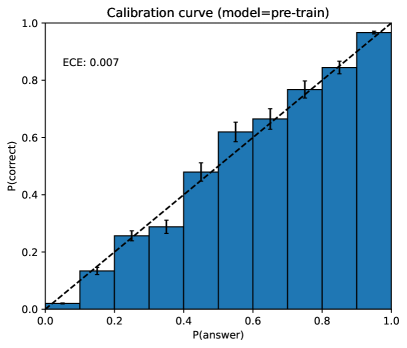
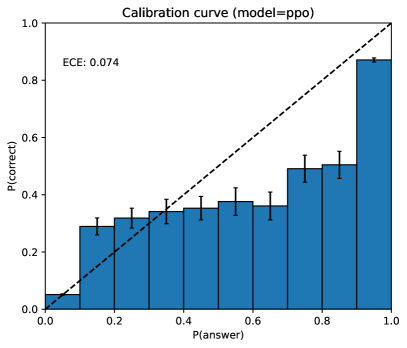
- 存在一个校准成本:改善训练后校准可能会在任意事实的幻觉上升。
- 对于系统性事实和参考文献,并不存在统计必要的幻觉,提示可通过体系结构或学习方式的改变来缓解。
- 即使在理想化、静态的设定下,没有训练数据错误,这些结果仍成立,凸显预测准确性、校准与事实生成之间的基本张力。
阅读本论文
在 Nubint 阅读器中打开原文,边读边就任意段落提问。
在 Nubint 中阅读本论文本解读由 AI 根据论文原文生成,引用前请核对原文。