
[论文解读] Calibrated One-class Classification for Unsupervised Time Series Anomaly Detection
本文提出COUTA,一种用于无监督时间序列异常检测的校准单类分类方法,通过解决异常污染和缺乏异常知识的问题,改进了正常性建模。它采用基于不确定性的校准来抑制噪声预测,通过原生异常校准注入真实的异常模式,相较于六组真实世界数据集上的最先进方法,F₁得分提升6%–31%。
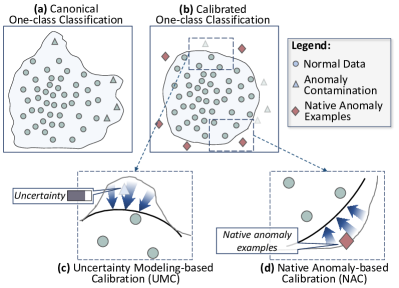
Time series anomaly detection is instrumental in maintaining system availability in various domains. Current work in this research line mainly focuses on learning data normality deeply and comprehensively by devising advanced neural network structures and new reconstruction/prediction learning objectives. However, their one-class learning process can be misled by latent anomalies in training data (i.e., anomaly contamination) under the unsupervised paradigm. Their learning process also lacks knowledge about the anomalies. Consequently, they often learn a biased, inaccurate normality boundary. To tackle these problems, this paper proposes calibrated one-class classification for anomaly detection, realizing contamination-tolerant, anomaly-informed learning of data normality via uncertainty modeling-based calibration and native anomaly-based calibration. Specifically, our approach adaptively penalizes uncertain predictions to restrain irregular samples in anomaly contamination during optimization, while simultaneously encouraging confident predictions on regular samples to ensure effective normality learning. This largely alleviates the negative impact of anomaly contamination. Our approach also creates native anomaly examples via perturbation to simulate time series abnormal behaviors. Through discriminating these dummy anomalies, our one-class learning is further calibrated to form a more precise normality boundary. Extensive experiments on ten real-world datasets show that our model achieves substantial improvement over sixteen state-of-the-art contenders.
研究动机与目标
- 解决单类时间序列异常检测中无标签训练数据内异常污染的关键挑战。
- 克服现有方法在正常性学习过程中缺乏真实异常行为知识的局限性。
- 开发一种对污染具有容忍性、并基于异常信息的单类分类框架,以提升正常性建模的准确性。
- 在高维和长序列的真实时间序列应用中,实现稳健且可扩展的异常检测。
- 提供一种简单但有效的校准机制,增强模型置信度与泛化能力,而无需复杂架构或目标函数。
提出的方法
- 引入基于不确定性的校准(UMC),通过在单类距离值上定义先验分布来建模预测不确定性。
- 设计一种新型学习目标,对高不确定性预测施加轻微惩罚,同时鼓励对困难正常样本做出自信预测。
- 提出原生异常校准(NAC),通过在原始时间序列数据上应用领域特定扰动来生成真实的异常样本。
- 使用扰动操作(如点异常、上下文异常、集体异常)在无需标注异常的情况下模拟真实的异常行为。
- 将UMC与NAC结合为统一的训练目标,以增强模型鲁棒性与正常边界学习能力。
- 采用基于滑动窗口的特征提取策略,并使用可学习的特征空间维度H以捕捉时序依赖性。
实验结果
研究问题
- RQ1基于不确定性的校准能否提升单类模型对训练数据中异常污染的鲁棒性?
- RQ2通过数据扰动注入真实异常模式的知识,能否在无监督设置下改善正常性建模?
- RQ3所提出的校准框架在F₁分数、AUC-PR以及对多样化异常类型的泛化能力方面,与最先进方法相比如何?
- RQ4扰动类型、损失权重和窗口长度等超参数对检测性能有何影响?
- RQ5该方法在真实系统中常见的长序列和高维时间序列数据上是否具备有效可扩展性?
主要发现
- COUTA在六组真实世界时间序列数据集上,相较于12种最先进方法,F₁得分提升6%–31%。
- 该方法对异常污染表现出卓越鲁棒性,在训练数据包含未知异常时仍能保持高性能。
- 使用完整扰动操作集合(Ω)的原生异常校准(NAC)表现最佳,尤其在ASD数据集上优势显著。
- COUTA在不同超参数设置下表现稳定,对α、β和l的敏感度极低,表明其具有强大泛化能力。
- 模型展现出优异可扩展性,每轮训练时间显著低于同类深度学习方法,尤其在长序列和高维序列上优势明显。
- 在长序列和高维设置下,COUTA优于TranAD、USAD和MSCRED等方法,后者因内存限制而失败。
阅读本论文
在 Nubint 阅读器中打开原文,边读边就任意段落提问。
在 Nubint 中阅读本论文本解读由 AI 根据论文原文生成,引用前请核对原文。