
[论文解读] Can Generative Large Language Models Perform ASR Error Correction?
本文研究使用 ChatGPT 对两种 ASR 架构(Conformer-Transducer 与 Whisper AED)进行零-shot 和少-shot 的 ASR 错误纠正,比较不受限、选择性和最近映射等方法,采用 0--shot 与 1-shot 提示。
ASR error correction is an interesting option for post processing speech recognition system outputs. These error correction models are usually trained in a supervised fashion using the decoding results of a target ASR system. This approach can be computationally intensive and the model is tuned to a specific ASR system. Recently generative large language models (LLMs) have been applied to a wide range of natural language processing tasks, as they can operate in a zero-shot or few shot fashion. In this paper we investigate using ChatGPT, a generative LLM, for ASR error correction. Based on the ASR N-best output, we propose both unconstrained and constrained, where a member of the N-best list is selected, approaches. Additionally, zero and 1-shot settings are evaluated. Experiments show that this generative LLM approach can yield performance gains for two different state-of-the-art ASR architectures, transducer and attention-encoder-decoder based, and multiple test sets.
研究动机与目标
- 为 ASR 输出的后处理中引入并评估错误纠正,而不重新训练。
- 在多种 ASR 架构与数据集上评估零-shot 与少-shot 的生成式大语言模型方法。
- 使用 ChatGPT 进行错误纠正时,比较不受限提示与受限(N-best)提示策略。
提出的方法
- 将 ASR 的 N-best 列表(默认前 5 条)输入给 ChatGPT,而不训练错误纠正器。
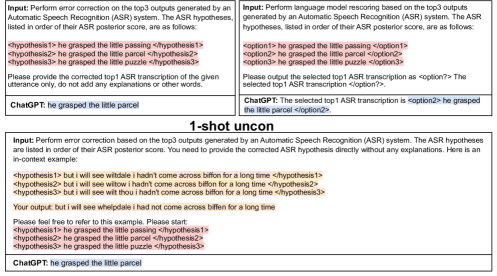
- 测试零-shot 不受限、零-shot 选择性,以及 1-shot 不受限提示。
- 应用受限解码变体:选择性方法和最近映射,以将输出限制在 N-best 候选中。
- 在两种 ASR 系统(Conformer-Transducer 与 Whisper small.en)上,对 LibriSpeech 测试集、TED-LIUM3 以及 Artie Bias 进行评估。
- 将 ChatGPT 的结果与微调的 N-best T5 错误纠正模型进行比较。

实验结果
研究问题
- RQ1一个生成式大语言模型(ChatGPT)在零-shot 和一-shot 设置中是否在无需额外训练的情况下提升 ASR 错误纠正?
- RQ2使用 ChatGPT 时,N-best 受限解码变体(选择性、最近)是否优于不受限生成?
- RQ3在不同的 ASR 架构和领域中,基于 ChatGPT 的纠正与微调的 T5 N-best 错误纠正模型相比有什么差异?
主要发现
- ChatGPT 在 Conformer-Transducer 和 Whisper AED 系统上均对 ASR baselines 提供性能提升。
- 带 ChatGPT 的零-shot 1-shot 不受限提示可改进 WER,在某些设置下,1-shot 的最近映射接近 T5 的性能。
- 受限方法(最近映射、选择性)可超越零-shot 的不受限输出,最近映射通常产生强结果。
- 基于 ChatGPT 的纠正在 LibriSpeech 相关的同领域数据以及部分域外数据上表现更好,但在某些 Whisper 驱动的情形中因 N-best 的多样性问题而下降。
- 与基于 T5 的错误纠正相比,在若干情景中 ChatGPT 具有竞争力或更优,且不需要预先训练模型。
阅读本论文
在 Nubint 阅读器中打开原文,边读边就任意段落提问。
在 Nubint 中阅读本论文本解读由 AI 根据论文原文生成,引用前请核对原文。