
[论文解读] Can Large Language Models Be an Alternative to Human Evaluations?
本论文研究将大型语言模型(LLMs)作为人类评估的替代方案,通过提供与人类评估相同的指令、样本和问题,并在开放式故事生成和对抗性攻击的输出中进行评估。
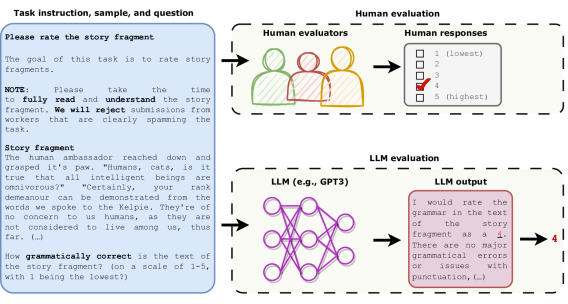
Human evaluation is indispensable and inevitable for assessing the quality of texts generated by machine learning models or written by humans. However, human evaluation is very difficult to reproduce and its quality is notoriously unstable, hindering fair comparisons among different natural language processing (NLP) models and algorithms. Recently, large language models (LLMs) have demonstrated exceptional performance on unseen tasks when only the task instructions are provided. In this paper, we explore if such an ability of the LLMs can be used as an alternative to human evaluation. We present the LLMs with the exact same instructions, samples to be evaluated, and questions used to conduct human evaluation, and then ask the LLMs to generate responses to those questions; we dub this LLM evaluation. We use human evaluation and LLM evaluation to evaluate the texts in two NLP tasks: open-ended story generation and adversarial attacks. We show that the result of LLM evaluation is consistent with the results obtained by expert human evaluation: the texts rated higher by human experts are also rated higher by the LLMs. We also find that the results of LLM evaluation are stable over different formatting of the task instructions and the sampling algorithm used to generate the answer. We are the first to show the potential of using LLMs to assess the quality of texts and discuss the limitations and ethical considerations of LLM evaluation.
研究动机与目标
- 由于不可靠性和低可重复性,推动NLP中人类评估的挑战。
- 提出将LLM评估作为替代,通过向LLMs输入与人类评估相同的指令、样本和问题。
- 在开放式故事生成和对抗性文本攻击中,系统地将LLM评估与专家人类评估进行经验比较。
- 分析在指令变体和采样超参数下,LLM评估的稳定性。
- 讨论采用基于LLM的评估的局限性、伦理和实际考量。
提出的方法
- 为LLMs提供与人类评估中使用的相同任务指令、样本和问题,并从LLM输出中提取Likert风格的评分。
- 使用多种LLMs(T0、text-curie-001、text-davinci-003、ChatGPT)并采用核采样来生成评分。
- 将LLM评分与三位专家英语教师对200个由人类编写和200个GPT-2生成的故事的评分进行比较。
- 在指令和采样温度的变化下重复实验,以评估鲁棒性。
实验结果
研究问题
- RQ1LLMs是否能以与专家人工评估者一致的方式对文本质量进行评分?
- RQ2在任务指令、问题和采样设置发生变化时,LLM评估有多稳定?
- RQ3LLM评估是否与人类判断在对抗性文本质量(流畅性与意义保留)方面一致?
主要发现
- 在强大模型(尤其是text-davinci-003)下,LLM评估得到的评分与专家人类评估一致,而在人类撰写文本相较于GPT-2生成文本在多个属性上更受青睐。
- LLM评估结果在不同任务指令和采样温度下显示出较小的方差,保持了人类撰写文本与模型生成文本之间的相对排序。
- ChatGPT能够解释其推理,倾向于给人类撰写的文本更高的评分,但在某些属性的绝对分数上有时会出现分歧。
- LLMs能够在流畅性和意义保留方面有效地对对抗样本与无害样本进行排名,与专家判断一致,尽管存在一些模型特有的偏见(如安全策略影响评分)。
- 该方法在可重复性和成本方面优于人工评估,同时也承认潜在的知识偏差和LLMs的安全约束等局限性。
阅读本论文
在 Nubint 阅读器中打开原文,边读边就任意段落提问。
在 Nubint 中阅读本论文本解读由 AI 根据论文原文生成,引用前请核对原文。