
[论文解读] Can Large Language Models Understand Context?
本文提出一个用于生成式大语言模型的上下文理解基准,评估上下文内学习和后训练量化,并显示在较大或量化模型在某些任务上优于较小的密集模型,但在不同任务中表现不一。
Understanding context is key to understanding human language, an ability which Large Language Models (LLMs) have been increasingly seen to demonstrate to an impressive extent. However, though the evaluation of LLMs encompasses various domains within the realm of Natural Language Processing, limited attention has been paid to probing their linguistic capability of understanding contextual features. This paper introduces a context understanding benchmark by adapting existing datasets to suit the evaluation of generative models. This benchmark comprises of four distinct tasks and nine datasets, all featuring prompts designed to assess the models' ability to understand context. First, we evaluate the performance of LLMs under the in-context learning pretraining scenario. Experimental results indicate that pre-trained dense models struggle with understanding more nuanced contextual features when compared to state-of-the-art fine-tuned models. Second, as LLM compression holds growing significance in both research and real-world applications, we assess the context understanding of quantized models under in-context-learning settings. We find that 3-bit post-training quantization leads to varying degrees of performance reduction on our benchmark. We conduct an extensive analysis of these scenarios to substantiate our experimental results.
研究动机与目标
- 构建一个由九个数据集的四个任务组成的上下文理解基准,以评估生成式LLM。
- 分析在该基准上不同规模和系列(OPT、LLaMA、GPT-3.5)模型的上下文理解表现的上下文内学习能力。
- 评估后训练3-bit量化(GPTQ)对上下文理解任务的影响。
- 提供对模型在处理上下文方面的语言及任务层面的详细分析,指出成功与失败之处。
提出的方法
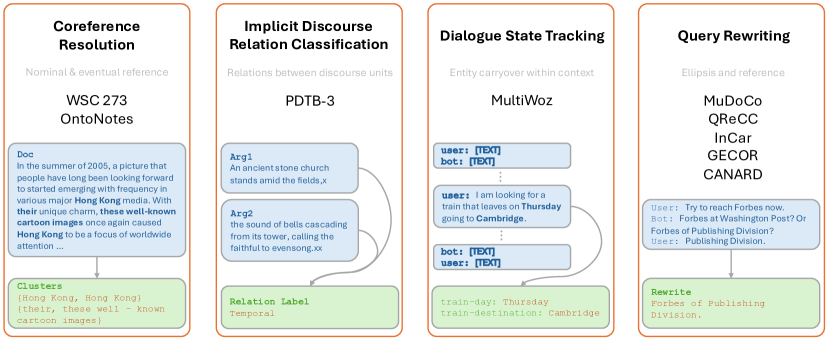
- 从九个数据集构建四个以上下文为焦点的任务(共指消解、对话状态跟踪、隐式话语关系分类、查询改写),并为上下文内学习定制提示。
- 在零-shot到十-shot设置下,评估不同模型家族的密集预训练模型(OPT 125M–2.7B、LLaMA 7B–65B)和GPT-3.5-turbo。
- 将后训练3-bit量化的LLaMA模型(GPTQ)与相同任务上的密集基线进行比较。
- 使用任务特定度量(例如,核心指代的CoNLL F1、DST的联合目标准确率、PDTB-3的准确率、QR的BLEU/ROUGE)来量化性能。
- 包含定性错误分析和关于查询改写的案例研究,以理解错误类型和模型行为。
实验结果
研究问题
- RQ1在上下文内学习下,LLM在四个以上下文为中心的任务中对上下文特征的理解有多好?
- RQ2模型规模和家族(OPT、LLaMA、GPT-3.5)如何影响上下文理解表现?
- RQ33-bit后训练量化对跨任务的上下文理解影响如何?
- RQ4量化模型是否通过规模来弥补较小尺寸带来的不足,在语言层面上它们在哪里失败?
- RQ5在与上下文相关的任务中,常见的错误类型是什么,密集模型与量化模型有何差异?
主要发现
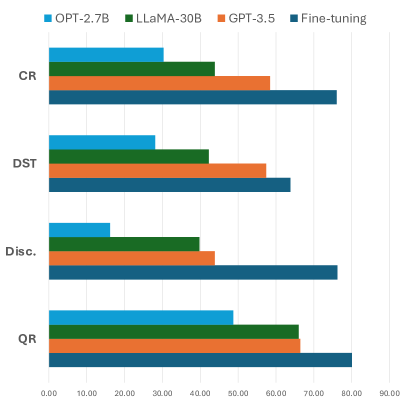
- 在上下文内学习的预训练LLM在大多数上下文任务上未能达到微调模型的水平。
- 量化的3-bit LLaMA(GPTQ)在各任务上表现出不同的下降,在扩展到30B时在某些话语任务中有增益。
- 一个30B经量化的LLaMA模型在多个任务上往往超过7B密集对手,表明规模有时可以压过量化在上下文理解中的影响。
- GPT-3.5在对话状态跟踪上达到微调模型的水平,但总体上FT模型在许多任务上仍然更优。
- 查询改写显示较大模型接近微调的差距,而较小模型则显示出显著的失败,突出ICL在生成任务中的局限。
- 在任务中,量化在QR数据集的某些生成度量(BLEU/ROUGE)上有所改善,但通常在其他任务中降低了对上下文的核心理解。
阅读本论文
在 Nubint 阅读器中打开原文,边读边就任意段落提问。
在 Nubint 中阅读本论文本解读由 AI 根据论文原文生成,引用前请核对原文。