
[论文解读] Can neutrino-assisted early dark energy models ameliorate the $H_0$ tension in a natural way?
本文研究了中微子辅助的早期暗能量(νEDE)模型以解决哈勃张力问题,提出标量场与中微子之间的耦合可自然地在物质-辐射相等时触发EDE。尽管通过中微子相变在EDE能量密度中产生了一个特征,但在所考虑的参数下,该模型未能产生足够的EDE占比($f_{\text{EDE}} \approx 10\%$)来缓解哈勃张力,表明在此特定实现中自然性有限。
The idea of neutrino-assisted early dark energy ($ν$EDE), where a coupling between neutrinos and the scalar field that models early dark energy (EDE) is considered, was introduced with the aim of reducing some of the fine-tuning and coincidence problems that appear in usual EDE models. In order to be relevant in ameliorating the $H_0$ tension, the contribution of EDE to the total energy density ($f_ ext{EDE}$) should be around 10\% near the redshift of matter-radiation equality. We verify under which conditions $ν$EDE models can fulfill these requirements for a model with a quartic self-coupling of the EDE field and an exponential coupling to neutrinos. We find that in the situation where the EDE field is frozen initially, the contribution to $f_ ext{EDE}$ can be significant but it is not sensitive to the neutrino-EDE coupling and does not address the EDE coincidence problem. On the other hand, if the EDE field starts already dynamical at the minimum of the effective potential, it tracks this time-dependent minimum that presents a feature triggered by the neutrino transition from relativistic to nonrelativistic particles. This feature generates $f_ ext{EDE}$ in a natural way at around this transition epoch, that roughly coincides with the matter-radiation equality redshift. For the set of parameters that we considered we did not find values that satisfy the requirements on the background cosmological evolution to mitigate the Hubble tension in a natural way in this particular $ν$EDE model.
研究动机与目标
- 评估中微子辅助的早期暗能量(νEDE)模型是否能在不微调初始条件的情况下自然缓解哈勃张力。
- 研究中微子从相对论性到非相对论性状态的转变是否能自然地在物质-辐射相等红移($z \sim 3.5$)触发EDE。
- 确定EDE标量场与中微子之间的耦合是否能产生显著且及时的能量密度贡献($f_{\text{EDE}} \approx 10\%$),以缓解哈勃张力。
- 比较两种初始条件情景:EDE场初始被冻结与从有效势的最小值开始。
- 使用CAMB评估模型在背景层面的可行性,重点关注$f_{\text{EDE}}$的演化以及中微子-EDE耦合的作用。
提出的方法
- 在CAMB中实现νEDE模型,仅在背景层面,采用四次自耦合势($V \propto \varphi^4$)和与中微子的指数耦合($A(\varphi) = \exp(\beta\varphi/M_{\text{Pl}})$)。
- 在爱因斯坦框架中求解标量场演化方程,通过追踪有效势的时间依赖最小值来模拟场的动力学。
- 分析两种初始条件情形:(1)由于哈勃阻尼,场在任意初始值被冻结;(2)场从有效势的最小值开始。
- 计算EDE能量密度占比$f_{\text{EDE}}$和偏差参数$\Delta$,以量化中微子-EDE耦合的影响。
- 使用解析近似(公式20)预测$f_{\text{EDE}}$,并与数值结果进行比较。
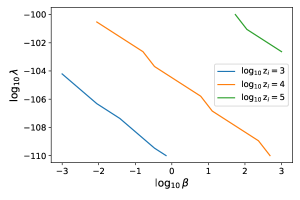
- 进行参数扫描,评估$f_{\text{EDE}}$对耦合强度$\beta$和自耦合$\lambda$的敏感性,同时保持其他宇宙学参数不变。
实验结果
研究问题
- RQ1中微子从相对论性到非相对论性状态的转变是否能自然地在物质-辐射相等时期触发EDE场?
- RQ2νEDE模型是否能在$z \sim 3.5$时产生足够大的$f_{\text{EDE}} \approx 10\%$以缓解哈勃张力?
- RQ3当场从有效势的最小值开始时,νEDE模型是否解决了EDE巧合问题?
- RQ4在场最小值初始条件情景下,中微子-EDE耦合($\beta$)如何影响$f_{\text{EDE}}$的演化?
- RQ5该模型是否能在不微调初始场值或标量场参数的情况下实现显著的$f_{\text{EDE}}$?
主要发现
- 当EDE场初始被冻结在任意值时,$f_{\text{EDE}}$可达到宇宙学相关的水平,但该行为对中微子-EDE耦合不敏感,且无法解决EDE巧合问题。
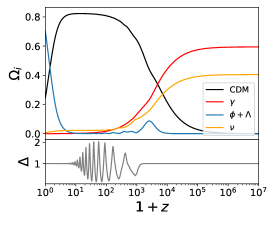
- 当场从有效势的最小值开始时,它自然地跟随时间依赖的最小值,且中微子相变在$z \sim 3.5$处诱导了$f_{\text{EDE}}$的峰值,与解析预测一致。
- 在场最小值情景中,中微子-EDE耦合具有不可忽视的作用,$f_{\text{EDE}}$随$\beta$显著变化,如图7所示。
- 尽管耦合有影响,但在场最小值情景中实现的最大$f_{\text{EDE}}$仍过低,无法满足缓解哈勃张力所需的$f_{\text{EDE}} \approx 10\%$。
- 增加自耦合$\lambda$以增强$f_{\text{EDE}}$会导致场保持冻结更长时间,实际上使模型进入第一种(非自然)初始条件情形。
- 即使在大耦合($\beta = 1000$)下,该模型仍无法产生显著的$f_{\text{EDE}}$,表明此特定νEDE实现存在根本性局限。
阅读本论文
在 Nubint 阅读器中打开原文,边读边就任意段落提问。
在 Nubint 中阅读本论文本解读由 AI 根据论文原文生成,引用前请核对原文。