
[论文解读] Can We Use Large Language Models to Fill Relevance Judgment Holes?
本文研究使用大语言模型(LLMs)填补对话式搜索测试集中的相关性判断空缺,发现若未在整个文档池中一致应用,LLM生成的标签会扭曲模型排名。尽管像ChatGPT这样的LLM在单独使用时与人工判断具有高度相关性,但当与人工标注数据结合时,排名差异显著——尤其在空缺较大时——表明全池标注对可靠评估至关重要。
Incomplete relevance judgments limit the re-usability of test collections. When new systems are compared against previous systems used to build the pool of judged documents, they often do so at a disadvantage due to the ``holes'' in test collection (i.e., pockets of un-assessed documents returned by the new system). In this paper, we take initial steps towards extending existing test collections by employing Large Language Models (LLM) to fill the holes by leveraging and grounding the method using existing human judgments. We explore this problem in the context of Conversational Search using TREC iKAT, where information needs are highly dynamic and the responses (and, the results retrieved) are much more varied (leaving bigger holes). While previous work has shown that automatic judgments from LLMs result in highly correlated rankings, we find substantially lower correlates when human plus automatic judgments are used (regardless of LLM, one/two/few shot, or fine-tuned). We further find that, depending on the LLM employed, new runs will be highly favored (or penalized), and this effect is magnified proportionally to the size of the holes. Instead, one should generate the LLM annotations on the whole document pool to achieve more consistent rankings with human-generated labels. Future work is required to prompt engineering and fine-tuning LLMs to reflect and represent the human annotations, in order to ground and align the models, such that they are more fit for purpose.
研究动机与目标
- 为解决测试集中不完整相关性判断('空缺')带来的挑战,此类问题在新系统评估时构成不利影响。
- 探究大语言模型(LLMs)是否能可靠生成相关性判断以填补对话式搜索中的这些空缺。
- 评估将LLM生成的判断与人工标注数据结合时,对模型排名性能的影响。
- 评估提示工程或微调是否能提升LLM输出与人工相关性判断的一致性。
- 确定整合LLM判断的最佳策略——空缺特定增强 vs. 全池重标注——以实现一致且公平的评估。
提出的方法
- 通过从TREC iKAT 2023测试集中移除某一模型的所有相关性判断,模拟新模型的评估,从而在文档池中制造不同程度的'空缺'。
- 使用LLMs(ChatGPT和LLaMA)通过零样本、单样本和少样本提示模板,为未标注文本生成相关性评分。
- 采用标准化提示模板,包含固定指令、用户角色、查询和文档输入,以确保LLM之间的一致性。
- 通过比较每个模型原始人工标注排名与其在加入LLM生成标签后的排名,计算性能差异。
- 通过测量原始排名与LLM增强排名之间的绝对排名差异,评估可靠性与偏差。
- 使用相关性度量评估LLM生成与人工相关性评分之间的一致性,重点关注标签分布与偏差。
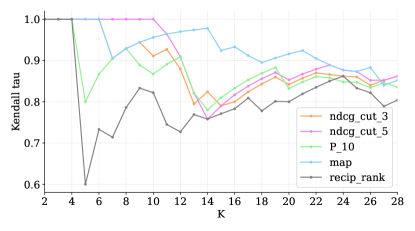
实验结果
研究问题
- RQ1当应用于存在'空缺'的不完整测试集时,LLM生成的相关性判断如何影响新模型的相对排名?
- RQ2LLM的选择(例如ChatGPT与LLaMA)是否显著改变具有不完整判断的新模型的排名结果?
- RQ3在仅标注缺失文档(空缺)还是重标注整个文档池时,LLM增强评估的性能更可靠?
- RQ4空缺大小(即未标注文档的比例)如何影响LLM生成判断在模型比较中的可靠性?
- RQ5提示工程或微调能否改善LLM判断与人工相关性评估之间的一致性,从而减少评估中的偏差?
主要发现
- 当单独使用时,LLM生成的相关性判断与人工判断具有高度相关性,但与人工标注数据结合后,这种相关性显著下降。
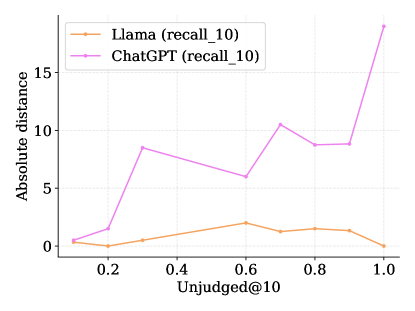
- ChatGPT倾向于对文档给予比人工更积极的评分,导致系统性偏差,从而扭曲模型排名——尤其在未标注文档数量(空缺)较大时更为明显。
- 人工标注排名与LLM增强排名之间的绝对排名差异随空缺大小增加而扩大,表明在判断稀疏时新模型的可靠性持续下降。
- LLaMA生成的判断与人工标签具有更强的一致性,并在不同空缺大小下保持更稳定的排名,表明其偏差低于ChatGPT。
- 与仅填补空缺相比,使用LLM生成标签对整个文档池进行重标注,可带来更一致且可靠的模型排名,有效减少偏差放大。
- 本研究结论认为,全池标注对于确保偏差均匀应用至关重要,未来工作必须聚焦于提示工程与微调,以更好地使LLM与人工判断标准对齐。
阅读本论文
在 Nubint 阅读器中打开原文,边读边就任意段落提问。
在 Nubint 中阅读本论文本解读由 AI 根据论文原文生成,引用前请核对原文。