
[论文解读] Causal Inference in Recommender Systems: A Survey of Strategies for Bias Mitigation, Explanation, and Generalization
本综述回顾了因果推断如何被整合到推荐系统中,以消除预测偏差、提升可解释性并增强泛化能力,基于 Rubin 的潜在结果框架与 Pearl 的结构因果模型。
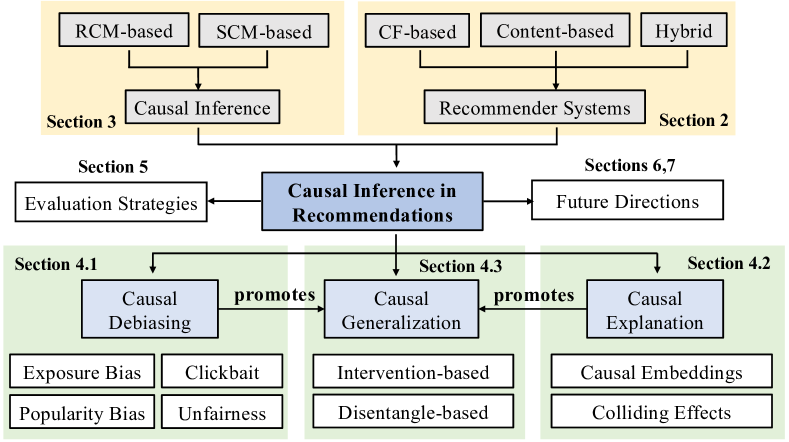
In the era of information overload, recommender systems (RSs) have become an indispensable part of online service platforms. Traditional RSs estimate user interests and predict their future behaviors by utilizing correlations in the observational historical activities, their profiles, and the content of interacted items. However, since the inherent causal reasons that lead to the observed users' behaviors are not considered, multiple types of biases could exist in the generated recommendations. In addition, the causal motives that drive user activities are usually entangled in these RSs, where the explainability and generalization abilities of recommendations cannot be guaranteed. To address these drawbacks, recent years have witnessed an upsurge of interest in enhancing traditional RSs with causal inference techniques. In this survey, we provide a systematic overview of causal RSs and help readers gain a comprehensive understanding of this promising area. We start with the basic concepts of traditional RSs and their limitations due to the lack of causal reasoning ability. We then discuss how different causal inference techniques can be introduced to address these challenges, with an emphasis on debiasing, explainability promotion, and generalization improvement. Furthermore, we thoroughly analyze various evaluation strategies for causal RSs, focusing especially on how to reliably estimate their performance with biased data if the causal effects of interests are unavailable. Finally, we provide insights into potential directions for future causal RS research.
研究动机与目标
- 解释由于因果推理缺口而导致的传统基于相关性的推荐系统的局限性。
- 总结两大因果推断框架(Rubin 的潜在结果与 Pearl 的结构因果模型)及其与推荐系统的联系。
- 讨论因果技术如何解决推荐系统中的去偏、可解释性和泛化问题。
- 分析在存在偏差数据和不可观测因果效应时对因果推荐系统的评估策略。
- 为未来的因果推荐系统研究提供方向。
提出的方法
- 介绍传统推荐系统的基础及其基于相关性的局限。
- 在推荐系统背景下介绍 Rubin 的潜在结果框架和 Pearl 的结构因果模型。
- 描述因果推断技术如何去偏推荐系统(例如解决曝光偏差)、提升可解释性并改进泛化能力。
- 讨论推荐系统中的因果图结构和干预概念(do-operator)。
- 解释后门调整和基于协变量的策略(IPW)在识别推荐系统数据中的因果效应方面的应用。
实验结果
研究问题
- RQ1传统 RS 如何产生曝光偏差,因果方法如何减轻这些偏差?
- RQ2Rubin 与 Pearl 的因果框架在推荐系统中的收益与权衡是什么?
- RQ3因果推断技术如何提升推荐系统的可解释性和泛化能力?
- RQ4在不可观测因果效应时,哪些评估策略能可靠地评估因果 RS 的性能?
- RQ5哪些未来方向有望推动因果推荐系统的发展?
主要发现
- 因果推荐系统为处理来自非随机曝光和观测评分中的混杂偏差提供了一个有原理的方法。
- Rubin 与 Pearl 的框架提供互补的视角:RCM 关注潜在结果;SCM 强调因果图和干预。
- 混合方法(例如结合辅助信息)有助于形成因果关系并减轻虚假相关。
- SCM 使得对干预和反事实的推理成为可能,促进可解释性和跨情境的有针对性泛化。
- 该综述概述了因果 RS 的评估策略,尤其是在因果效应不可直接观测时。
- 它明确了因果推荐系统研究中的未解决问题和未来方向。

阅读本论文
在 Nubint 阅读器中打开原文,边读边就任意段落提问。
在 Nubint 中阅读本论文本解读由 AI 根据论文原文生成,引用前请核对原文。