
[论文解读] CBDC-AquaSphere: Interoperable Central Bank Digital Currency Built on Trusted Computing and Blockchain
本文提出 CBDC-AquaSphere,一种新型可互操作的中央银行数字货币协议,结合可信执行环境(TEE)与区块链技术,实现半集中式 CBDC 实例之间的安全、原子化跨机构转账。通过在 TEE 保护的框架内适配原子互换协议,该协议确保在多个 CBDC 之间(无论为央行或零售银行)实现隐私保护、抗审查性及可验证性,且无需创建新代币。
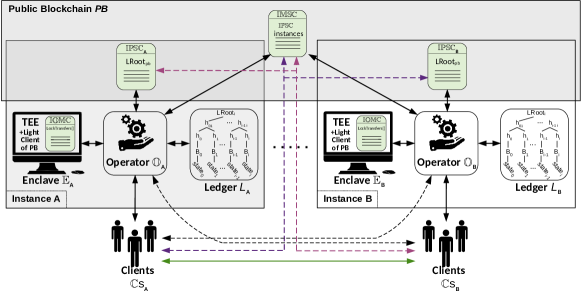
The adoption of decentralized, tamper-proof ledger systems is paving the way for new applications and opportunities in different contexts. While most research aims to improve their scalability, privacy, and governance issues, interoperability has received less attention. Executing transactions across various blockchains is notably instrumental in unlocking the potential of novel applications, particularly in the financial sector, where their potential would otherwise be significantly diminished. Therefore, interoperable ledgers are crucial to ensure the expansion and further adoption of such a technology in various contexts. In this paper, we present a protocol that uses a combination of trusted execution environment (TEE) and blockchains to enable interoperability over independent semi-centralized CBDC ledgers, guaranteeing the atomicity of inter-bank transfers. Our interoperability protocol uses a custom adaptation of atomic swap protocol and is executed by any pair of CBDC instances to realize a one-way transfer. It ensures features such as atomicity, verifiability, correctness, censorship resistance, and privacy while offering high scalability in terms of the number of CBDC instances. Our approach enables to possible deployment scenarios that can be combined: (1) CBDC instances represent central banks of multiple countries, and (2) CBDC instances represent the set of retail banks and a paramount central bank of a single country. We provide a detailed description of our protocol as well as an extensive analysis of its benefits, features, and security. In this WIP paper, we made a proof-of-concept implementation and made a partial evaluation, while the more extensive evaluation will be made in our future work.
研究动机与目标
- 解决半集中式 CBDC 系统之间互操作性的关键缺口,以支持跨境及跨机构金融运作。
- 通过集成可信执行环境(TEE)克服集中式 CBDC 环境中的隐私与信任挑战,实现可验证、安全的交易执行。
- 在不依赖中心化中介或新增货币供应的前提下,确保跨银行转账的原子性与抗审查性。
- 在单一统一协议中支持国家中央银行与国家零售银行网络的实用部署场景。
- 提供不可争议的审查证明与可验证的交易完整性,以增强可审计性与监管合规性。
提出的方法
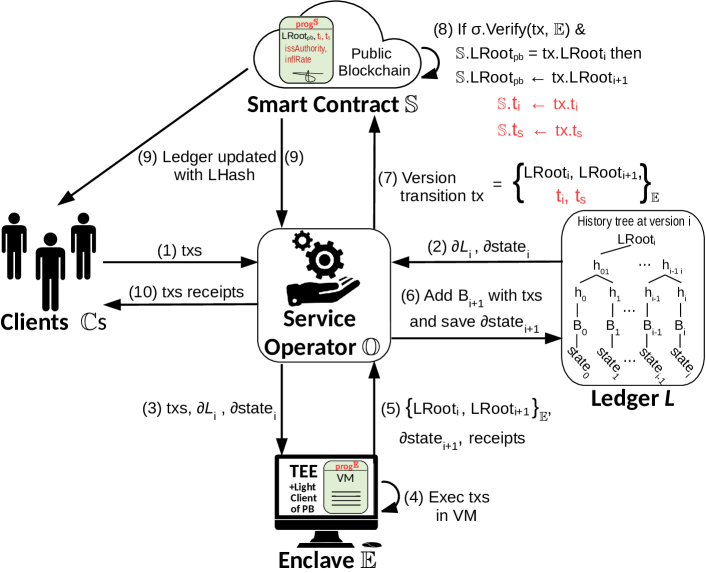
- 利用 TEE(如 Intel SGX)在密码学隔离环境中执行并验证交易,确保正确性与机密性。
- 适配原子互换协议,实现任意一对 CBDC 实例之间的单向、跨机构转账,保证原子性。
- 使用无许可区块链(如 Ethereum)作为公开审计层,确保交易的不可篡改性、无歧义性与可验证性。
- 集成智能合约以强制执行策略级控制,如代币到期、使用限制或货币政策机制。
- 设计跨 CBDC 通信层,通过避免创建新代币并实现安全、可验证的协调,维持货币均衡。
- 通过加密所有交易数据并依赖 TEE 执行计算,确保隐私,避免暴露敏感信息。
实验结果
研究问题
- RQ1如何在不引入新货币供应或中心化协调的前提下,实现半集中式 CBDC 系统之间的互操作性?
- RQ2何种机制可确保使用可信硬件在独立 CBDC 实例之间实现跨银行转账的原子性与可验证性?
- RQ3基于 TEE 的协议能否在保护交易隐私与正确性的前提下,提供不可争议的审查证明?
- RQ4该协议如何支持多样化的部署模式,包括国家中央银行与国家零售银行网络?
- RQ5在 TEE 与区块链组合的跨 CBDC 环境中,可形式化保证的隐私与安全属性有哪些?
主要发现
- 该协议成功实现了任意一对 CBDC 实例之间的原子化、隐私保护且可验证的单向转账,无论其机构来源如何。
- 不可争议的审查证明可由任何外部方验证,提升了透明度与可审计性,同时不损害隐私。
- TEE 的集成确保了交易执行的正确性,即使在 CBDC 实例不可信的情况下也能防止恶意操纵。
- 系统通过避免在跨机构转账过程中创建新代币,维持了货币均衡,保护了货币政策的完整性。
- 该协议与现有法律与监管框架兼容,包括反洗钱(AML)、了解你的客户(KYC)及消费者保护法律,得益于其可审计性与合规设计。
- 概念验证实现证明了可行性,但未来工作将开展更广泛的评估。
阅读本论文
在 Nubint 阅读器中打开原文,边读边就任意段落提问。
在 Nubint 中阅读本论文本解读由 AI 根据论文原文生成,引用前请核对原文。