
[论文解读] CDA: Contrastive-adversarial Domain Adaptation
本文提出CDA,一种两阶段对比对抗域适应框架,通过结合对抗学习实现域级对齐与对比学习实现类别级紧凑性和分离性,从而提升无监督域适应性能。CDA在Office-31和Digits-5数据集上达到最先进性能,通过增强类内紧凑性和清晰分离的决策边界,其准确率相较DANN等方法最高提升11%。
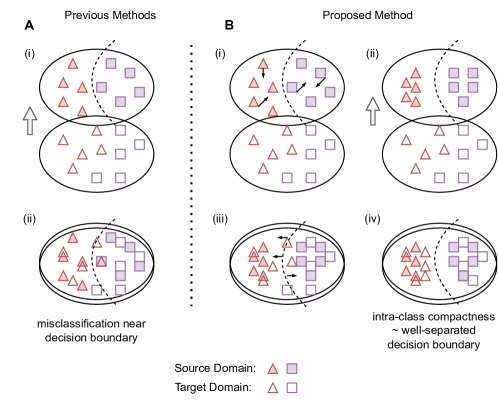
Recent advances in domain adaptation reveal that adversarial learning on deep neural networks can learn domain invariant features to reduce the shift between source and target domains. While such adversarial approaches achieve domain-level alignment, they ignore the class (label) shift. When class-conditional data distributions are significantly different between the source and target domain, it can generate ambiguous features near class boundaries that are more likely to be misclassified. In this work, we propose a two-stage model for domain adaptation called extbf{C}ontrastive-adversarial extbf{D}omain extbf{A}daptation extbf{(CDA)}. While the adversarial component facilitates domain-level alignment, two-stage contrastive learning exploits class information to achieve higher intra-class compactness across domains resulting in well-separated decision boundaries. Furthermore, the proposed contrastive framework is designed as a plug-and-play module that can be easily embedded with existing adversarial methods for domain adaptation. We conduct experiments on two widely used benchmark datasets for domain adaptation, namely, extit{Office-31} and extit{Digits-5}, and demonstrate that CDA achieves state-of-the-art results on both datasets.
研究动机与目标
- 为解决对抗域适应在处理源域与目标域之间类别条件分布偏移方面的局限性。
- 通过实现超越域级对齐的类别级对齐,提升决策边界的清晰度。
- 设计一个即插即用的对比模块,以增强现有对抗域适应方法。
- 通过联合域级与类别级对齐,在Office-31和Digits-5等基准数据集上实现最先进性能。
提出的方法
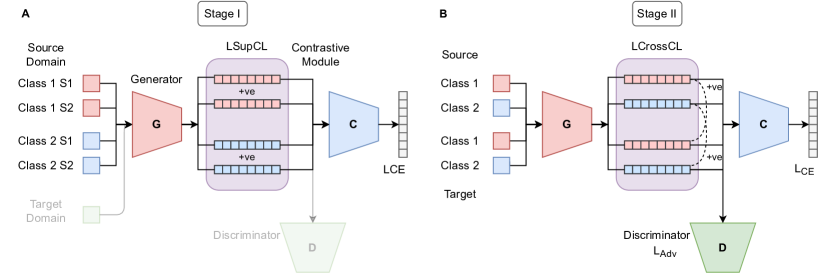
- CDA采用两阶段训练流程:首先在有标签的源域上进行监督对比学习,以增强类内紧凑性和类间分离性。
- 在第二阶段,通过训练域判别器来区分源域和目标域特征,实现整体域分布的对抗性对齐。
- 引入跨域对比损失,使来自源域和目标域的同类特征更接近,而不同类特征更远离。
- 该框架整合了多种损失组件——监督对比损失、对抗损失和跨域对比损失——以端到端方式联合优化。
- 对比模块被设计为插件式组件,可无缝集成至现有对抗域适应模型中,无需架构重构。
- 采用在ImageNet上预训练的ResNet-50主干网络作为特征生成器,并配备独立的分类器头和域判别器头。
实验结果
研究问题
- RQ1对比学习是否能在超越域级对齐的基础上,改善无监督域适应中的类别级对齐?
- RQ2对比学习与对抗学习的两阶段训练机制如何影响目标域上的决策边界质量与泛化性能?
- RQ3将所提出的对比模块集成到现有对抗域适应框架中,能在多大程度上提升性能?
- RQ4对比学习与对抗学习的结合是否能在Office-31和Digits-5等标准基准上实现更好的泛化性能?
主要发现
- 在Office-31数据集上,CDA实现了89.9%的最先进平均准确率,优于DANN、MADA和CDAN等先前方法。
- 在Digits-5基准上,CDA在SVHN → MNIST任务上达到96.8%准确率,MNIST → USPS任务上达到97.4%,MNIST → MNIST-M任务上达到96.6%,全面超越所有基线方法。
- 相较DANN,CDA在Office-31上平均准确率提升约9%,在Digits-5上提升11%,证明了对比模块的有效性。
- t-SNE可视化显示,CDA生成的嵌入在类边界附近具有更优的分离性和类别判别性,优于DANN。
- 消融实验表明,对比模块显著提升了性能,主要通过增强类间分离性和跨域对齐实现。
- 对比模块的即插即用设计使其可无缝集成至现有对抗方法中,仅通过最小修改即可实现性能增益。
阅读本论文
在 Nubint 阅读器中打开原文,边读边就任意段落提问。
在 Nubint 中阅读本论文本解读由 AI 根据论文原文生成,引用前请核对原文。