
[论文解读] CF-KAN: Kolmogorov-Arnold Network-based Collaborative Filtering to Mitigate Catastrophic Forgetting in Recommender Systems
CF-KAN 提出了一种新颖的协同过滤方法,利用柯尔莫哥洛夫-阿诺德网络(KANs)通过在边级别而非节点级别学习非线性函数,以缓解推荐系统中的灾难性遗忘问题。该方法在推荐准确度上优于最先进方法,在持续学习中表现出对灾难性遗忘的强鲁棒性,并通过边级别的可视化提供可解释的推荐结果。
Collaborative filtering (CF) remains essential in recommender systems, leveraging user--item interactions to provide personalized recommendations. Meanwhile, a number of CF techniques have evolved into sophisticated model architectures based on multi-layer perceptrons (MLPs). However, MLPs often suffer from catastrophic forgetting, and thus lose previously acquired knowledge when new information is learned, particularly in dynamic environments requiring continual learning. To tackle this problem, we propose CF-KAN, a new CF method utilizing Kolmogorov-Arnold networks (KANs). By learning nonlinear functions on the edge level, KANs are more robust to the catastrophic forgetting problem than MLPs. Built upon a KAN-based autoencoder, CF-KAN is designed in the sense of effectively capturing the intricacies of sparse user--item interactions and retaining information from previous data instances. Despite its simplicity, our extensive experiments demonstrate 1) CF-KAN's superiority over state-of-the-art methods in recommendation accuracy, 2) CF-KAN's resilience to catastrophic forgetting, underscoring its effectiveness in both static and dynamic recommendation scenarios, and 3) CF-KAN's edge-level interpretation facilitating the explainability of recommendations.
研究动机与目标
- 为解决动态推荐系统中协同过滤(CF)模型灾难性遗忘这一关键问题。
- 探索柯尔莫哥洛夫-阿诺德网络(KANs)的潜力,其在边级别学习非线性函数,作为传统基于 MLP 的 CF 模型的稳健替代方案。
- 在静态和持续学习设置下评估 CF-KAN 的性能,特别是在处理稀疏用户-物品交互方面。
- 通过利用 KANs 的边级别参数化提升模型可解释性,实现透明的推荐推理过程。
- 与双塔模型和基于自编码器的基线模型相比,展示 CF-KAN 的可扩展性和效率。
提出的方法
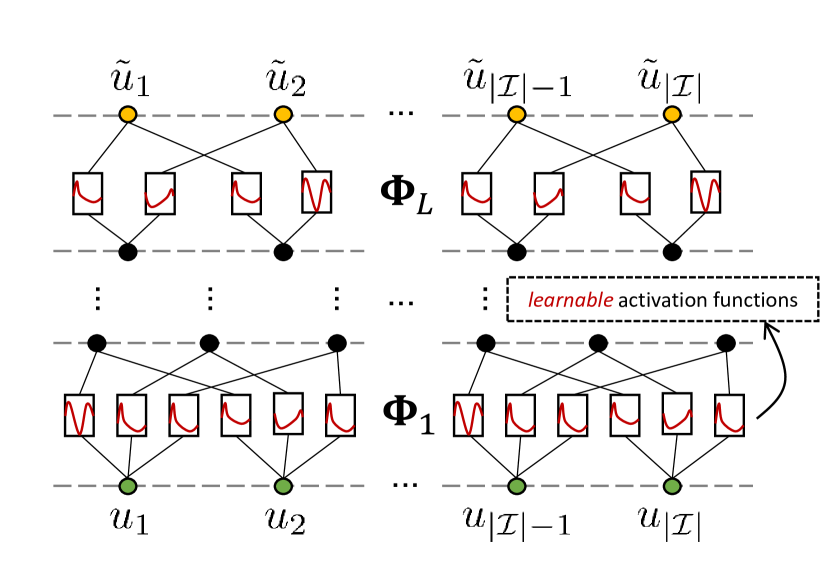
- CF-KAN 基于一种基于 KAN 的自编码器架构,通过边级别的非线性激活函数学习用户和物品嵌入。
- 与 MLP 不同,后者在每个节点上固定激活函数,KANs 在边级别学习参数化样条形式的激活函数,从而实现更自适应和鲁棒的函数逼近。
- 该模型采用简单的自编码器设计,用于重建用户-物品交互矩阵,在增量训练过程中保留历史知识。
- KAN 中的边级别参数更新可将参数变化局部化,减少对先前学习表示的干扰,从而缓解灾难性遗忘。
- 该方法采用可学习的样条基激活函数(如 SiLU、ReLU),并使用基于网格的参数化方式,以建模稀疏交互数据中的复杂非线性关系。
- 系统性地调整超参数,如 KAN 层数(L)、网格数量(G)、隐藏维度(d)以及激活函数类型,以实现最优性能。
实验结果
研究问题
- RQ1基于 KAN 的协同过滤是否在推荐准确度上优于传统的基于 MLP 的 CF 方法?
- RQ2在模型对新数据进行增量训练的持续学习场景中,CF-KAN 表现如何?
- RQ3与基于 MLP 的基线模型相比,CF-KAN 在多大程度上缓解了灾难性遗忘?
- RQ4KAN 的边级别结构是否能提供可解释且可视化的推荐路径?
- RQ5与双塔模型及其他自编码器基线模型相比,CF-KAN 在训练速度和内存消耗方面的可扩展性如何?
主要发现
- CF-KAN 实现了更优的推荐准确度,在 ML-1M 数据集上 R@20 得分为 0.19,优于所有基线模型,包括 MF-BPR、NGCF、LightGCN 和 SGL。
- 在持续学习中,CF-KAN 展现出对灾难性遗忘的强鲁棒性,即使在增量训练新数据后仍保持高性能。
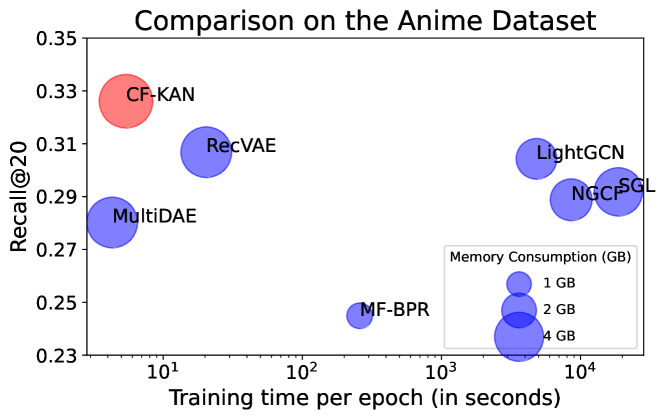
- CF-KAN 是自编码器基线模型中训练速度最快的,ML-1M 数据集上每轮仅需 0.2 秒,显著快于 MultiDAE(0.1 秒/轮)和 RecVAE(0.4 秒/轮)。
- 在 ML-1M 和 Yelp 数据集上,CF-KAN 消耗的 GPU 内存少于 NGCF 和 SGL,分别为 1.42 GB 和 2.62 GB,在内存效率方面优于其他自编码器模型。
- 最优配置为 L=1 层、G=2 个网格、d=512,且使用 SiLU 激活函数;当网络更深或参数过多时,性能因过拟合而下降。
- 可视化结果证实,CF-KAN 提供了可解释的推荐路径,例如通过共享观看历史将 'Demon Slayer' 与 'Mugen Train' 关联起来,而 CF-MLP 则缺乏清晰的可解释性。
阅读本论文
在 Nubint 阅读器中打开原文,边读边就任意段落提问。
在 Nubint 中阅读本论文本解读由 AI 根据论文原文生成,引用前请核对原文。