
[论文解读] CFR-ICL: Cascade-Forward Refinement with Iterative Click Loss for Interactive Image Segmentation
该论文提出 CFR-ICL,一种新颖的交互式图像分割框架,整合了级联前向精炼(CFR)以实现统一推理,迭代点击损失(ICL)以减少训练中的用户点击次数,以及 SUEM 拷贝-粘贴增强技术以提升训练多样性。该方法在性能上达到当前最先进水平,在 Berkeley 数据集上将平均点击次数减少 33.2%,在 DAVIS 数据集上减少 15.5%,在 IoU 达到 95% 时相比之前的工作表现更优。
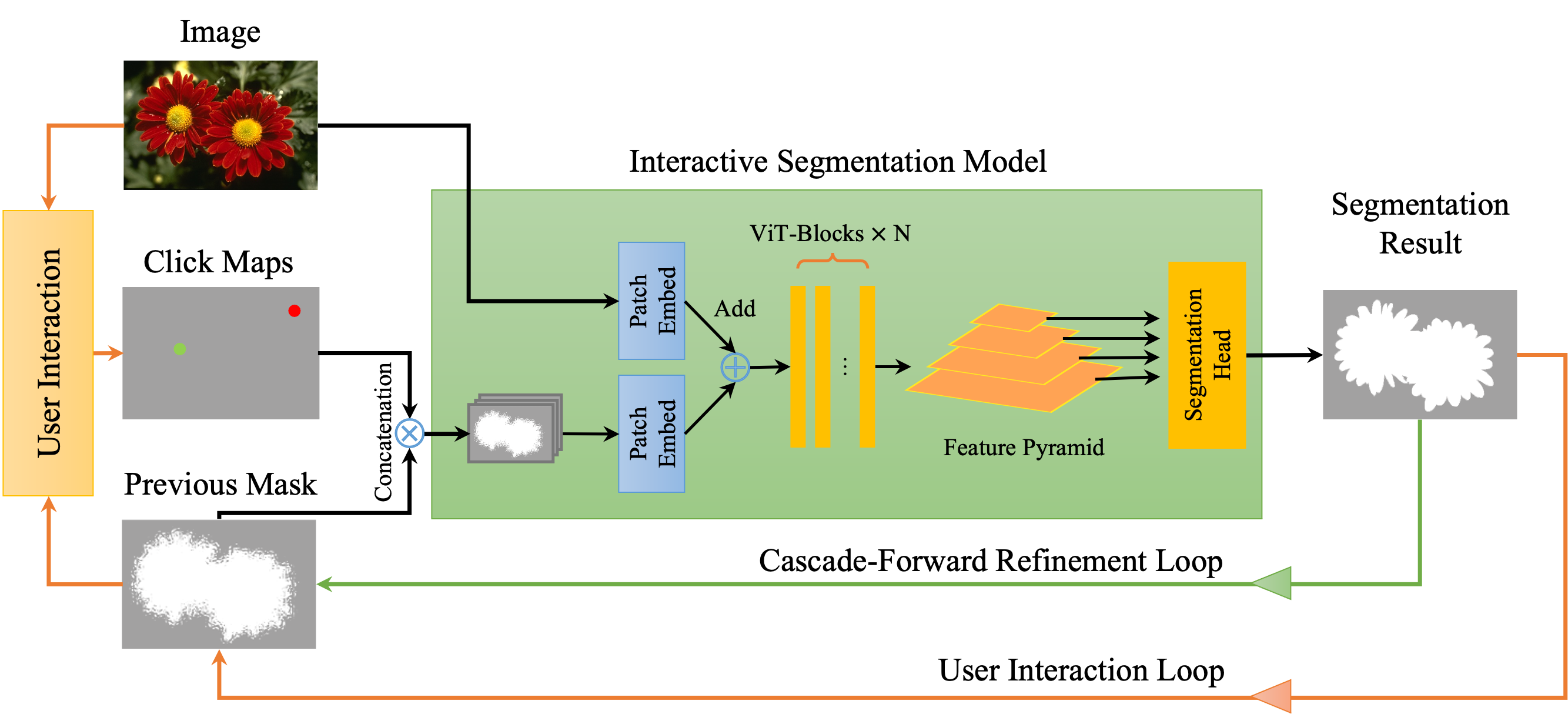
The click-based interactive segmentation aims to extract the object of interest from an image with the guidance of user clicks. Recent work has achieved great overall performance by employing feedback from the output. However, in most state-of-the-art approaches, 1) the inference stage involves inflexible heuristic rules and requires a separate refinement model, and 2) the number of user clicks and model performance cannot be balanced. To address the challenges, we propose a click-based and mask-guided interactive image segmentation framework containing three novel components: Cascade-Forward Refinement (CFR), Iterative Click Loss (ICL), and SUEM image augmentation. The CFR offers a unified inference framework to generate segmentation results in a coarse-to-fine manner. The proposed ICL allows model training to improve segmentation and reduce user interactions simultaneously. The proposed SUEM augmentation is a comprehensive way to create large and diverse training sets for interactive image segmentation. Extensive experiments demonstrate the state-of-the-art performance of the proposed approach on five public datasets. Remarkably, our model reduces by 33.2\%, and 15.5\% the number of clicks required to surpass an IoU of 0.95 in the previous state-of-the-art approach on the Berkeley and DAVIS sets, respectively.
研究动机与目标
- 解决基于点击的交互式分割中分割质量与用户交互成本之间的不平衡问题。
- 通过统一精炼过程,消除对启发式规则和独立精炼模型的依赖,实现推理阶段的统一化。
- 通过一种专为交互式分割设计的新颖数据增强策略,提升训练效率与模型泛化能力。
- 实现端到端学习,明确在训练过程中最小化所需用户点击次数。
- 开发一种灵活且统一的推理框架,通过迭代方式逐步提升分割细节。
提出的方法
- 提出级联前向精炼(CFR),一种双循环迭代推理机制,通过利用前序输出,以粗到精的方式逐步优化分割掩码。
- 提出迭代点击损失(ICL),一种新型损失函数,将点击次数与点击顺序编码进训练过程,以优化用户点击次数的最小化。
- 设计 SUEM 拷贝-粘贴增强策略,一种包含四种变体的综合性数据增强方法,以提升训练集的多样性与规模。
- 采用 ViT-Huge 主干网络,在 SBD 与 C+L 数据集上通过 ICL 与 SUEM 进行微调,以实现最优性能。
- 在实际应用中采用 CFR-1 推理(一步精炼)以兼顾计算效率与强大性能。
- 在 A-CFR 中采用基于阈值的自适应终止机制,当改进幅度低于 20 像素时动态停止精炼过程。
实验结果
研究问题
- RQ1统一的推理框架是否能在不依赖启发式规则或独立精炼模型的前提下,提升分割质量?
- RQ2在训练过程中编码点击次数与点击顺序的损失函数,是否能有效减少实现高精度分割所需的用户点击次数?
- RQ3像 SUEM 拷贝-粘贴这样的综合性数据增强策略,是否能显著提升交互式分割中的模型泛化能力?
- RQ4ICL、CFR 与 SUEM 的结合是否能在多种基准测试中实现最先进性能?
- RQ5与现有基于迭代掩码引导或推理时优化的方法相比,所提出方法在效率与精度方面表现如何?
主要发现
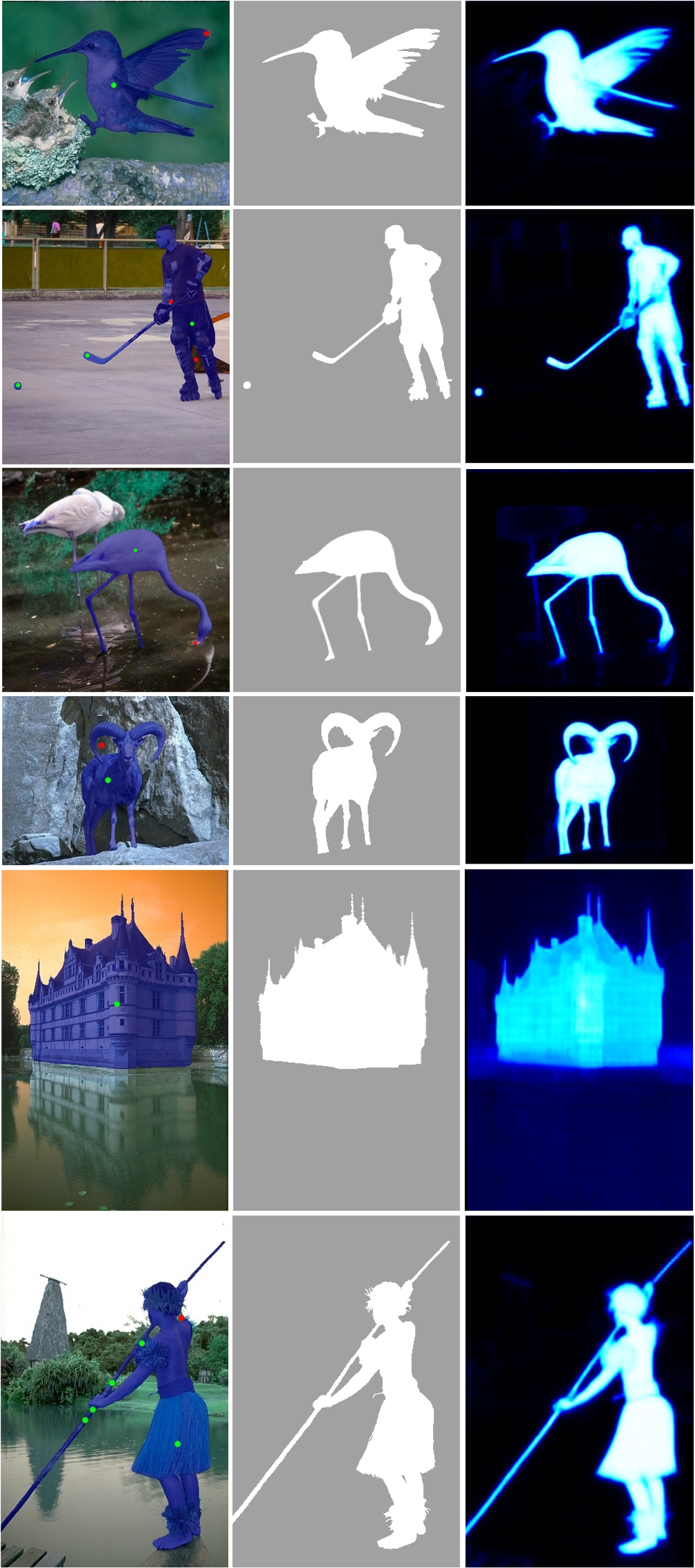
- 所提出的 CFR-1 推理方案在 Berkeley 数据集上实现了 95% IoU 条件下平均仅 2.9 次点击,相比之前最先进方法提升 33.2%。
- 在 DAVIS 数据集上,该方法将平均点击次数降低至 7.5 次(IoU 达 95%),相比先前最佳结果减少 15.5%。
- 迭代点击损失(ICL)支持显式最小化用户点击次数的训练,显著提升模型在低交互场景下的偏好表现。
- SUEM 拷贝-粘贴增强策略在 GrabCut、Berkeley 与 DAVIS 数据集上显著提升性能,证明其在提升数据多样性与模型泛化能力方面的有效性。
- A-CFR-4 变体通过在变化趋于可忽略时自适应终止精炼过程,优于 CFR-4,体现出动态停止机制的优势。
- 完整版 CFR-ICL 框架在五个公开数据集(包括 SBD、DAVIS、PascalVOC、Berkeley 与 GrabCut)上均达到最先进性能。
阅读本论文
在 Nubint 阅读器中打开原文,边读边就任意段落提问。
在 Nubint 中阅读本论文本解读由 AI 根据论文原文生成,引用前请核对原文。