
[论文解读] Chain of History: Learning and Forecasting with LLMs for Temporal Knowledge Graph Completion
本文提出一个 PEFT 微调的 LLM 框架,利用结构感知的历史与反向逻辑提示执行时态知识图谱完成,在 ICEWS 和 YAGO 数据集上相比基于嵌入的方法和其他 LLM 方法取得了有竞争力的结果。
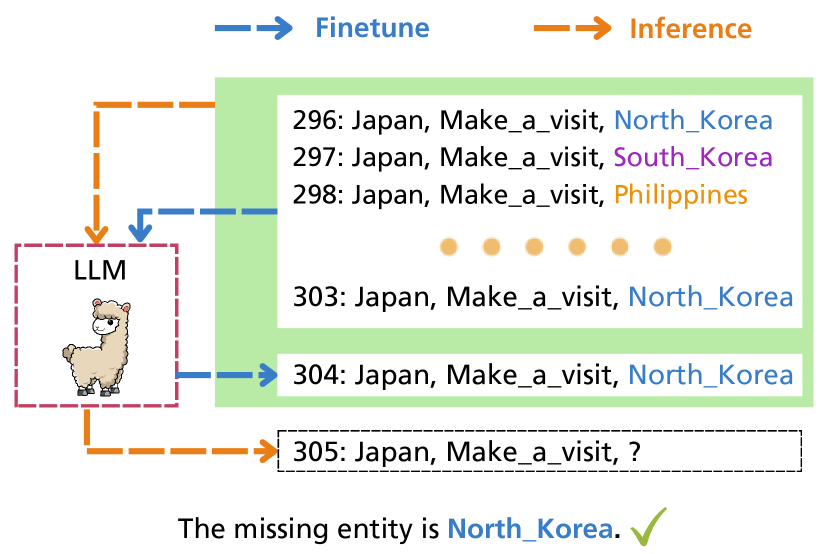
Temporal Knowledge Graph Completion (TKGC) is a complex task involving the prediction of missing event links at future timestamps by leveraging established temporal structural knowledge. This paper aims to provide a comprehensive perspective on harnessing the advantages of Large Language Models (LLMs) for reasoning in temporal knowledge graphs, presenting an easily transferable pipeline. In terms of graph modality, we underscore the LLMs' prowess in discerning the structural information of pivotal nodes within the historical chain. As for the generation mode of the LLMs utilized for inference, we conduct an exhaustive exploration into the variances induced by a range of inherent factors in LLMs, with particular attention to the challenges in comprehending reverse logic. We adopt a parameter-efficient fine-tuning strategy to harmonize the LLMs with the task requirements, facilitating the learning of the key knowledge highlighted earlier. Comprehensive experiments are undertaken on several widely recognized datasets, revealing that our framework exceeds or parallels existing methods across numerous popular metrics. Additionally, we execute a substantial range of ablation experiments and draw comparisons with several advanced commercial LLMs, to investigate the crucial factors influencing LLMs' performance in structured temporal knowledge inference tasks.
研究动机与目标
- 通过使用大型语言模型(LLMs)激发并实现对时态知识图谱(TKGs)进行有效推理。
- 开发一个可迁移的结构感知框架,将历史图信息融入TKGC。
- 在微调期间通过反向逻辑提示减轻基于LLM的结构化推理中的逆转问题。
- 展示参数高效微调(PEFT)以使LLMs与TKGC任务对齐。
- 提供全面的消融研究与与现有TKGC方法及商业化LLMs的比较。
提出的方法
- 将模式匹配历史、实体增强历史和关系增强历史结合的结构增强历史建模,以为LLM推理提供信息。
- 通过三种提示策略(普通、文本感知、位置感知)在微调期间引入反向逻辑,以缓解结构化推理中的逆转问题。
- 使用基于LoRA的PEFT进行指令微调,在保持基础模型不变的同时更新少量参数。
- 通过束搜索解码使用LLMs生成候选答案序列,并选择概率最高的序列。
- 使用历史链路(L)来提供上下文,并关注不同数据集的最优历史长度。
- 在ICEWS和YAGO数据集上,与基于嵌入的TKGC模型以及多种开源/商业LLMs进行对比评估。
实验结果
研究问题
- RQ1在具备结构感知历史和反向逻辑提示的情况下,LLMs 是否能够成为进行外推TKGC的有效推理代理?
- RQ2与全参数微调相比,PEFT(LoRA)微调如何影响LLM在TKGC任务上的性能?
- RQ3历史增强、反向数据和提示策略对前向和后向(逆向)时序推理有何影响?
- RQ4模型规模和数据集特征如何影响基于LLM的TKGC性能,包括与商业LLMs的比较?
主要发现
- 所提出的框架在若干TKGC基准上实现了高度竞争性甚至优于最先进方法的性能。
- 基于结构的历史增强(模式历史、实体历史和关系历史)提升了TKGC的前向和后向推理。
- 在微调期间引入逆向逻辑缓解了逆转诅咒,并通常提升或保持前向推理。
- 基于LoRA的指令微调在相对较小的参数更新下取得了显著结果,且更大模型规模并不一定保证更好的TKGC性能。
- 商业化LLMs表现各异;某些带有RLHF的对话模型在某些数据集上可以接近或超过基线模型,而在其他数据集上的表现仍低于专门的TKGC模型。
- 在所有数据集上,历史长度和数据增强策略影响性能;在某些数据集上历史过长会带来收益递减或产生负面影响。

阅读本论文
在 Nubint 阅读器中打开原文,边读边就任意段落提问。
在 Nubint 中阅读本论文本解读由 AI 根据论文原文生成,引用前请核对原文。