
[论文解读] Challenges and Practices of Deep Learning Model Reengineering: A Case Study on Computer Vision
本论文通过混合方法案例研究,探究计算机视觉领域深度学习模型的逆向工程,分析了来自开源项目的348个缺陷,并对持续两年的逆向工程工作进行了从业者访谈。研究识别出关键挑战——模型工程化、性能调试、操作可移植性以及定制化数据流水线——并提出了一种新型逆向工程工作流程,附有缺陷频率和最佳实践标注。
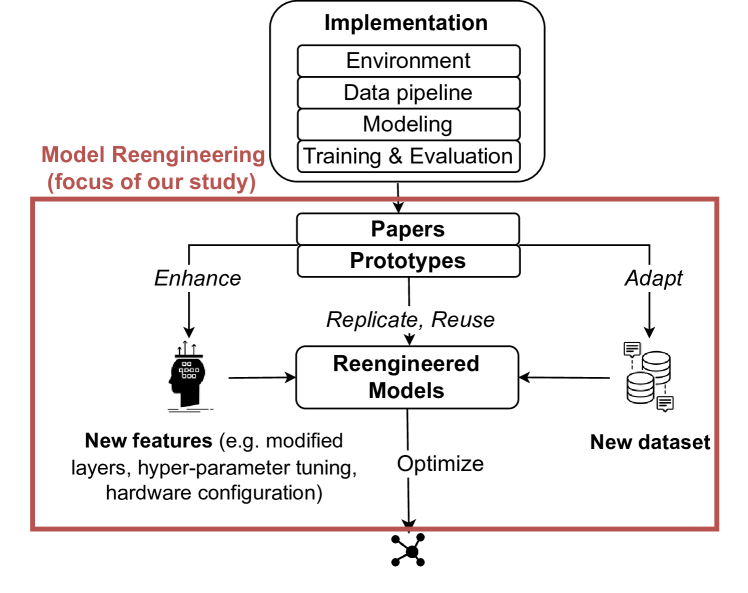
Many engineering organizations are reimplementing and extending deep neural networks from the research community. We describe this process as deep learning model reengineering. Deep learning model reengineering - reusing, reproducing, adapting, and enhancing state-of-the-art deep learning approaches - is challenging for reasons including under-documented reference models, changing requirements, and the cost of implementation and testing. In addition, individual engineers may lack expertise in software engineering, yet teams must apply knowledge of software engineering and deep learning to succeed. Prior work has examined on DL systems from a "product" view, examining defects from projects regardless of the engineers' purpose. Our study is focused on reengineering activities from a "process" view, and focuses on engineers specifically engaged in the reengineering process. Our goal is to understand the characteristics and challenges of deep learning model reengineering. We conducted a case study of this phenomenon, focusing on the context of computer vision. Our results draw from two data sources: defects reported in open-source reeengineering projects, and interviews conducted with open-source project contributors and the leaders of a reengineering team. Our results describe how deep learning-based computer vision techniques are reengineered, analyze the distribution of defects in this process, and discuss challenges and practices. Integrating our quantitative and qualitative data, we proposed a novel reengineering workflow. Our findings inform several future directions, including: measuring additional unknown aspects of model reengineering; standardizing engineering practices to facilitate reengineering; and developing tools to support model reengineering and model reuse.
研究动机与目标
- 理解深度学习模型逆向工程中的挑战与实践,特别是在计算机视觉领域的应用。
- 分析深度学习逆向工程项目中缺陷的特征及其根本原因。
- 识别在环境配置、训练和模型部署过程中阻碍可重现性与可靠性的重复性问题。
- 基于来自开源项目和从业者团队的实证数据,构建一个面向流程的深度学习模型逆向工程框架。
- 通过识别当前实践中的差距,为未来深度学习工程的工具开发与标准化工作提供依据。
提出的方法
- 结合27个开源计算机视觉项目的定量缺陷分析与定性访谈,开展混合方法案例研究。
- 分析了开源逆向工程项目中报告的348个缺陷,按缺陷类型、深度学习生命周期阶段及根本原因进行分类。
- 对一名持续两年的深度学习模型逆向工程工作中的2名从业者和6名团队负责人进行访谈,以理解现实世界中的挑战与实践。
- 改编并应用现有缺陷分类体系对缺陷进行分类,通过评分者间一致性检验与校准确保可靠性。
- 整合定量缺陷数据与定性洞察,开发一种新型逆向工程工作流程,标注挑战、实践与缺陷频率。
- 通过团队负责人成员核验验证研究发现,并通过迭代框架优化与外部验证缓解潜在偏见。
实验结果
研究问题
- RQ1在计算机视觉领域的深度学习模型逆向工程项目中,最常见的缺陷类型及其根本原因是什么?
- RQ2缺陷模式在深度学习生命周期的不同阶段(如环境设置、训练、推理)之间有何差异?
- RQ3在预训练深度学习模型的逆向工程过程中,工程团队面临的主要挑战是什么?
- RQ4与环境相关的缺陷,特别是接口和API问题,如何导致逆向工程失败?
- RQ5在长期从事深度学习模型逆向工程的经验团队中,涌现出哪些实践与工作流程模式?
主要发现
- 58%的深度学习逆向工程缺陷由再使用者报告,表明重用是主要的失败来源。
- 68%的可重现性相关缺陷在训练阶段被发现,凸显训练是关键的故障点。
- 88%的环境缺陷与接口相关,46%由API缺陷引起,凸显库与框架集成的脆弱性。
- 训练缺陷表现出多样化的症状与根本原因,包括超参数调优问题与数据质量问题,其普遍性高于以往以产品为导向的研究。
- 四项核心挑战浮现:模型工程化、性能调试、深度学习操作的可移植性,以及定制化数据流水线管理。
- 本研究开发了一种新型逆向工程工作流程,整合定量缺陷频率与定性实践,为深度学习逆向工程提供面向流程的框架。
阅读本论文
在 Nubint 阅读器中打开原文,边读边就任意段落提问。
在 Nubint 中阅读本论文本解读由 AI 根据论文原文生成,引用前请核对原文。