
[论文解读] ChatGPT as a Factual Inconsistency Evaluator for Text Summarization
该论文研究 ChatGPT 作为文本摘要的零样本事实不一致性评估器,在三个任务上显示出与最新指标竞争力或更优,同时指出词汇偏见和推理局限。
The performance of text summarization has been greatly boosted by pre-trained language models. A main concern of existing methods is that most generated summaries are not factually inconsistent with their source documents. To alleviate the problem, many efforts have focused on developing effective factuality evaluation metrics based on natural language inference, question answering, and syntactic dependency et al. However, these approaches are limited by either their high computational complexity or the uncertainty introduced by multi-component pipelines, resulting in only partial agreement with human judgement. Most recently, large language models(LLMs) have shown excellent performance in not only text generation but also language comprehension. In this paper, we particularly explore ChatGPT's ability to evaluate factual inconsistency under a zero-shot setting by examining it on both coarse-grained and fine-grained evaluation tasks including binary entailment inference, summary ranking, and consistency rating. Experimental results indicate that ChatGPT generally outperforms previous evaluation metrics across the three tasks, indicating its great potential for factual inconsistency evaluation. However, a closer inspection of ChatGPT's output reveals certain limitations including its preference for more lexically similar candidates, false reasoning, and inadequate understanding of instructions.
研究动机与目标
- 在零样本设置中评估 ChatGPT 发现摘要中的事实不一致的能力。
- 在多个数据集上将 ChatGPT 与最新事实性评估指标进行对比。
- 评估粗粒度(蕴涵)、细粒度(排序)和基于评分的(一致性)任务。
- 研究提示设计(零样本和零样本链式思维)及其对性能的影响。
提出的方法
- 为蕴涵推断设计零样本提示并评估源文本与摘要之间的一致性。
- 使用零样本链式思维提示来引出推理,并与标准的零样本提示进行比较。
- 在六个数据集组成的 SUMMAC 基准测试上进行评估(FactCC、CoGenSumm、XSumFaith、Polytope、SummEval、FRANK)。
- 评估三个任务:二分类不一致检测(EI)、摘要排序和一致性评分。
- 以平衡准确率作为主要指标以应对数据集类别不平衡。
实验结果
研究问题
- RQ1在多样的数据集中,ChatGPT 是否能够在零样本设置中可靠检测摘要中的事实不一致?
- RQ2零样本链式思维提示是否比标准零样本提示提升 ChatGPT 的事实性评估性能?
- RQ3与最先进的指标相比,ChatGPT 在蕴涵、排序和一致性评分任务上的表现如何?
- RQ4在事实不一致性评估中观察到的局限性和失败模式是什么(例如词汇偏置、错误推理)?
主要发现
- 使用零样本链式思维提示的 ChatGPT 在 CoGenSum、SummEval 和 FRANK 数据集上取得最佳结果并超越 SummaC ZS。
- ChatGPT ZS-COT 在 CoGenSum、Polytope、FactCC、SummEval 和 FRANK 上分别比 ChatGPT ZS 提升了 11.0%、4.5%、4.8%、6.8% 和 1.7%。
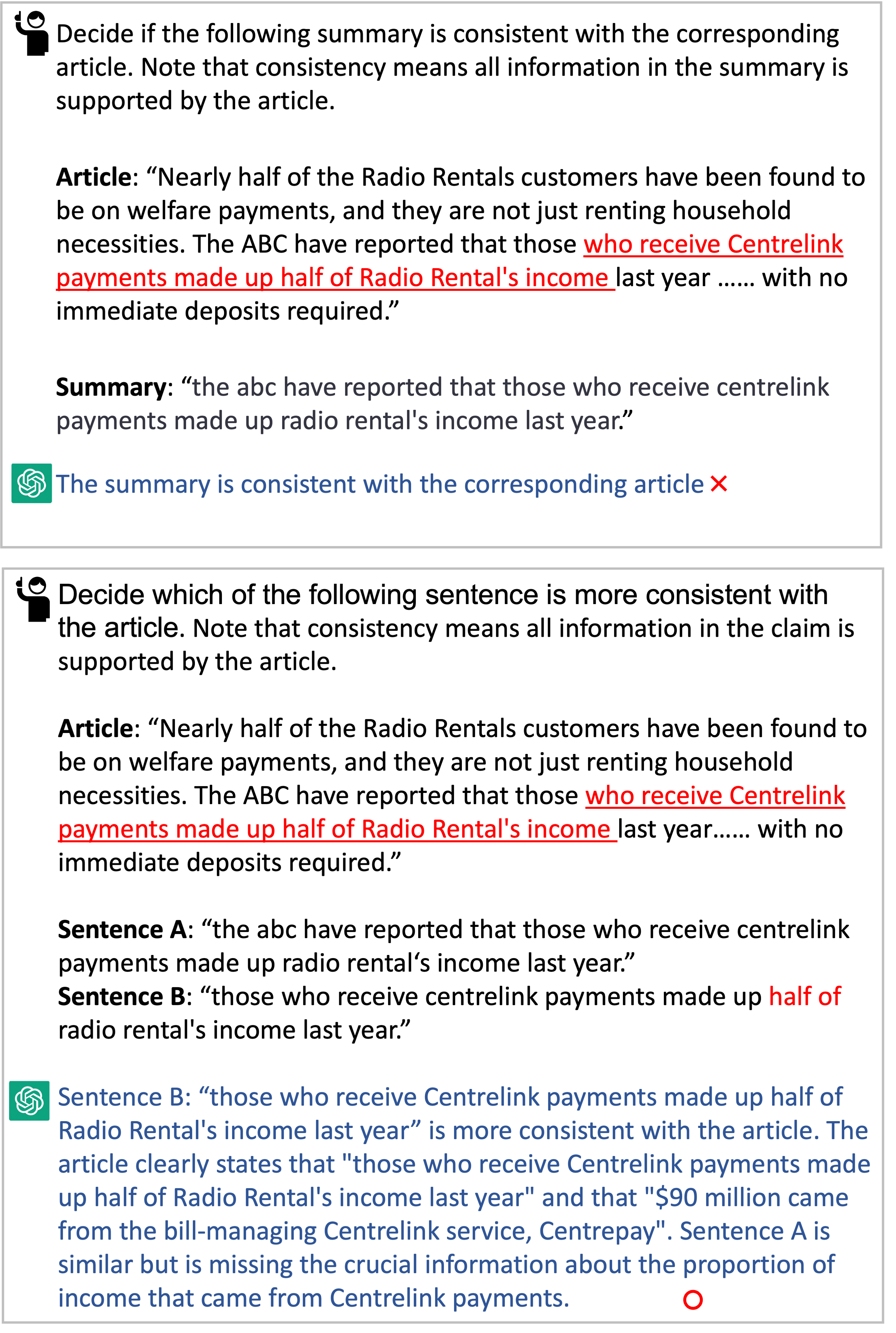
- 在各数据集上,ChatGPT 展现出强大潜力,但往往偏好词汇上相似的候选项,易受错误推断和与指令不一致的影响。
- 在排序任务中,ChatGPT 的准确率达到 85.2%,超过若干基线并接近人类水平 (83.9%)。
- 一致性评分结果显示 ChatGPT 与人类判断高度一致,尤其在 FRANK 上,尽管在 XSum 上相关性下降,因为抽象摘要减少了词汇重叠。
- 错误分析表明提示可能并未始终约束输出,而零样本 CoT 提示可能先给出结论,阻碍论证。
阅读本论文
在 Nubint 阅读器中打开原文,边读边就任意段落提问。
在 Nubint 中阅读本论文本解读由 AI 根据论文原文生成,引用前请核对原文。