
[论文解读] ChatGPT Asks, BLIP-2 Answers: Automatic Questioning Towards Enriched Visual Descriptions
该论文提出 ChatCaptioner,是一个自动提问系统,ChatGPT 向 BLIP-2 提问以丰富图像描述,产生比仅使用 BLIP-2 更有信息量的描述和检测到的对象数量,经人工评估验证。
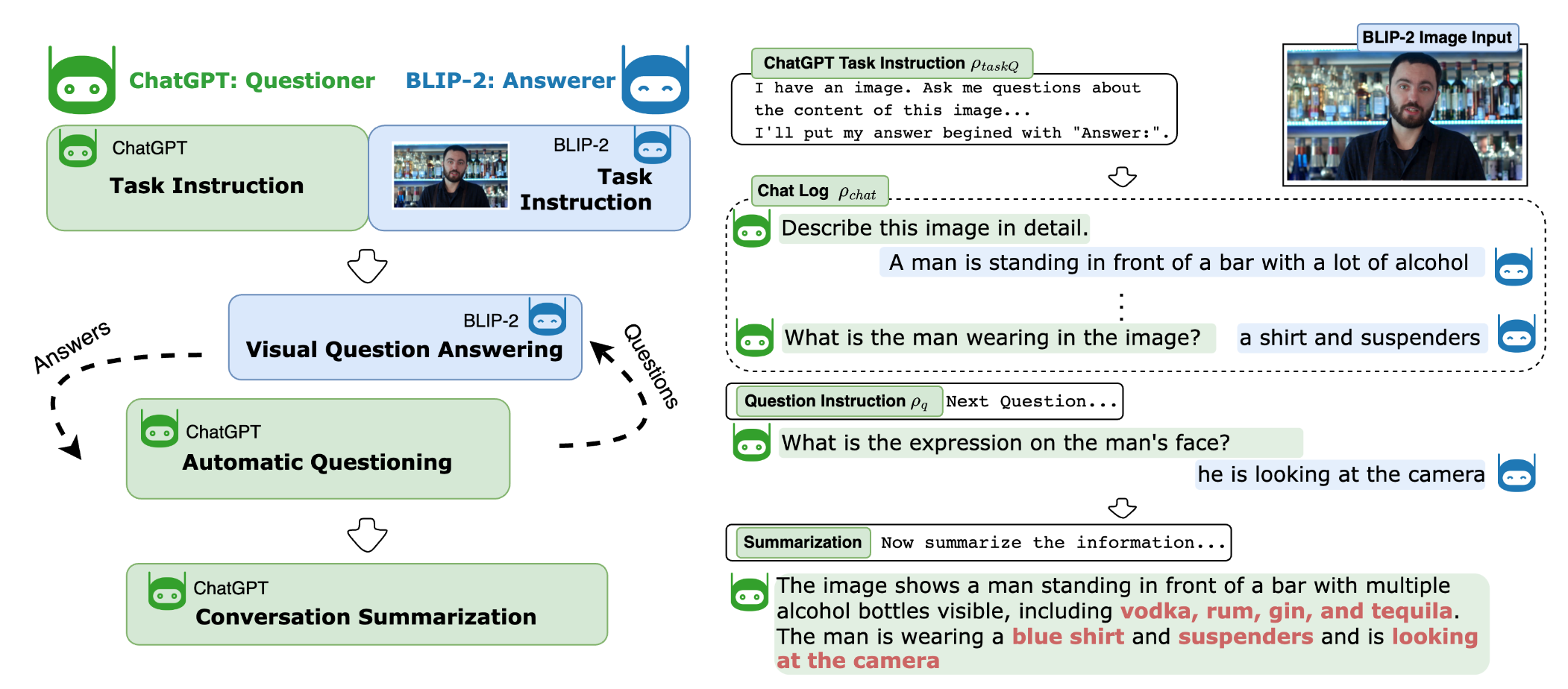
Asking insightful questions is crucial for acquiring knowledge and expanding our understanding of the world. However, the importance of questioning has been largely overlooked in AI research, where models have been primarily developed to answer questions. With the recent advancements of large language models (LLMs) like ChatGPT, we discover their capability to ask high-quality questions when provided with a suitable prompt. This discovery presents a new opportunity to develop an automatic questioning system. In this paper, we introduce ChatCaptioner, a novel automatic-questioning method deployed in image captioning. Here, ChatGPT is prompted to ask a series of informative questions about images to BLIP-2, a strong vision question-answering model. By keeping acquiring new visual information from BLIP-2's answers, ChatCaptioner is able to generate more enriched image descriptions. We conduct human-subject evaluations on common image caption datasets such as COCO, Conceptual Caption, and WikiArt, and compare ChatCaptioner with BLIP-2 as well as ground truth. Our results demonstrate that ChatCaptioner's captions are significantly more informative, receiving three times as many votes from human evaluators for providing the most image information. Besides, ChatCaptioner identifies 53% more objects within the image than BLIP-2 alone measured by WordNet synset matching. Code is available at https://github.com/Vision-CAIR/ChatCaptioner
研究动机与目标
- 证明自动、遵循指令的大语言模型能够生成信息丰富的问题以改进图像字幕。
- 在 ChatGPT 与 BLIP-2 之间集成一个自动问答循环,以提取更多图像细节。
- 评估丰富的图像描述是否比基线字幕模型提供更多信息且覆盖更多对象。
- 在多个数据集上通过人工研究评估问句的质量和字幕的正确性。
提出的方法
- 提示 ChatGPT 针对图像逐条生成一个信息量丰富的问题,并在先前的问答基础上构建(三部分提示:任务指令、聊天记录和每个问题的指令)。
- 将 BLIP-2 作为视觉问答回答方,使用不确定性提示以避免编造答案。
- 丢弃任何遵循回答模式的编造答案,以保持对话的一致性。
- 用 ChatGPT 对对话进行总结,生成最终丰富的图像描述。
- 通过人工评估将字幕与 BLIP-2 和 ground-truth 字幕进行比较,并利用 WordNet 同义词集合匹配分析对象覆盖。

实验结果
研究问题
- RQ1ChatGPT 是否能够生成多样且信息量丰富的问题,以从 BLIP-2 提取比静态字幕更丰富的视觉信息?
- RQ2ChatCaptioner 的字幕是否提供更丰富的图像描述并识别出比仅 BLIP-2 更多的对象?
- RQ3不确定性提示对 BLIP-2 的答案质量及整体字幕准确性有何影响?
- RQ4自动问询机制在不同图像和数据集上的问题有多大程度的多样性?
- RQ5相较于基线,人工评估者如何评价 ChatCaptioner 字幕的信息量和正确性?
主要发现
- ChatCaptioner 的字幕显著更具信息量,因提供最多图像信息而获得三倍的人类投票。
- ChatCaptioner 相较于单独的 BLIP-2,在图像中识别的对象多 53%,这是通过 WordNet 同义词集合匹配来衡量的。
- 不确定性提示通过解决对不可回答或含糊问题的不确定性,减少了 BLIP-2 的错误回答。
- 自动问题具有多样性,覆盖图像的高层次、对象级、数值和上下文等方面。
- ChatGPT 和 InstructGPT 展现出强大且不重复的问题生成能力,而较小的模型则表现出重复或提问能力差。
阅读本论文
在 Nubint 阅读器中打开原文,边读边就任意段落提问。
在 Nubint 中阅读本论文本解读由 AI 根据论文原文生成,引用前请核对原文。