
[论文解读] Chirality-Induced Magnetization of Magnetite by an RNA Precursor
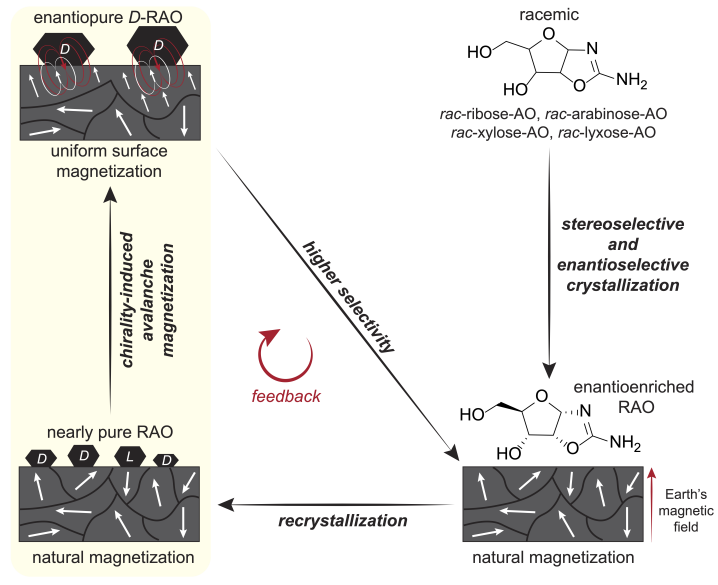
本文提出,手性核糖胺肟(RAO),一种RNA前体,可通过手性诱导自旋选择性(CISS)效应,在磁铁矿(Fe₃O₄)表面诱导雪崩式磁化。手性分子局部排列磁自旋,触发协同的长程磁化级联,放大微弱的天然剩磁,为磁性矿物上持久的自旋选择性化学提供了前生物上合理的机制。
Life is homochiral and homochirality is a fundamental feature of living systems on Earth. While the exact mechanism that led to homochirality is still not fully understood, any realistic scenario on the origins of life needs to address the emergence of homochirality. In order to impose and maintain chirality in a prebiotic network, an environmental factor functioning as a chiral agent is demanded. Magnetized surfaces are prebiotically plausible chiral agents, shown to be effective in enantioseparation of ribose-aminooxazoline (RAO), a ribonucleic acid (RNA) precursor, due to the chiral-induced spin selectivity (CISS) effect. As such, mechanisms for breaking the magnetic symmetry of magnetic minerals are of the utmost importance. Here we report the avalanche magnetization of magnetite $(Fe_{3}O_{4})$ by the crystallization of enantiopure RAO. The observed breaking of the magnetic symmetry is induced by the chiral molecules due to the CISS effect and spreads out across the magnetic surface like an avalanche, providing a way to uniformly magnetize a magnetic surface without fully covering it. Considered together with our previous results on enantioseparation by crystallization on a magnetic surface, chirality-induced avalanche magnetization paves the way for a cooperative feedback between chiral molecules and magnetic surfaces. With this feedback, a weak natural bias in the net magnetization can be amplified and spin-selective processes can be accommodated on magnetic minerals on a persistent basis.
研究动机与目标
- 研究手性分子如何在前生物磁性矿物(如磁铁矿)中打破磁对称性。
- 探讨如核糖胺肟(RAO)等手性分子是否能在磁铁矿表面诱导并放大磁化。
- 建立手性分子与磁性表面之间的反馈机制,以维持对对映体形成至关重要的自旋选择性过程。
- 证明CISS效应可驱动磁性表面无完全覆盖情况下的协同、长程磁化传播。
- 提供一条前生物上合理的路径,将微弱的天然磁偏置放大为持久、定向的磁化。
提出的方法
- 合成对映体纯的核糖胺肟(RAO),一种前生物RNA前体,并在前生物合理条件下使其在磁铁矿(Fe₃O₄)表面结晶。
- 采用磁光克尔效应(MOKE)测量检测并绘制RAO结晶诱导的表面磁化变化。
- 使用超导量子干涉装置(SQUID)磁强计量化样品的净磁化强度和磁滞回线。
- 利用磁力显微镜(mc-AFM)成像表面形貌,并将分子结晶与局部磁畴结构相关联。
- 应用圆二色谱(CD)光谱确认RAO的对映体纯度及其与手性表面的相互作用。
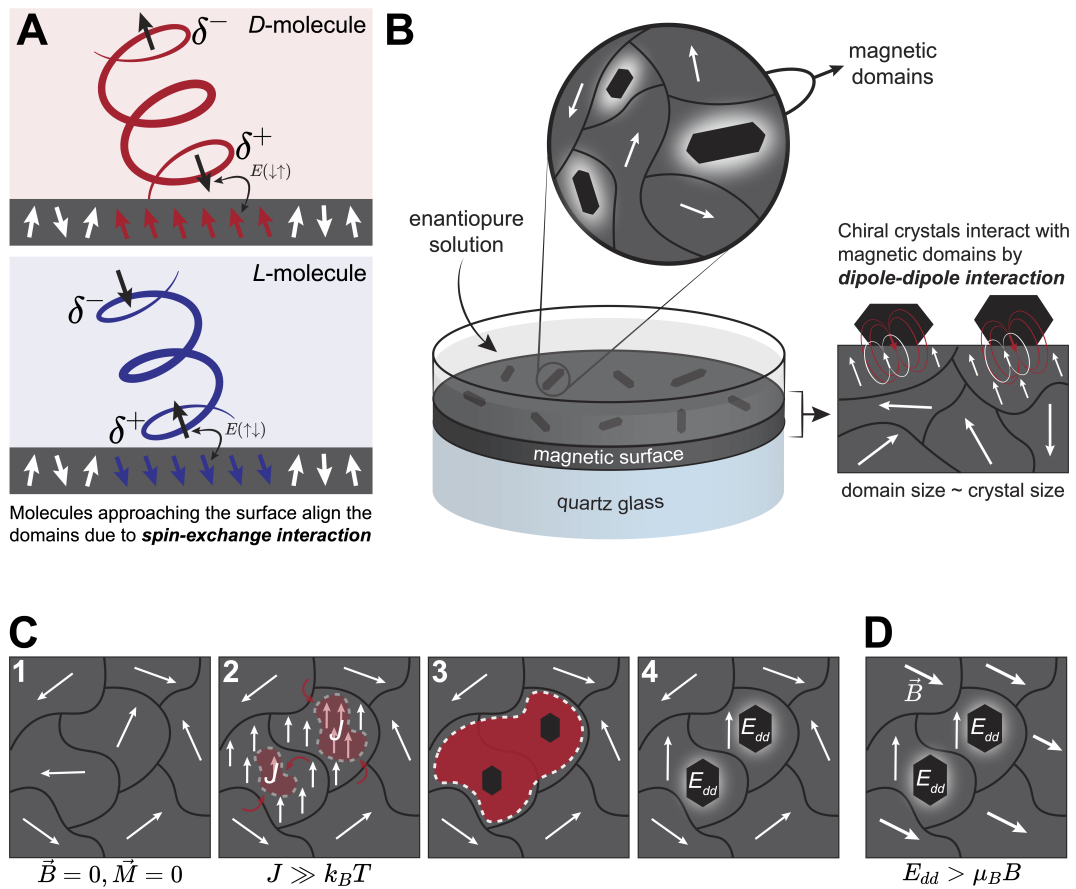
- 采用包含手性分子-自旋交换相互作用($J_c$)的二维伊辛模型哈密顿量对系统进行建模,表明手性分子可产生有效磁场,驱动集体自旋排列及雪崩式磁化。
实验结果
研究问题
- RQ1手性分子如RAO是否可通过CISS效应在磁铁矿表面诱导长程、协同的磁化?
- RQ2手性RAO晶体的存在是否会导致磁铁矿中可测量的、定向的净磁化,即使表面未完全覆盖?
- RQ3自生磁铁矿的微弱天然剩磁是否可通过手性分子诱导的自旋排列被放大?
- RQ4CISS效应在介导手性分子与磁性表面相互作用、驱动集体磁有序方面发挥何种作用?
- RQ5温度如何影响手性诱导磁化在磁畴中传播的效率与范围?
主要发现
- 对映体纯RAO在磁铁矿表面结晶可诱导可测量的、定向的净磁化,即使其在表面稀疏分布。
- 磁化以雪崩式方式在表面传播,表明由手性分子-表面相互作用驱动的协同长程自旋排列过程。
- MOKE与SQUID测量证实,诱导磁化具有持久性并表现出磁滞,表明形成了稳定的磁畴。
- 手性分子通过自旋交换相互作用($J_c$)产生的有效磁场强度强且作用范围短(~0.01–1 eV),足以触发表面集体自旋重取向。
- 在二维伊辛模型近似下,系统表现出二级相变类似行为,低温下因自旋关联增强,磁化传播更为剧烈。
- 观测到的磁化方向由RAO的分子手性决定,证实了手性对磁有序的控制机制。
阅读本论文
在 Nubint 阅读器中打开原文,边读边就任意段落提问。
在 Nubint 中阅读本论文本解读由 AI 根据论文原文生成,引用前请核对原文。