
[论文解读] CiPR: An Efficient Framework with Cross-instance Positive Relations for Generalized Category Discovery
本文提出CiPR,一种用于广义类别发现(GCD)的新框架,通过利用未标注数据中的跨样本正样本关系来提升表征学习。通过引入一种半监督的分层聚类算法——选择性邻域聚类(Selective Neighbor Clustering, SNC),CiPR 实现了高效的一次性标签分配与类别数量估计,无需事先知晓未见类别的数量,在通用数据集和细粒度数据集上均取得了最先进性能。
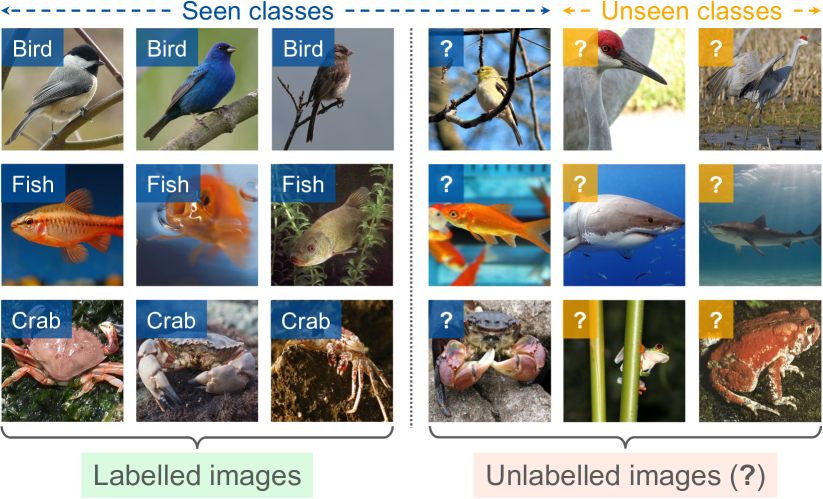
We tackle the issue of generalized category discovery (GCD). GCD considers the open-world problem of automatically clustering a partially labelled dataset, in which the unlabelled data may contain instances from both novel categories and labelled classes. In this paper, we address the GCD problem with an unknown category number for the unlabelled data. We propose a framework, named CiPR, to bootstrap the representation by exploiting Cross-instance Positive Relations in the partially labelled data for contrastive learning, which have been neglected in existing methods. To obtain reliable cross-instance relations to facilitate representation learning, we introduce a semi-supervised hierarchical clustering algorithm, named selective neighbor clustering (SNC), which can produce a clustering hierarchy directly from the connected components of a graph constructed from selective neighbors. We further present a method to estimate the unknown class number using SNC with a joint reference score that considers clustering indexes of both labelled and unlabelled data, and extend SNC to allow label assignment for the unlabelled instances with a given class number. We thoroughly evaluate our framework on public generic image recognition datasets and challenging fine-grained datasets, and establish a new state-of-the-art. Code: https://github.com/haoosz/CiPR
研究动机与目标
- 解决现有GCD方法将已标注与未标注数据独立处理且需已知类别数量的局限性。
- 通过利用未标注数据中常被先前方法忽略的跨样本正样本关系,改进GCD中的表征学习。
- 开发一种方法,实现对未知未见类别的数量进行高效估计,而无需重复聚类运行。
- 通过半监督聚类方法,实现对未标注与已标注数据的可靠、高纯度伪标签生成。
提出的方法
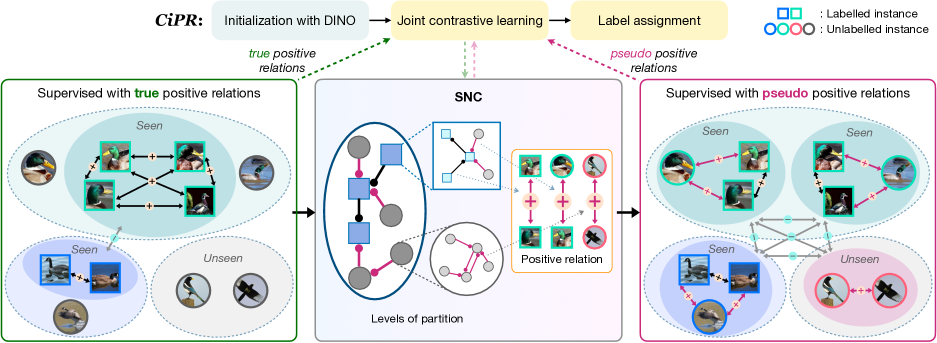
- 提出CiPR框架,通过整合未标注样本之间以及未标注与已标注样本之间的跨样本正样本关系,增强对比表征学习。
- 提出选择性邻域聚类(SNC),一种无超参数的分层聚类算法,通过选择性邻域的图连通分量生成可靠伪标签。
- SNC通过利用已知类别标签约束聚类形成,确保聚类过程中与已知类别保持一致。
- SNC通过结合已标注与未标注数据的聚类质量度量,计算联合参考分数,实现高效的类别数量估计。
- 该框架通过单次运行SNC同时完成表征学习(通过伪正样本关系)与最终标签分配,消除了迭代聚类的需要。
- SNC的一对一合并策略使得在无需多次算法运行的情况下,能够快速且准确地估计未知类别数量。
实验结果
研究问题
- RQ1未标注数据之间的跨样本正样本关系是否能改善广义类别发现中的表征学习?
- RQ2如何设计一种半监督分层聚类方法,以在尊重已知类别标签的同时生成可靠的伪标签?
- RQ3能否在无需重复聚类运行的情况下,高效估计未标注数据中未见类别的数量?
- RQ4同时利用未标注-未标注与未标注-已标注关系是否能带来优于仅使用单一关系类型的性能提升?
- RQ5所提出的基于SNC的框架在通用与细粒度数据集上,与现有最先进方法相比,在准确率与效率方面表现如何?
主要发现
- CiPR在CIFAR-100与CUB-200数据集上均取得最先进性能,显著优于先前的SOTA方法。
- 通过SNC同时利用未标注-未标注与未标注-已标注关系,性能达到最高,与仅使用单一关系类型相比,CIFAR-100的整体准确率提升1.0个百分点。
- SNC在整个训练过程中生成的伪标签纯度始终高于k-means与FINCH,表明其提供更可靠的监督信号。
- 该方法在未见类别上表现最佳,CUB-200上达到55.6%的准确率,显著优于基线及其他基线方法。
- 与先前SOTA方法中采用的迭代k-means方法相比,SNC的类别数量估计速度快于10倍,得益于单次运行的估计策略。
- SNC的联合参考分数在多个数据集中均能高精度识别真实未见类别的数量。
阅读本论文
在 Nubint 阅读器中打开原文,边读边就任意段落提问。
在 Nubint 中阅读本论文本解读由 AI 根据论文原文生成,引用前请核对原文。