
[论文解读] Circumstellar interaction signatures in the low luminosity type II SN 2021gmj
本研究通过多波长观测揭示了低光度II型超新星SN 2021gmj的星周物质相互作用,表现为光变曲线早期偏离及高电离态发射线。流体动力学建模与光谱分析表明,星周物质质量较低(0.025 M☉),前身星质量约为10 M☉,爆炸能量适中,暗示此类相互作用特征在低光度II型超新星中可能普遍存在。
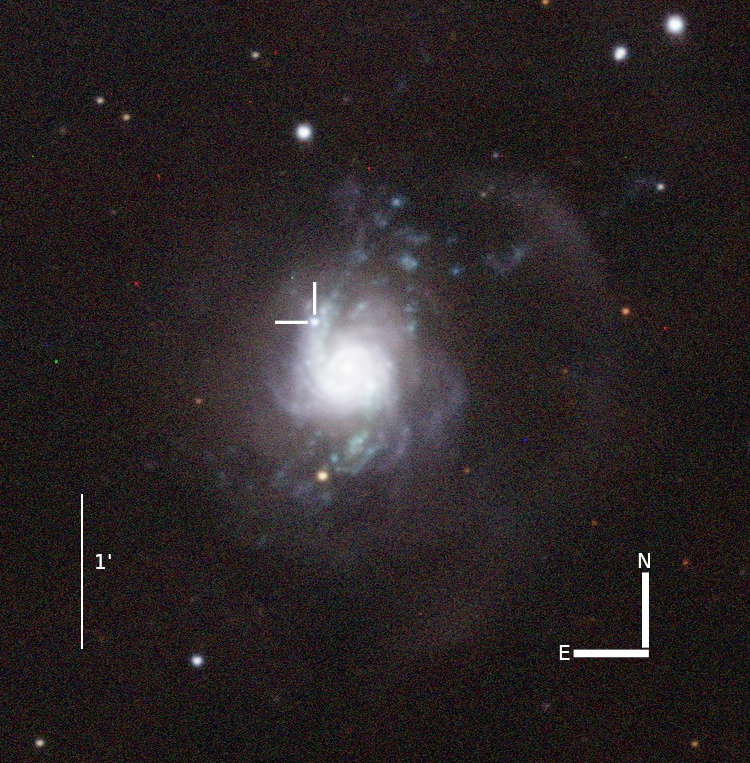
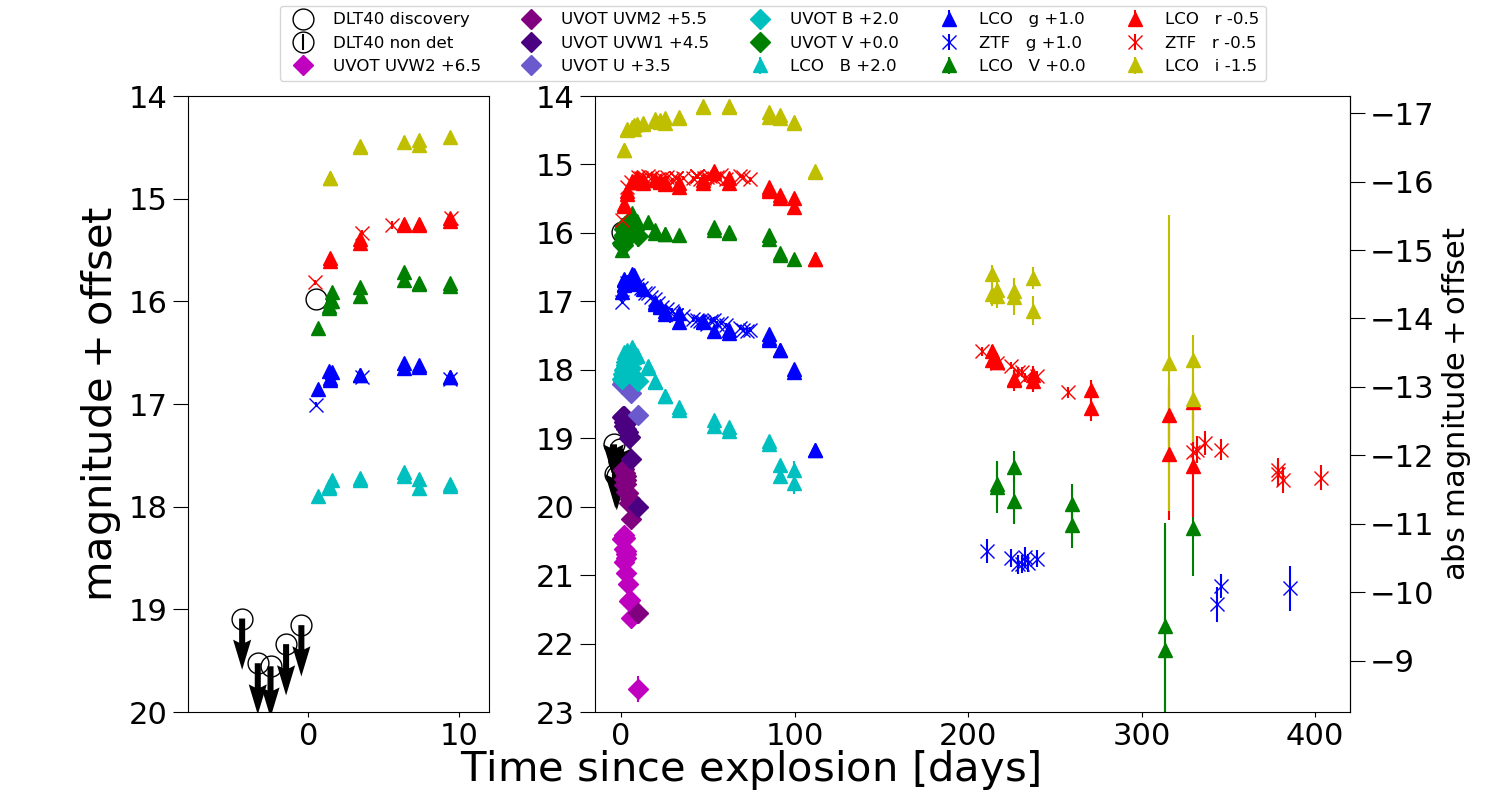
We present comprehensive optical observations of SN~2021gmj, a Type II supernova (SN~II) discovered within a day of explosion by the Distance Less Than 40~Mpc (DLT40) survey. Follow-up observations show that SN~2021gmj is a low-luminosity SN~II (LL~SN~II), with a peak magnitude $M_V = -15.45$ and Fe~II velocity of $\sim 1800 \ \mathrm{km} \ \mathrm{s}^{-1}$ at 50 days past explosion. Using the expanding photosphere method, we derive a distance of $17.8^{+0.6}_{-0.4}$~Mpc. From the tail of the light curve we obtain a radioactive nickel mass of $0.014 \pm 0.001$ M$_{\odot}$. The presence of circumstellar material (CSM) is suggested by the early-time light curve, early spectra, and high-velocity H$α$ in absorption. Analytical shock-cooling models of the light curve cannot reproduce the fast rise, supporting the idea that the early-time emission is partially powered by the interaction of the SN ejecta and CSM. The inferred low CSM mass of 0.025 M$_{\odot}$ in our hydrodynamic-modeling light curve analysis is also consistent with our spectroscopy. We observe a broad feature near 4600 Å, which may be high-ionization lines of C, N, or/and He~II. This feature is reproduced by radiation-hydrodynamic simulations of red supergiants with extended atmospheres. Several LL~SNe~II show similar spectral features, implying that high-density material around the progenitor may be common among them.
研究动机与目标
- 表征低光度II型超新星SN 2021gmj的光度与光谱演化特征。
- 通过光变曲线与光谱分析,探究前身星周围星周物质(CSM)的存在及其性质。
- 通过流体动力学建模与膨胀光球法,确定前身星质量、爆炸能量及⁵⁶Ni质量。
- 探讨光谱中高电离态发射特征是否可作为低光度II型超新星中广泛星周物质相互作用的指示。
提出的方法
- 从多个天文台(包括DLT40、凯克望远镜、MMT和拉斯坎布雷斯天文台)获取光度曲线数据,用于建模早期激波冷却与平台期。
- 利用LRIS、DEIMOS、Binospec和FLOYDS仪器的光谱数据,识别高电离态谱线并测量多普勒速度偏移。
- 应用膨胀光球法,基于V波段星等与光球温度,推导出距离为17.8⁺⁰.⁶₋₀.⁴ Mpc。
- 通过光变曲线尾部估算放射性⁵⁶Ni质量,得到M₅₆Ni = 0.014 ± 0.001 M☉。
- 采用SNEC程序进行流体动力学建模,假设星周物质为稳态风型,以推断星周物质质量与爆炸能量。
- 将具有延伸大气层的红超巨星的辐射流体动力学模拟结果与4600 Å处的宽特征进行比较,以解释其起源。
实验结果
研究问题
- RQ1SN 2021gmj前身星周围星周物质(CSM)的性质与质量为何?
- RQ2SN 2021gmj的早期光变曲线如何偏离标准激波冷却模型?这对其能量来源有何启示?
- RQ34600 Å附近的宽发射特征由何引起?其是否与C、N或He II的高电离态谱线一致?
- RQ4星周物质相互作用特征在低光度II型超新星中是否普遍存在?
- RQ5SN 2021gmj的前身星质量与爆炸能量为何?其与标准模型相比有何差异?
主要发现
- SN 2021gmj的V波段峰值星等为MV = -15.45,符合低光度II型超新星的分类。
- 爆炸中合成的⁵⁶Ni质量为0.014 ± 0.001 M☉,与低能量、中等质量前身星模型一致。
- 通过膨胀光球法推导出SN 2021gmj的距离为17.8⁺⁰.⁶₋₀.⁴ Mpc。
- 早期光变曲线建模显示光变上升迅速,与标准激波冷却模型不符,支持星周物质相互作用提供能量输入。
- 流体动力学建模结果表明,对于10 M☉前身星,星周物质质量为0.025 M☉,爆炸能量为0.294 foe。
- 4600 Å附近的宽特征被识别为高电离态谱线(C、N、He II)的可能混合,与具有星周物质的延伸红超巨星的辐射流体动力学模拟结果一致。
阅读本论文
在 Nubint 阅读器中打开原文,边读边就任意段落提问。
在 Nubint 中阅读本论文本解读由 AI 根据论文原文生成,引用前请核对原文。