
[论文解读] Citation-Enhanced Generation for LLM-based Chatbots
本文提出了一种无需训练、事后处理的框架——引用增强生成(Citation-Enhanced Generation, CEG),通过检索支持性文档并利用自然语言蕴涵(NLI)生成引用,减少基于大语言模型(LLM)聊天机器人的幻觉现象。该方法在检测到缺乏引用的陈述时,会重新生成响应,无需模型微调或数据标注,即可在三个幻觉基准测试中达到最先进性能。
Large language models (LLMs) exhibit powerful general intelligence across diverse scenarios, including their integration into chatbots. However, a vital challenge of LLM-based chatbots is that they may produce hallucinated content in responses, which significantly limits their applicability. Various efforts have been made to alleviate hallucination, such as retrieval augmented generation and reinforcement learning with human feedback, but most of them require additional training and data annotation. In this paper, we propose a novel post-hoc Citation-Enhanced Generation (CEG) approach combined with retrieval argumentation. Unlike previous studies that focus on preventing hallucinations during generation, our method addresses this issue in a post-hoc way. It incorporates a retrieval module to search for supporting documents relevant to the generated content, and employs a natural language inference-based citation generation module. Once the statements in the generated content lack of reference, our model can regenerate responses until all statements are supported by citations. Note that our method is a training-free plug-and-play plugin that is capable of various LLMs. Experiments on various hallucination-related datasets show our framework outperforms state-of-the-art methods in both hallucination detection and response regeneration on three benchmarks. Our codes and dataset will be publicly available.
研究动机与目标
- 解决基于大语言模型(LLM)的聊天机器人中的幻觉问题,且无需额外训练或数据标注。
- 开发一种灵活、即插即用的解决方案,适用于多种预训练大语言模型(LLM)。
- 通过检测无支持的陈述并利用引用重新生成响应,提升事实一致性。
- 评估检索与自然语言蕴涵(NLI)模块在事后验证流程中的有效性。
提出的方法
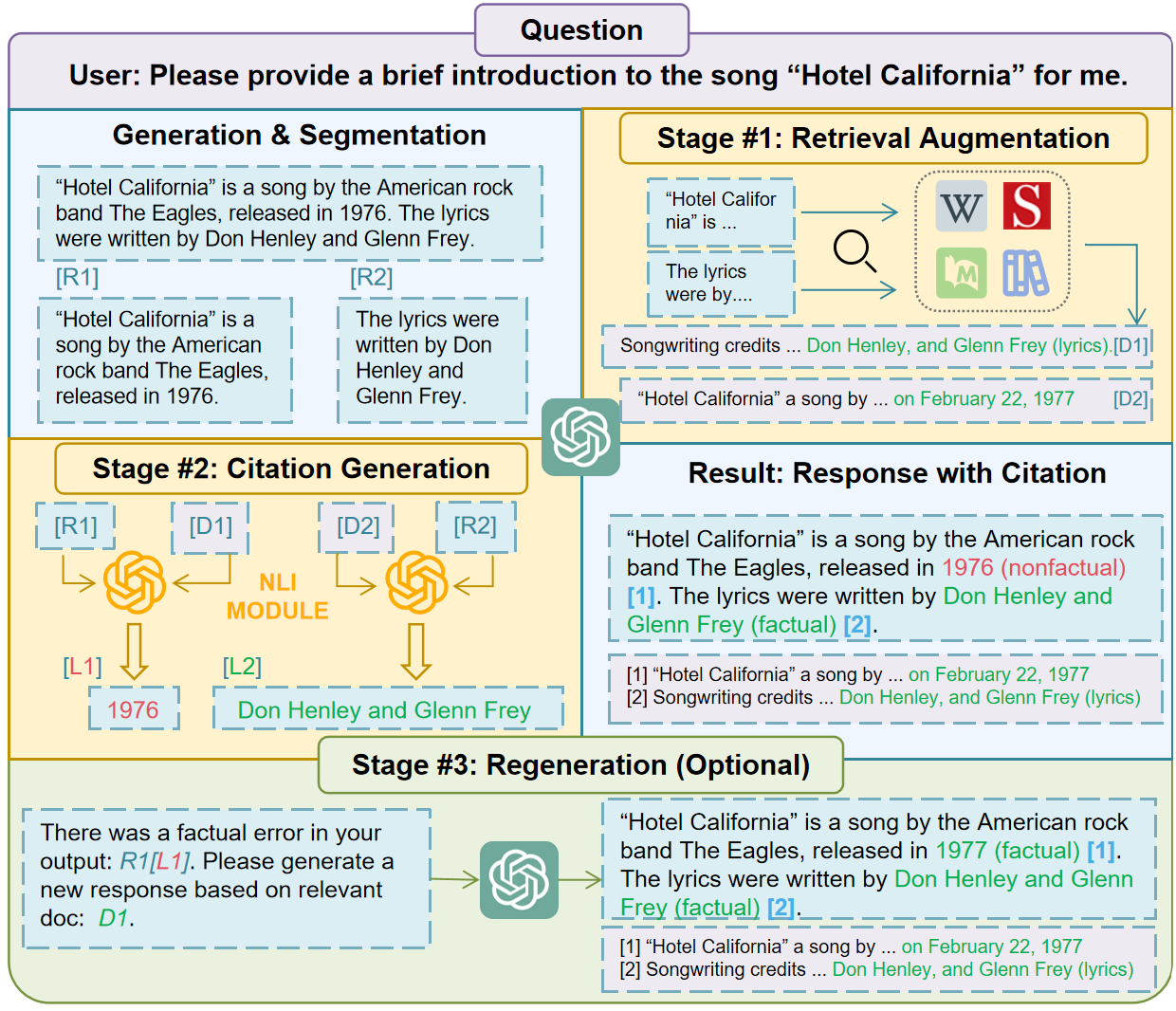
- 一种事后检索模块使用稠密检索模型(如 SimCSE-BERT)搜索相关文档,以支持生成内容。
- 一种基于自然语言蕴涵(NLI)的引用生成模块,验证大语言模型(LLM)输出中的陈述是否被检索到的文档所支持。
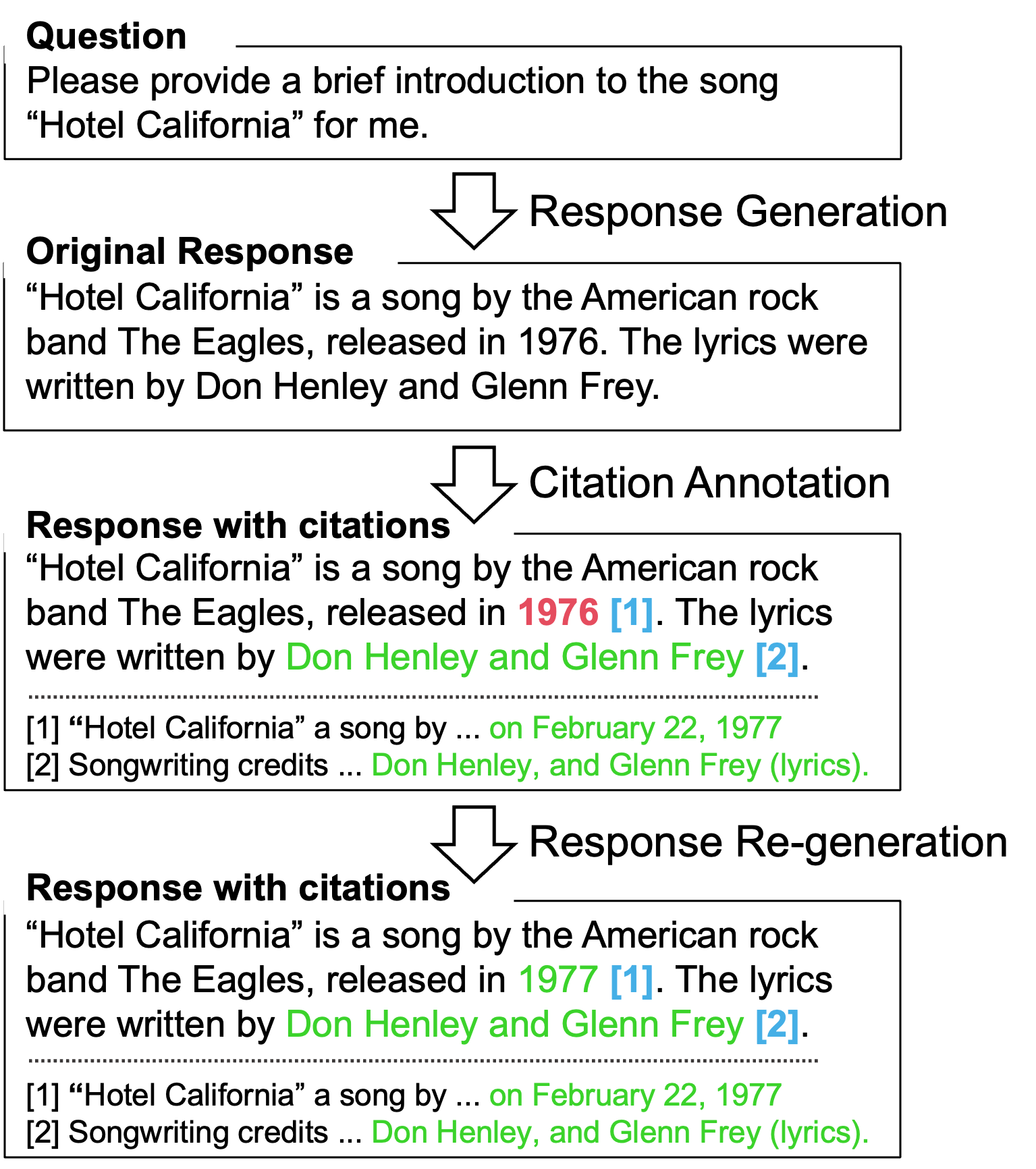
- 若检测到无支持的陈述,系统将提示大语言模型(LLM)根据引用反馈重新生成响应。
- 该框架作为插件运行,无需模型微调或架构修改。
- 系统使用前-k篇检索文档(k ≈ 5–6)以平衡效率与效果。
- 使用 GPT-4 和 GPT-3.5-Turbo-Instruct 等 NLI 模型,评估陈述与检索证据之间的蕴涵关系。
实验结果
研究问题
- RQ1一种无需重新训练的后处理引用生成框架,能否有效减少基于大语言模型(LLM)聊天机器人中的幻觉?
- RQ2检索增强的自然语言蕴涵(NLI)在识别大语言模型(LLM)生成响应中无支持陈述方面有多有效?
- RQ3为平衡性能与效率,最优的检索文档数量(k)是多少?
- RQ4不同大语言模型(LLM)作为 NLI 模型在引用验证中的表现如何?
- RQ5该框架是否可普遍应用于多种大语言模型(LLM)和基准测试?
主要发现
- CEG 框架在三个与幻觉相关的基准测试中达到最先进性能,其在幻觉检测与响应重生成方面均优于现有方法。
- 使用 SimCSE-BERT 作为检索器时,该框架在 WikiRetr 数据集上使用前10篇文档实现了 76.8% 的检索准确率。
- GPT-4 和 GPT-3.5-Turbo-Instruct 在引用验证任务中分别与人工标注者达成 96% 和 91% 的一致率。
- 最优的 k 值约为 5–6,因为更高的 k 值会导致注意力分散和相关性下降,从而降低性能。
- 引用生成模块在 WikiRetr-GPT3 数据集上达到 78.2% 的精确率,在 WikiRetr-GPT4 数据集上达到 75.7%,表明陈述与证据之间具有高质量对齐。
- 该框架在不同大语言模型(LLM)上表现出强鲁棒性,且无需微调或额外数据标注。
阅读本论文
在 Nubint 阅读器中打开原文,边读边就任意段落提问。
在 Nubint 中阅读本论文本解读由 AI 根据论文原文生成,引用前请核对原文。