
[论文解读] Class-Incremental Learning with Repetition
本文提出了类增量学习中的重复(CIR)场景,通过两种随机流生成器对数据流中类别的自然重复进行建模。提出了一种新型重放策略——频率感知重放(ER-FA),在未平衡的CIR流上优于现有方法,通过提升罕见类别的准确率而不牺牲常见类别的性能,表明重复可自然促进知识积累,即使没有显式重放也能实现。
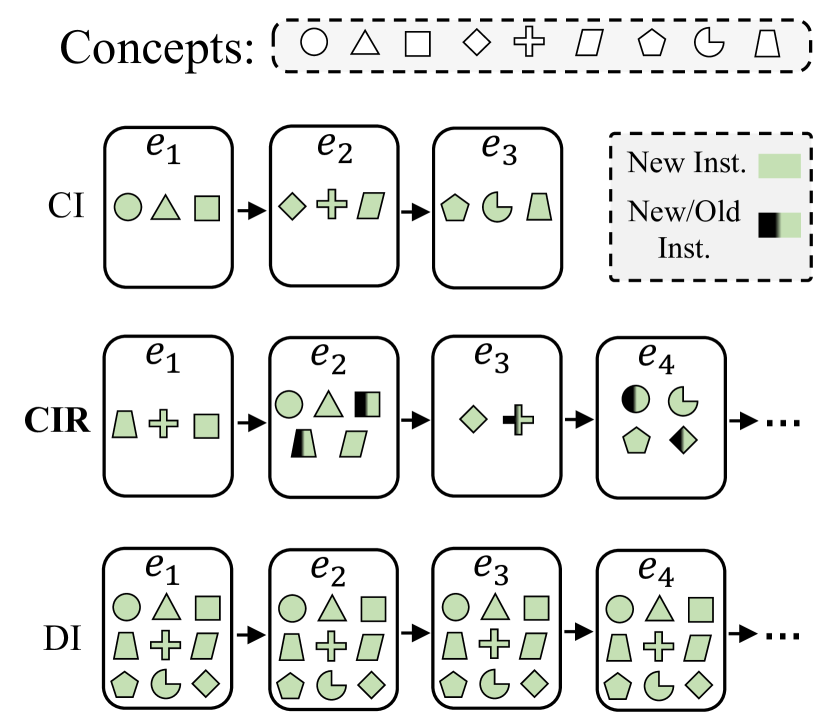
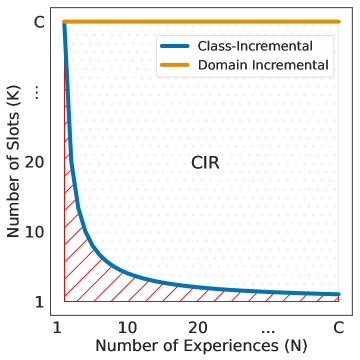
Real-world data streams naturally include the repetition of previous concepts. From a Continual Learning (CL) perspective, repetition is a property of the environment and, unlike replay, cannot be controlled by the agent. Nowadays, the Class-Incremental (CI) scenario represents the leading test-bed for assessing and comparing CL strategies. This scenario type is very easy to use, but it never allows revisiting previously seen classes, thus completely neglecting the role of repetition. We focus on the family of Class-Incremental with Repetition (CIR) scenario, where repetition is embedded in the definition of the stream. We propose two stochastic stream generators that produce a wide range of CIR streams starting from a single dataset and a few interpretable control parameters. We conduct the first comprehensive evaluation of repetition in CL by studying the behavior of existing CL strategies under different CIR streams. We then present a novel replay strategy that exploits repetition and counteracts the natural imbalance present in the stream. On both CIFAR100 and TinyImageNet, our strategy outperforms other replay approaches, which are not designed for environments with repetition.
研究动机与目标
- 为解决持续学习中缺乏真实数据流建模的问题,提出类增量学习中的重复(CIR)场景,其中重复是环境的自然、不可控属性。
- 设计两种易于使用、可参数化的流生成器,能从单一数据集生成多样化的CIR流,支持可复现且可解释的评估。
- 在CIR设置下对现有持续学习策略进行实证评估,并分析自然重复对知识积累与遗忘的影响。
- 提出一种新型重放策略——频率感知重放(ER-FA),专为某些类别重复频率较低的未平衡CIR流设计。
- 证明自然重复可减少对人工重放的依赖,且ER-FA在各类别频率分布下均能提供稳健、均衡的性能表现。
提出的方法
- 设计两种随机流生成器:一种控制类别重复频率,另一种管理首次出现与重复模式,均可通过可解释参数进行配置。
- 在Avalanche框架中实现生成器,支持任意图像分类数据集,可无缝集成至标准持续学习流水线。
- 所提出的ER-FA重放策略基于类别频率动态优先选择重放样本,对重复频率较低的类别赋予更高优先级。
- ER-FA使用记忆缓冲区,按类别频率对样本进行加权存储,确保低频类别在训练过程中得到更好保留。
- 在CIFAR-100与TinyImageNet上评估该方法,采用平衡与未平衡的重复分布,按类别与总体测量准确率。
- 采用中心化核对齐(CKA)与权重分析研究模型表示随时间的动态演化,深入揭示知识保留机制。
实验结果
研究问题
- RQ1数据流中的自然重复如何影响持续学习中的知识积累,特别是在缺乏显式重放的情况下?
- RQ2现有基于重放的持续学习策略在具有未平衡重复的CIR流上有多强的泛化能力?
- RQ3能否设计一种重放策略,专门利用CIR流的统计特性,尤其是类别频率不平衡?
- RQ4仅靠自然重复是否足以缓解灾难性遗忘,还是仍需人工重放?
- RQ5在CIR流中,模型表示如何随时间演化?与标准CI或DI场景相比有何差异?
主要发现
- 即使未使用任何持续学习策略,CIR流中仍能自然发生知识积累,如微调在先前见过的类别上实现非平凡的准确率。
- 尽管重放策略仍能提供性能优势,但在自然重复存在的条件下,其对防止灾难性遗忘并非必需。
- 基于LwF的蒸馏方法在中等重复率的CIR流中表现良好,优于部分重放基线方法。
- ER-FA在罕见类别上取得最高准确率(CIFAR-100上为37.6±2.9),同时在常见类别上保持强劲性能,优于所有其他重放变体。
- 在仅10%的类别以10%频率重复的未平衡流中,ER-FA相比标准重放提升平均准确率10.7个百分点,相比ER-ACE提升7.5个百分点。
- ER-FA降低了各类别间性能方差,相比基线重放策略提供更稳健、更一致的结果。
阅读本论文
在 Nubint 阅读器中打开原文,边读边就任意段落提问。
在 Nubint 中阅读本论文本解读由 AI 根据论文原文生成,引用前请核对原文。