
[论文解读] Classification of Classical Spin Liquids: Detailed Formalism and Suite of Examples
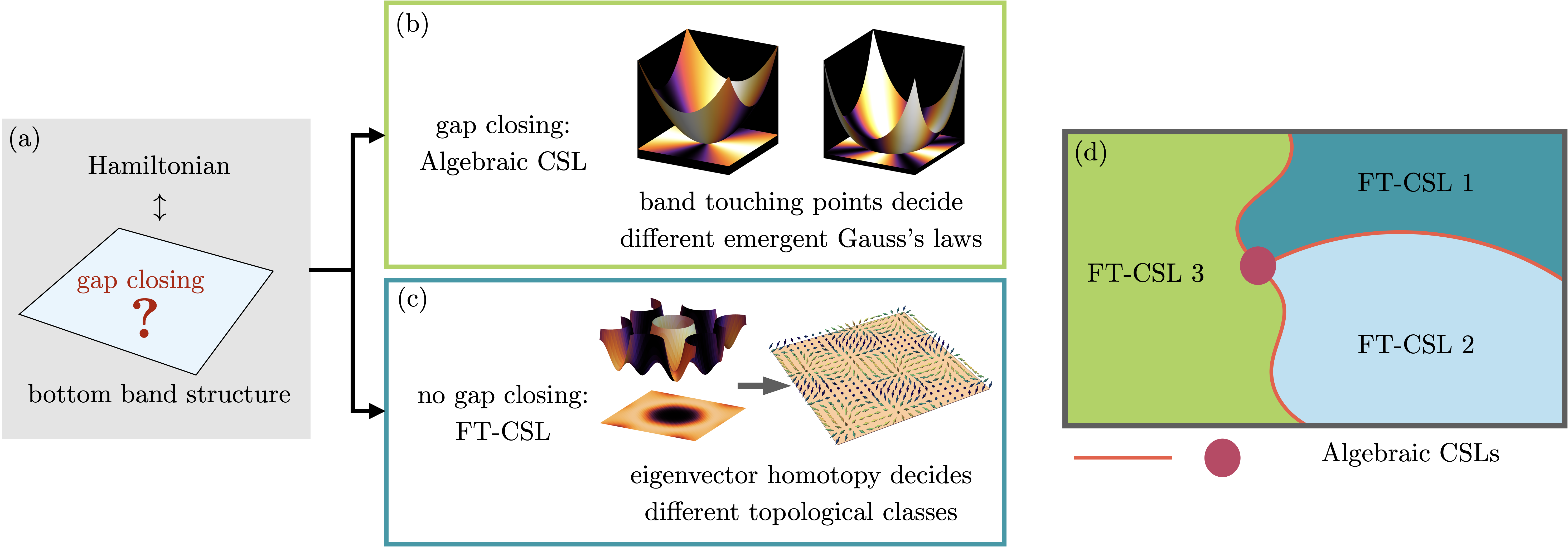
本文基于软自旋哈密顿量的谱特性,提出了一套全面的经典自旋液体(CSLs)分类体系。该体系将自旋液体区分为代数型CSLs——通过无能隙点及涌现的一般化高斯定律进行分类——与脆弱拓扑型CSLs——通过平坦能带的本征矢量同伦性质进行分类。该框架统一了已知的CSL模型,并预测了新的奇异相态,包括具有各向异性高斯定律、针状奇点及零温下脆弱拓扑相之间相变的相态。
The hallmark of highly frustrated systems is the presence of many states close in energy to the ground state. Fluctuations between these states can preclude the emergence of any form of order and lead to the appearance of spin liquids. Even on the classical level, spin liquids are not all alike: they may have algebraic or exponential correlation decay, and various forms of long wavelength description, including vector or tensor gauge theories. Here, we introduce a classification scheme, allowing us to fit the diversity of classical spin liquids (CSLs) into a general framework as well as predict and construct new kinds. CSLs with either algebraic or exponential correlation-decay can be classified via the properties of the bottom flat band(s) in their soft-spin Hamiltonians. The classification of the former is based on the algebraic structures of gapless points in the spectra, which relate directly to the emergent generalized Gauss's laws that control the low temperature physics. The second category of CSLs, meanwhile, are classified by the fragile topology of the gapped bottom band(s). Utilizing the classification scheme we construct new models realizing exotic CSLs, including one with anisotropic generalized Gauss's laws and charges with subdimensional mobility, one with a network of pinch-line singularities in its correlation functions, and a series of fragile topological CSLs connected by zero-temperature transitions.
研究动机与目标
- 开发一个系统化的经典自旋液体(CSLs)分类框架,以捕捉其多样的物理行为。
- 解决在几何阻挫自旋系统中观察到的多种CSLs缺乏统一理论框架的问题。
- 基于软自旋哈密顿量的谱结构对CSLs进行分类,区分代数型与脆弱拓扑型CSLs。
- 提供一种可预测的工具,用于构建具有特定涌现规范理论与拓扑性质的新型CSL模型。
- 将分类框架与平坦能带理论及实空间基态简并度相联系,从而实现对CSLs的解析与数值研究。
提出的方法
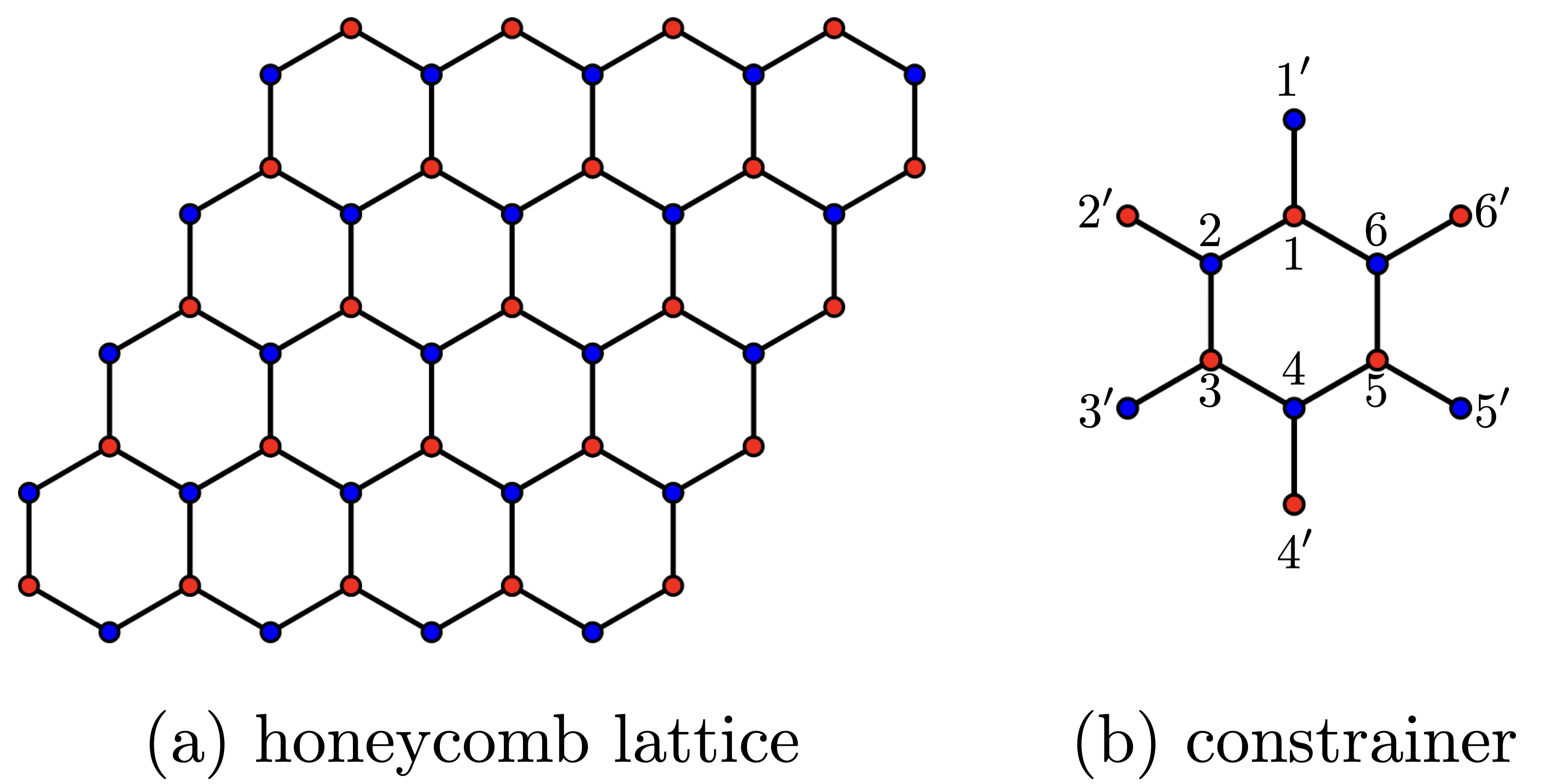
- 形式化约束哈密顿量方法,以建模具有广延基态简并度的经典自旋液体。
- 分析软自旋哈密顿量的谱,重点关注底部平坦能带及其与更高 dispersive 能带的耦合。
- 通过识别谱中能隙闭合点并提取这些点处本征矢量结构中的涌现一般化高斯定律,对代数型CSLs进行分类。
- 通过本征矢量同伦理论对脆弱拓扑型CSLs进行分类,利用平坦能带本征矢量的拓扑不变量。
- 将该形式化方法应用于已知模型(如kagome、pyrochlore、honeycomb-snowflake),并构建具有奇异性质的新模型。
- 使用自洽高斯近似(SCGA)研究CSLs的稳定性及其相变,同时承认其在处理硬自旋约束方面的局限性。
实验结果
研究问题
- RQ1如何基于其低能谱特性对经典自旋液体进行系统性分类?
- RQ2代数型CSLs中一般化高斯定律的涌现由什么决定?其与能隙闭合点结构有何关联?
- RQ3哪些拓扑不变量用于分类脆弱拓扑型CSLs?其与代数型CSLs中的不变量有何不同?
- RQ4该分类体系能否预测具有非平凡关联结构(如针状线或次维电荷)的新类型CSLs?
- RQ5在本征矢量同伦与谱拓扑的框架下,不同CSL相之间的零温相变如何表现?
主要发现
- 该分类体系成功地将已知的CSL模型(如kagome、pyrochlore与honeycomb-snowflake反铁磁体)基于其谱与拓扑特性统一组织为一个整体图景。
- 代数型CSLs由软自旋哈密顿量谱中无能隙点的代数结构分类,其直接决定了涌现一般化高斯定律的形式。
- 脆弱拓扑型CSLs由底部平坦能带本征矢量的同伦类分类,其不同的拓扑不变量可区分不同相态。
- 该框架预测了一类具有各向异性一般化高斯定律的新CSL,其电荷表现出次维移动性,从而扩展了自旋液体中已知规范理论的范围。
- 构建了一个自旋关联函数中具有针状奇点网络的模型,展示了CSLs中新型长波长关联结构的存在。
- 证明了脆弱拓扑型CSLs之间的零温相变发生于不同同伦类的边界,为经典系统中的拓扑相变提供了机制。
阅读本论文
在 Nubint 阅读器中打开原文,边读边就任意段落提问。
在 Nubint 中阅读本论文本解读由 AI 根据论文原文生成,引用前请核对原文。