
[论文解读] CLIP-S$^4$: Language-Guided Self-Supervised Semantic Segmentation
CLIP-S⁴ 提出了一种自监督语义分割框架,利用 CLIP 的视觉-语言嵌入来学习高质量、具备语言泛化能力的像素表征,且无需任何人工标注。通过强制模型嵌入与 CLIP 的联合视觉-文本嵌入保持一致,并在已知和未知类别上保持语义一致性,该方法在无监督和语言驱动的语义分割任务中实现了最先进性能,尤其在识别未知类别方面表现优异。
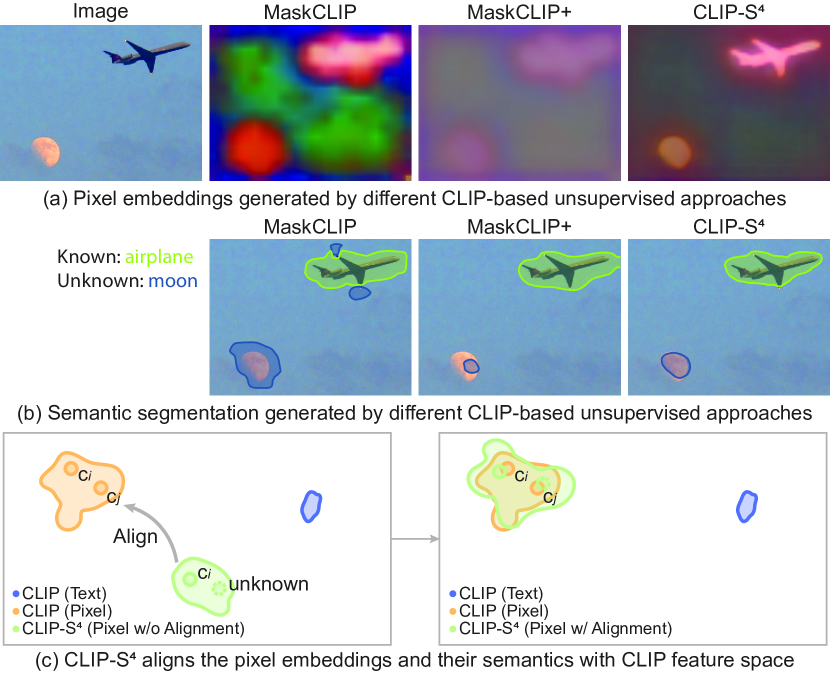
Existing semantic segmentation approaches are often limited by costly pixel-wise annotations and predefined classes. In this work, we present CLIP-S$^4$ that leverages self-supervised pixel representation learning and vision-language models to enable various semantic segmentation tasks (e.g., unsupervised, transfer learning, language-driven segmentation) without any human annotations and unknown class information. We first learn pixel embeddings with pixel-segment contrastive learning from different augmented views of images. To further improve the pixel embeddings and enable language-driven semantic segmentation, we design two types of consistency guided by vision-language models: 1) embedding consistency, aligning our pixel embeddings to the joint feature space of a pre-trained vision-language model, CLIP; and 2) semantic consistency, forcing our model to make the same predictions as CLIP over a set of carefully designed target classes with both known and unknown prototypes. Thus, CLIP-S$^4$ enables a new task of class-free semantic segmentation where no unknown class information is needed during training. As a result, our approach shows consistent and substantial performance improvement over four popular benchmarks compared with the state-of-the-art unsupervised and language-driven semantic segmentation methods. More importantly, our method outperforms these methods on unknown class recognition by a large margin.
研究动机与目标
- 解决语义分割中像素级人工标注的高昂成本与局限性。
- 克服现有方法在缺乏先验类别信息时无法识别未知类别的缺陷。
- 实现在训练时无需标注或预定义类别列表的语言驱动语义分割。
- 开发一种无需类别名称的无类别语义分割设定,训练过程中不依赖任何类别名称。
- 通过自监督与一致性正则化,提升像素嵌入质量,并增强其与 CLIP 联合视觉-文本嵌入空间的一致性。
提出的方法
- 通过在增强图像视图上进行像素-分割对比学习,学习初始像素嵌入,以聚合视觉上相似的像素。
- 通过最小化模型生成的像素嵌入与 CLIP 的联合图像-文本嵌入之间的距离,强制实现嵌入一致性。
- 通过将模型预测与 CLIP 在一组目标类别(包括已知和未知原型)上的预测对齐,强制实现语义一致性。
- 在训练过程中,利用 CLIP 的最高激活片段生成已知和未知类别的类别原型。
- 通过联合使用对比损失、嵌入一致性损失与语义一致性损失,端到端训练分割头。
- 通过仅依赖 CLIP 的零样本能力,不使用任何类别名称或标注,实现无类别语义分割。
实验结果
研究问题
- RQ1能否通过视觉-语言模型的引导,提升自监督像素表征学习,从而在无需人工标注的情况下改善语义分割性能?
- RQ2当训练过程中未提供任何类别信息时,模型在语义分割中对未知类别的泛化能力能达到何种程度?
- RQ3强制模型嵌入与 CLIP 联合嵌入空间保持一致,对分割性能和零样本泛化能力有何影响?
- RQ4在语义一致性损失中同时使用已知和未知类别原型,对模型鲁棒性与泛化能力有何影响?
- RQ5能否通过统一框架在无监督、迁移学习和语言驱动分割任务中均实现最先进性能,且完全无需监督?
主要发现
- 在 Pascal VOC 上,CLIP-S⁴ 在无监督语义分割任务中实现了 72.2% 的平均 IoU,较之前无监督方法在区域相似性上提升超过 1.9%。
- 在语言驱动分割任务中,CLIP-S⁴ 在 Pascal Context 上达到 33.6% 的 mIoU,较 MaskCLIP+ 提升 2.9% 的 mIoU,并显著改善了未知类别的识别能力。
- 该方法与 CLIP 嵌入保持强一致性,其片段嵌入与 CLIP 嵌入之间的平均余弦相似度达到 0.66,表明跨模态一致性良好。
- 消融实验表明,结合嵌入一致性损失与语义一致性损失可获得最佳性能(53.7% pAcc,33.6% mIoU),优于单一损失。
- 模型性能对未知类别原型数量不敏感,mIoU 在 16 至 256 个原型之间仅波动 0.6%。
- 使用 top-32 至 top-64 片段生成原型可获得稳定且高质量的嵌入,其与参考原型的余弦相似度超过 0.99。

阅读本论文
在 Nubint 阅读器中打开原文,边读边就任意段落提问。
在 Nubint 中阅读本论文本解读由 AI 根据论文原文生成,引用前请核对原文。