
[论文解读] Close to Human-Level Agreement: Tracing Journeys of Violent Speech in Incel Posts with GPT-4-Enhanced Annotations
本研究利用GPT-4增强的标注方法,对690万条incels.is帖子中的暴力言论进行分类,揭示了随着时间推移,整体暴力内容呈现统计学上显著的增加,尤其是非指向性暴力和用户层面的升级。研究显示,GPT-4与人工标注者达成接近人类水平的一致性(kappa = 0.62),实现了对极端在线社群中演变暴力言论模式的可扩展、高精度检测。
This study investigates the prevalence of violent language on incels.is. It evaluates GPT models (GPT-3.5 and GPT-4) for content analysis in social sciences, focusing on the impact of varying prompts and batch sizes on coding quality for the detection of violent speech. We scraped over 6.9M posts from incels.is and categorized a random sample into non-violent, explicitly violent, and implicitly violent content. Two human coders annotated 3,028 posts, which we used to tune and evaluate GPT-3.5 and GPT-4 models across different prompts and batch sizes regarding coding reliability. The best-performing GPT-4 model annotated an additional 30,000 posts for further analysis. Our findings indicate an overall increase in violent speech overtime on incels.is, both at the community and individual level, particularly among more engaged users. While directed violent language decreases, non-directed violent language increases, and self-harm content shows a decline, especially after 2.5 years of user activity. We find substantial agreement between both human coders (K = .65), while the best GPT-4 model yields good agreement with both human coders (K = 0.54 for Human A and K = 0.62 for Human B). Weighted and macro F1 scores further support this alignment. Overall, this research provides practical means for accurately identifying violent language at a large scale that can aid content moderation and facilitate next-step research into the causal mechanism and potential mitigations of violent expression and radicalization in communities like incels.is.
研究动机与目标
- 调查incels.is在线社区中暴力言论的普遍性及其随时间的演变。
- 评估GPT-3.5和GPT-4在社会科学研究语境下对暴力内容分类的性能,重点关注提示工程和批量大小的影响。
- 建立一个可靠的、经人工标注的基线,用于对三类暴力言论进行分类:非指向性、明确指向性和隐含指向性暴力。
- 追踪个体用户随时间的暴力内容轨迹,识别与用户参与时长相关的模式。
- 提供一种可扩展、高精度的方法,利用大语言模型大规模检测极端在线论坛中的暴力言论,支持内容审核与未来研究。
提出的方法
- 从incels.is爬取690万条帖子,并随机抽取3,028条供两名人工标注者使用三类暴力分类体系(非指向性、明确指向性、隐含指向性暴力)进行人工标注。
- 通过多种提示变体和批量大小,训练并评估GPT-3.5和GPT-4模型,以优化分类的可靠性与成本效率。
- 使用Cohen’s Kappa、加权F1和宏平均F1分数,衡量人工标注者之间以及GPT-4与人工标注者之间的一致性。
- 采用输入批量处理(每批最多50条帖子),将GPT-4的推理成本从每条0.0055美元降低至0.0005美元,10万次标注总成本约为50美元。
- 追踪论坛整体与个体用户层面的暴力内容趋势,分析不同用户参与时长下各类暴力形式的变化。
- 向GPT-4提供基于推理的分类方法,以提升可解释性,并在模糊案例中支持人工标注者。
实验结果
研究问题
- RQ1incels.is论坛整体及个体用户中,暴力言论的整体普遍性及其随时间的变化趋势如何?
- RQ2GPT-4在分类incel论坛内容中不同类型暴力言论时,与人工标注者相比表现如何?
- RQ3提示工程和批量大小对社会科学研究中基于大语言模型的内容分类准确性与成本效率有何影响?
- RQ4不同形式的暴力言论——非指向性、明确指向性和隐含指向性——如何随时间演变,特别是与用户参与时长的关系如何?
- RQ5GPT-4能否作为人类标注在高流量、敏感在线社区中检测暴力言论的可靠、可扩展的替代方案?
主要发现
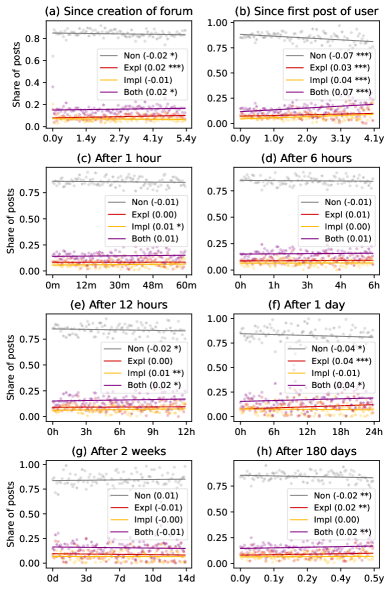
- 在分析的33,028条评论中,15.7%表现出暴力言论,整体暴力内容随时间呈现统计学上显著的增加。
- 表现最佳的GPT-4模型与人工标注者达成实质性一致(与Human B的kappa = 0.62,与Human A的kappa = 0.54),表明其接近人类水平的可靠性。
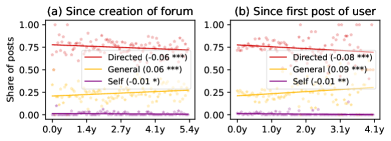
- 非指向性暴力语言随时间增加,而指向性暴力语言减少,表明社区内部敌意性质发生转变。
- 自残相关内容显著下降,尤其在用户活动超过2.5年后,表明可能存在麻木化或表达模式的转变。
- 用户层面分析显示,参与时长越长,暴力内容的普遍性越高,表明可能存在一种激进化轨迹。
- 通过优化批量处理,GPT-4的每条标注成本降至约0.0005美元,10万次标注的总成本从预估的180美元降至50美元。
阅读本论文
在 Nubint 阅读器中打开原文,边读边就任意段落提问。
在 Nubint 中阅读本论文本解读由 AI 根据论文原文生成,引用前请核对原文。