
[论文解读] CLUSTSEG: Clustering for Universal Segmentation
ClustSeg 提出了一种基于 Transformer 的通用分割框架,将分割重新表述为迭代聚类,使用任务感知的、非参数、循环跨注意力,在单一架构中处理超像素、语义、实例和全景分割。
We present CLUSTSEG, a general, transformer-based framework that tackles different image segmentation tasks (i.e., superpixel, semantic, instance, and panoptic) through a unified neural clustering scheme. Regarding queries as cluster centers, CLUSTSEG is innovative in two aspects:1) cluster centers are initialized in heterogeneous ways so as to pointedly address task-specific demands (e.g., instance- or category-level distinctiveness), yet without modifying the architecture; and 2) pixel-cluster assignment, formalized in a cross-attention fashion, is alternated with cluster center update, yet without learning additional parameters. These innovations closely link CLUSTSEG to EM clustering and make it a transparent and powerful framework that yields superior results across the above segmentation tasks.
研究动机与目标
- 推动一个能够在没有任务特定架构的情况下处理多种分割范式的通用分割框架。
- 将分割重新表述为聚类问题,以统一不同的分割任务。
- 引入任务感知的初始化(Dreamy-Start),按任务为聚类中心作种子。
- 开发一个非参数、循环跨注意力机制,以执行迭代式 EM 风格聚类。
- 在核心分割基准上展示出色的性能。
提出的方法
- 将查询视为聚类中心,并用任务感知语义初始化它们:对语义/物件类别设为中心种子;对实例/物体设为图像派生的种子;对超像素设为基于网格的种子。
- 采用一个受 EM 启发的迭代方案,在不增加可学习参数的情况下,通过跨注意力更新聚类成员(E 步)和中心(M 步)。
- 实现循环跨注意力以高效执行多次 EM 风格迭代(复杂度 O(TKHW D) 相较于 naive 跨注意力的 O(HW D))。
- 对语义初始化使用记忆库辅助的 Dreamy-Start 以编码全局类别统计;对实例分割使用基于图像上下文自适应的种子;对超像素分割使用基于网格的种子。
- 利用分层的 RCross_Attention 解码器在不同分辨率和任务之间细化聚类。
实验结果
研究问题
- RQ1一个基于 Transformer 的单一框架是否可以通过将分割形式化为聚类来统一超像素、语义、实例和全景分割?
- RQ2在不改变架构的前提下,应该如何初始化聚类中心以尊重任务特定语义(语义/实例/超像素)?
- RQ3一种 EM 启发式、非参数、循环跨注意力策略是否能够高效收敛到跨任务的高质量分割?
- RQ4Dreamy-Start 初始化对基准测试上的分割性能有何影响?
- RQ5相较于任务特定和其他通用模型,ClustSeg 在标准数据集上的表现如何?
主要发现
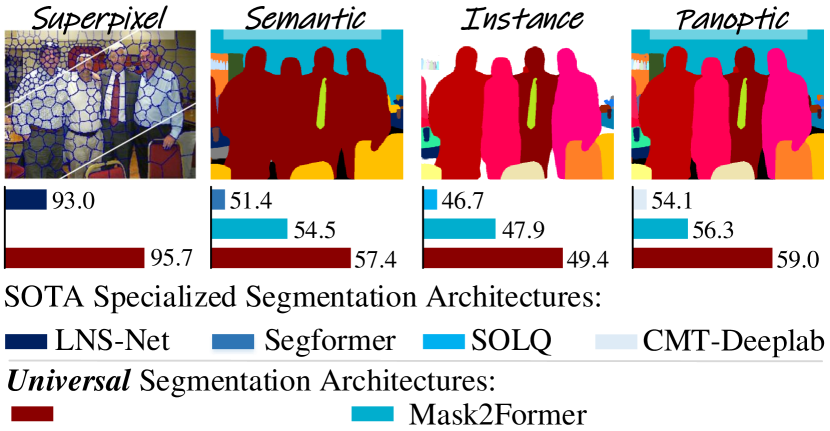
- ClustSeg 在四个核心任务上取得高水平的分割性能,包括 COCO 全景分割的 PQ 为 59.0,COCO 实例分割的 AP 为 49.1,ADE20K 语义分割的 mIoU 为 57.4,以及 BSDS500 超像素分割的 ASA/CO 领先。
- 引入任务感知查询初始化(Dreamy-Start),在不进行架构改动的情况下为不同任务提供了有信息量的聚类种子。
- 提出一个非参数的循环跨注意力模块,仿效 EM 聚类的迭代 E- 和 M-步骤,在不增加可学习参数的前提下提升聚类质量。
- 证明在一个统一的 Transformer 框架中的基于聚类的分割可以在关键基准上超越专用模型和此前的通用模型。
- 显示 ClustSeg 设计在 Panoptic COCO(PQ 与 AP 指标)以及在现有数据集上的语义/实例/全景质量指标均取得良好结果。

阅读本论文
在 Nubint 阅读器中打开原文,边读边就任意段落提问。
在 Nubint 中阅读本论文本解读由 AI 根据论文原文生成,引用前请核对原文。