
[论文解读] Cohere: Managing Differential Privacy in Large Scale Systems
Cohere 是一个统一的隐私管理框架,可在异构的大规模应用中实现高效、集中的差分隐私(DP)预算分配。通过引入细粒度隐私分析、属性分区机制以及效用优化的规划器,Cohere 在相同隐私预算约束下,相比最先进方法,实现了6.4–28倍的效用提升。
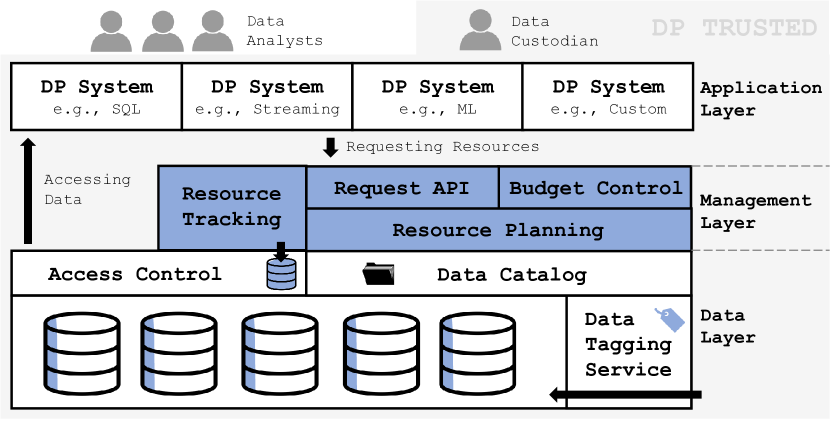
The need for a privacy management layer in today's systems started to manifest with the emergence of new systems for privacy-preserving analytics and privacy compliance. As a result, many independent efforts have emerged that try to provide system support for privacy. Recently, the scope of privacy solutions used in systems has expanded to encompass more complex techniques such as Differential Privacy (DP). The use of these solutions in large-scale systems imposes new challenges and requirements. Careful planning and coordination are necessary to ensure that privacy guarantees are maintained across a wide range of heterogeneous applications and data systems. This requires new solutions for managing and allocating scarce and non-replenishable privacy resources. In this paper, we introduce Cohere, a new system that simplifies the use of DP in large-scale systems. Cohere implements a unified interface that allows heterogeneous applications to operate on a unified view of users' data. In this work, we further address two pressing system challenges that arise in the context of real-world deployments: ensuring the continuity of privacy-based applications (i.e., preventing privacy budget depletion) and effectively allocating scarce shared privacy resources (i.e., budget) under complex preferences. Our experiments show that Cohere achieves a 6.4--28x improvement in utility compared to the state-of-the-art across a range of complex workloads.
研究动机与目标
- 解决大规模异构系统中缺乏集中化、统一的差分隐私(DP)预算管理问题。
- 确保长期运行的隐私敏感工作负载中隐私预算的连续性,防止过早耗尽。
- 在复杂的应用偏好与优先级约束下,实现对稀缺且不可 replenish 的DP资源的有效分配。
- 在单一一致的隐私接口中支持多样工作负载,包括机器学习流水线与分析任务。
- 通过优化隐私会计机制,提升系统整体效用,实现更高效的预算利用。
提出的方法
- Cohere 提供统一接口,抽象异构应用中的用户数据,实现对隐私保证的全局视图。
- 引入属性分区(PAs)以建模群体级隐私预算,支持按数据组进行细粒度分配。
- 采用新颖的、优化的整数线性规划(ILP)公式进行隐私预算分配,在RDP组合约束下最大化效用。
- 引入采样感知的隐私分析,降低预算会计中的过度保守性。
- 规划器同时支持精确ILP求解与启发式优化,兼顾可扩展性,性能针对离线预算规划进行调优。
- 使用用户轮换机制,确保跨应用查询语义的一致性,并减少偏差。
实验结果
研究问题
- RQ1如何在大规模系统中,对多样化且独立的应用,实现差分隐私预算的集中管理与分配?
- RQ2为确保长期运行工作负载的连续性并防止隐私预算耗尽,系统层面需要哪些抽象机制?
- RQ3如何通过细粒度隐私会计提升效用,同时不损害端到端的隐私保证?
- RQ4在隐私预算规划中,分配精度、性能与可扩展性之间存在哪些权衡?
- RQ5采样与属性分区机制的集成如何影响整体系统效用与预算效率?
主要发现
- Cohere 在多样化复杂工作负载中,相比最先进方法,效用提升达6.4–28倍,展现出显著的效率优势。
- 细粒度隐私分析与采样感知会计的集成,对效用的提升影响大于分配算法的选择。
- 基于ILP的规划器平均在48分钟内完成所有工作负载实例的求解,峰值内存使用量为1.3 GB,证实其在真实场景部署的可行性。
- 基于启发式的规划将模拟时间缩短至3.5分钟(无PAs)至最多22分钟(有PAs),表明其对复杂工作负载具备实际可扩展性。
- 使用属性分区机制使内存使用量增加至约550MB,但可实现更精确、更公平的数据组间预算分配。
- 系统规划器不在关键路径上,因此可合理利用充足计算资源来优化稀缺的隐私预算。

阅读本论文
在 Nubint 阅读器中打开原文,边读边就任意段落提问。
在 Nubint 中阅读本论文本解读由 AI 根据论文原文生成,引用前请核对原文。