
[论文解读] CoLoRA: Continuous low-rank adaptation for reduced implicit neural modeling of parameterized partial differential equations
CoLoRA 提出了一种连续低秩微调框架,用于参数化 PDE 的降维建模,通过在时间上连续适应低秩权重,实现了在新物理参数和初始条件下对解场的快速、高精度预测。与最先进的方法(如 F-FNO 和 CROM)相比,CoLoRA 在数据稀缺场景下表现出更优的精度和参数效率——误差降低一个数量级,参数更少。
This work introduces reduced models based on Continuous Low Rank Adaptation (CoLoRA) that pre-train neural networks for a given partial differential equation and then continuously adapt low-rank weights in time to rapidly predict the evolution of solution fields at new physics parameters and new initial conditions. The adaptation can be either purely data-driven or via an equation-driven variational approach that provides Galerkin-optimal approximations. Because CoLoRA approximates solution fields locally in time, the rank of the weights can be kept small, which means that only few training trajectories are required offline so that CoLoRA is well suited for data-scarce regimes. Predictions with CoLoRA are orders of magnitude faster than with classical methods and their accuracy and parameter efficiency is higher compared to other neural network approaches.
研究动机与目标
- 解决在大量物理参数和初始条件下高效模拟参数化 PDE 的挑战,尤其是在数据稀缺的场景下。
- 通过引入非线性、低秩参数化,突破线性降维模型中的柯尔莫哥洛夫障碍,以捕捉主导传输的动力学行为。
- 通过预先训练神经网络并连续时间适应低秩权重,而非从头开始微调,实现在线推理的快速化。
- 将物理信息变分原理整合到适应过程中,以确保伽辽金最优性并保持物理量的守恒。
- 在极少数训练轨迹下实现高精度与高速度,适用于昂贵的高保真模拟。
提出的方法
- 在给定 PDE 的少量解轨迹上预训练神经网络,学习解流形的一般表征。
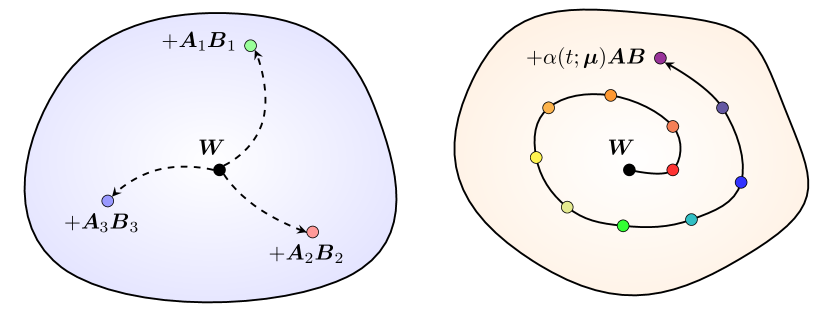
- 通过可学习的缩放函数 α(t, μ) 在时间上连续地对低秩矩阵 A 和 B 进行权重的低秩自适应,实现动态、时间依赖的参数更新。
- 在神经网络输入中将时间与空间坐标解耦,将时间视为连续的适应变量,以反映 PDE 解的时序演化。
- 采用变分、方程驱动的方法(CoLoRA-EQ),通过在在线推理期间求解 PDE 的弱形式,强制实现伽辽金最优性。
- 将预训练网络与时间自适应的低秩组件结合,实现在不重新训练的情况下,对新参数 μ 和初始条件实现快速、高精度的预测。
- 利用平滑、低维时间演化所蕴含的归纳偏置,保持适应组件的秩较小,从而减少离线和在线参数数量。
实验结果
研究问题
- RQ1时间上的连续低秩自适应是否能够在极少量训练数据下,实现对新物理参数和初始条件的 PDE 解场的准确且高效预测?
- RQ2CoLoRA 在精度、参数效率和推理速度方面是否优于现有的数据驱动和物理信息代理模型,尤其是在低数据场景下?
- RQ3将物理方程整合到在线自适应阶段(CoLoRA-EQ)是否能提升解的质量,例如实现质量守恒或确保因果性?
- RQ4CoLoRA 在像伯杰方程和维拉斯夫方程这类主导传输的 PDE 中,能在多大程度上规避柯尔莫哥洛夫障碍?
- RQ5与 F-FNO 等算子学习方法和 CROM 等非线性模型降维技术相比,CoLoRA 在误差、参数数量和数据效率方面表现如何?
主要发现
- CoLoRA 在基准 PDE(如一维伯杰方程、二维波动方程、维拉斯夫方程)上实现了 1.1×10⁻³ 到 9.87×10⁻⁴ 的相对误差,仅需约 10 条训练轨迹,优于 F-FNO 和 CROM。
- CoLoRA-D(数据驱动)的误差比 F-FNO 低一个数量级,同时参数量减少 10 倍(例如,在维拉斯夫方程上为 5,451 对比 F-FNO 的 >10⁶)。
- CoLoRA-EQ(方程驱动)在维拉斯夫问题中将质量守恒至机器精度,而 CoLoRA-D 和 F-FNO 无法保持这一物理量。
- 与最先进的方法(如 DINo 和 CROM)相比,CoLoRA 将参数量减少一个数量级,同时在二维波动方程和一维伯杰方程上实现了更低的误差。
- CoLoRA 的预测速度比经典数值求解器快多个数量级,且在低数据场景下比线性插值更精确。
- 即使物理参数远离训练参数,CoLoRA 仍能保持高精度,展现出强大的泛化能力和鲁棒性。

阅读本论文
在 Nubint 阅读器中打开原文,边读边就任意段落提问。
在 Nubint 中阅读本论文本解读由 AI 根据论文原文生成,引用前请核对原文。