
[论文解读] Comparing the willingness to share for human-generated vs. AI-generated fake news
这项预先注册的在线实验包含988名参与者,比较了人们对由GPT-4生成和人工撰写的关于COVID-19的虚假新闻的分享行为。尽管认为AI生成的虚假新闻准确性较低,但参与者在分享意愿上并无显著差异,凸显了其病毒式传播的严重风险。政治倾向和认知反思测试得分等社会经济因素进一步预测了人们对AI生成虚假信息的易感性。
Generative artificial intelligence (AI) presents large risks for society when it is used to create fake news. A crucial factor for fake news to go viral on social media is that users share such content. Here, we aim to shed light on the sharing behavior of users across human-generated vs. AI-generated fake news. Specifically, we study: (1) What is the perceived veracity of human-generated fake news vs. AI-generated fake news? (2) What is the user's willingness to share human-generated fake news vs. AI-generated fake news on social media? (3) What socio-economic characteristics let users fall for AI-generated fake news? To this end, we conducted a pre-registered, online experiment with $N=$ 988 subjects and 20 fake news from the COVID-19 pandemic generated by GPT-4 vs. humans. Our findings show that AI-generated fake news is perceived as less accurate than human-generated fake news, but both tend to be shared equally. Further, several socio-economic factors explain who falls for AI-generated fake news.
研究动机与目标
- 调查用户对人工生成与AI生成虚假新闻真实性的感知。
- 检验用户在分享人工生成与AI生成虚假新闻方面的意愿是否存在差异。
- 识别预测用户对AI生成虚假新闻易感性的社会经济特征。
- 为制定基于证据的策略以减轻社交媒体中AI生成虚假信息的风险提供依据。
提出的方法
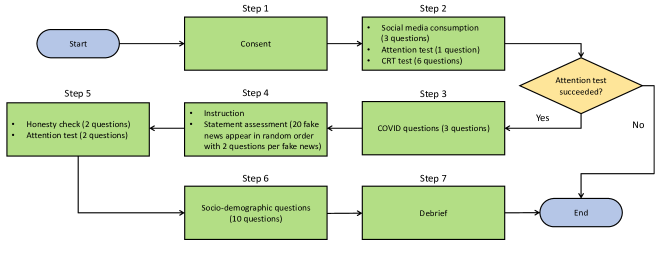
- 对来自不同背景的988名参与者开展预先注册的在线实验。
- 向参与者展示20则虚假新闻条目——10则为人工撰写,10则为GPT-4生成——内容涉及COVID-19主题。
- 使用7点量表测量感知真实性,使用7点李克特量表测量分享意愿。
- 收集人口统计与社会经济数据,包括年龄、政治倾向和认知反思测试得分。
- 使用多元回归模型分析个体特征对用户易感AI生成虚假新闻的影响。
- 控制混杂变量,并通过测量分享意愿而非实际分享行为来确保伦理标准。
实验结果
研究问题
- RQ1人工生成的虚假新闻与AI生成的虚假新闻的感知真实性如何?
- RQ2人工生成的虚假新闻与AI生成的虚假新闻的分享意愿如何?
- RQ3哪些社会经济特征能够解释为何部分用户会受AI生成虚假新闻影响?
- RQ4在AI生成虚假信息的情境下,感知真实性和分享行为之间有何关联?
主要发现
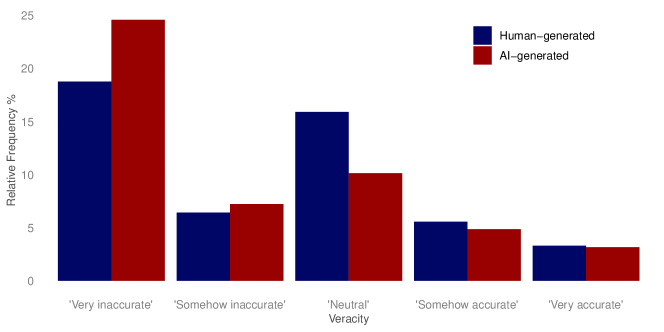
- AI生成的虚假新闻被感知为显著不如人工生成的虚假新闻准确,其平均感知真实性得分为3.8,而人工生成内容的得分为4.5。
- 尽管感知准确性较低,AI生成与人工生成虚假新闻在分享意愿上并无统计学上的显著差异。
- 自认为保守的参与者更可能受AI生成虚假新闻影响,表明政治倾向是关键预测因子。
- 认知反思测试得分较低与对AI生成虚假新闻更高的易感性相关,表明批判性思维能力较弱会增加脆弱性。
- 感知真实性和分享意愿之间的相关性较弱,表明对准确性的信念并不能强有力地预测分享行为。
- 年龄和教育水平也与易感性存在显著但复杂的关联,年轻用户以及教育水平较低者更易受影响。
阅读本论文
在 Nubint 阅读器中打开原文,边读边就任意段落提问。
在 Nubint 中阅读本论文本解读由 AI 根据论文原文生成,引用前请核对原文。