
[论文解读] Complex Mixer for MedMNIST Classification Decathlon
该论文提出了一种复杂混合器(C-Mixer),通过激励学习和基于随机掩码的自监督预训练,解决MedMNIST(v2)中的信息丢失和标签不确定性问题,通过利用复值特征空间和鲁棒表示学习,在监督学习、弱监督学习和图像增强任务中均实现了最先进性能。
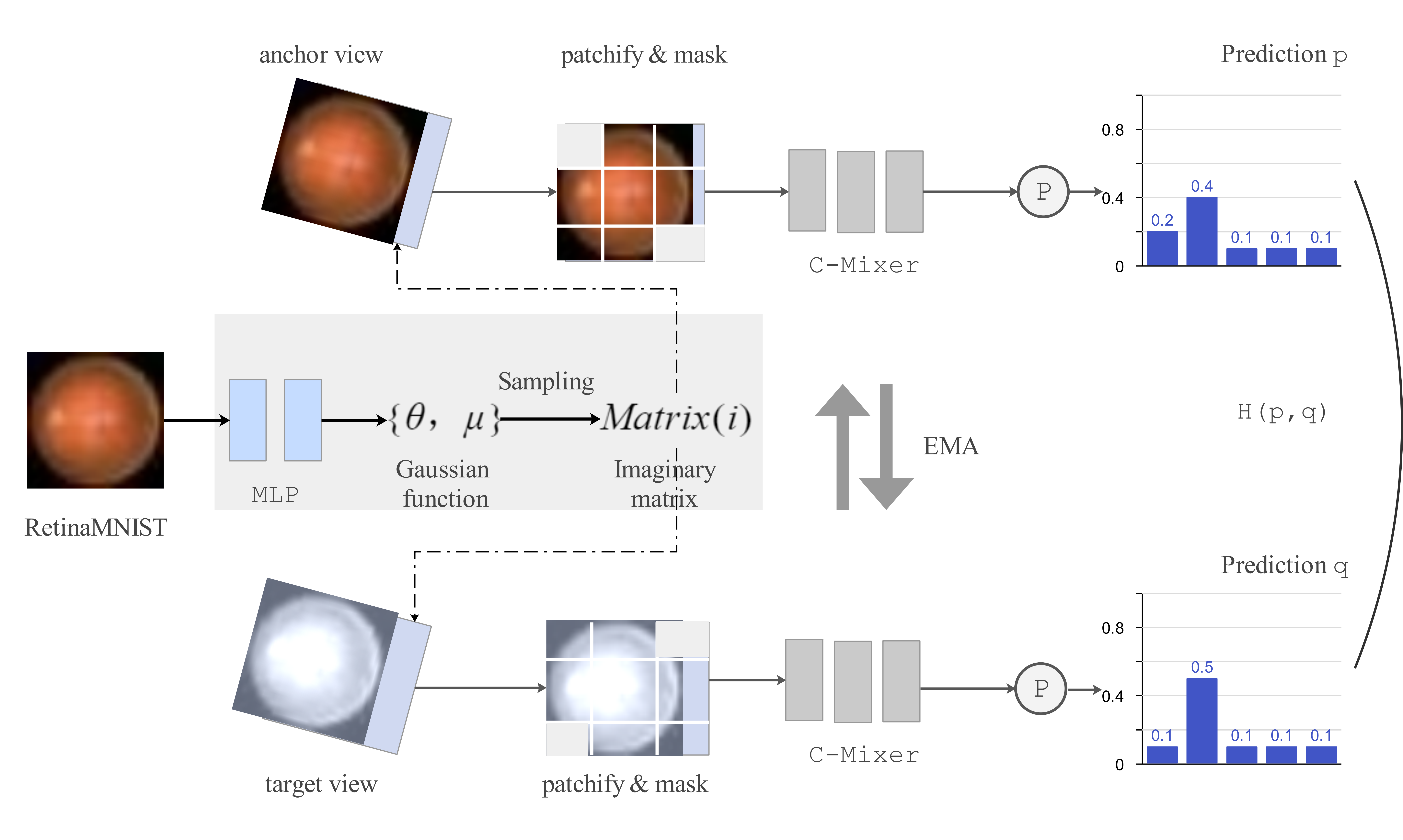
With the development of the medical image field, researchers seek to develop a class of datasets to block the need for medical knowledge, such as ext{MedMNIST} (v2). MedMNIST (v2) includes a large number of small-sized (28 $ imes$ 28 or 28 $ imes$ 28 $ imes$ 28) medical samples and the corresponding expert annotations (class label). The existing baseline model (Google AutoML Vision, ResNet-50+3D) can reach an average accuracy of over 70\% on MedMNIST (v2) datasets, which is comparable to the performance of expert decision-making. Nevertheless, we note that there are two insurmountable obstacles to modeling on MedMNIST (v2): 1) the raw images are cropped to low scales may cause effective recognition information to be dropped and the classifier to have difficulty in tracing accurate decision boundaries; 2) the labelers' subjective insight may cause many uncertainties in the label space. To address these issues, we develop a Complex Mixer (C-Mixer) with a pre-training framework to alleviate the problem of insufficient information and uncertainty in the label space by introducing an incentive imaginary matrix and a self-supervised scheme with random masking. Our method (incentive learning and self-supervised learning with masking) shows surprising potential on both the standard MedMNIST (v2) dataset, the customized weakly supervised datasets, and other image enhancement tasks.
研究动机与目标
- 解决MedMNIST(v2)中因医学图像极端下采样(从224×224下采样至28×28)导致的信息丢失问题,该问题会模糊对诊断至关重要的病灶细节。
- 缓解MedMNIST(v2)中因主观专家标注导致的标签不确定性问题,该问题会阻碍分类器的泛化能力与性能表现。
- 提出一种新型机器学习范式——复值表示学习,利用虚部成分增强特征表达能力与决策边界鲁棒性。
- 设计一种基于随机掩码的自监督预训练框架,以正则化模型并提升在标签噪声下的泛化能力。
- 在多种医学图像任务中验证方法的有效性,包括标准分类、弱监督学习以及图像增强任务。
提出的方法
- 通过在输入特征中注入可学习的高斯噪声(以均值和方差为参数),引入激励学习,以丰富识别友好的信号并降低建模成本。
- 通过结合实部与虚部特征表示构建复数空间,使模型能够学习旋转不变性与相位敏感性模式,从而提升决策边界学习能力。
- 实施基于图像块随机掩码的自监督预训练方案,强制实现潜在正则化,提升对标签不确定性的鲁棒性。
- 采用带有复值卷积层的视觉Transformer(ViT)主干网络,在复数域中处理图像,以增强高维空间中的特征表示能力。
- 在512×512分辨率图像上使用L1损失和AdamW优化器训练C-Mixer,批量大小为8,基础初始学习率为0.001。
- 在下游任务上使用标准交叉熵损失和数据增强技术(如RandAugment)对预训练模型进行微调。
实验结果
研究问题
- RQ1在因下采样导致细粒度细节丢失的低分辨率医学图像上,使用可学习噪声的激励学习是否能提升分类性能?
- RQ2在MedMNIST(v2)数据集中,基于随机掩码的自监督学习在多大程度上能减轻标签不确定性带来的负面影响?
- RQ3复值特征表示是否能增强医学图像分类任务中的决策边界学习与鲁棒性?
- RQ4与现有模型(如MSN、ViT)相比,所提出的C-Mixer在标准与弱监督医学图像基准上的准确率与泛化能力如何?
- RQ5所提出方法是否能超越分类任务,在密集预测任务(如图像增强)中实现良好泛化?
主要发现
- 在CIFAR-10和CIFAR-100上端到端微调后,该方法在Top-1准确率上相比MSN实现了2%的绝对提升,表明在监督有限条件下具有更优泛化能力。
- 在仅使用10%训练数据的MNIST数据集上,该方法性能几乎与MSN持平,表明在极小标注数据下仍具备强大性能。
- 在基于U-Net架构的图像增强任务中,使用复卷积层的模型在纹理与色彩恢复方面表现出显著提升。
- 基于随机掩码的自监督预训练能有效正则化模型,降低对标签噪声的敏感性,并提升相似样本间的一致性。
- 大量实验证实,该方法在监督学习、弱监督学习与密集预测任务中均表现优异,验证了其广泛适用性。
- 复值表示的使用使模型能够在高维空间中学习到更鲁棒的决策平面,从而在低分辨率输入下仍能实现良好泛化。
阅读本论文
在 Nubint 阅读器中打开原文,边读边就任意段落提问。
在 Nubint 中阅读本论文本解读由 AI 根据论文原文生成,引用前请核对原文。