
[论文解读] Compressed Depth Map Super-Resolution and Restoration: AIM 2024 Challenge Results
本论文报道 AIM 2024 挑战在压缩深度图超分辨率和修复的结果,比较多种将高分辨率 RGB 指引与压缩低分辨率深度输入融合的方法,并给出含有最佳方法的主结果表。
The increasing demand for augmented reality (AR) and virtual reality (VR) applications highlights the need for efficient depth information processing. Depth maps, essential for rendering realistic scenes and supporting advanced functionalities, are typically large and challenging to stream efficiently due to their size. This challenge introduces a focus on developing innovative depth upsampling techniques to reconstruct high-quality depth maps from compressed data. These techniques are crucial for overcoming the limitations posed by depth compression, which often degrades quality, loses scene details and introduces artifacts. By enhancing depth upsampling methods, this challenge aims to improve the efficiency and quality of depth map reconstruction. Our goal is to advance the state-of-the-art in depth processing technologies, thereby enhancing the overall user experience in AR and VR applications.
研究动机与目标
- 解决在 AR/VR 场景中从压缩的低分辨率深度输入重建高质量深度图的挑战。
- 基准测试并比较多种方法(基线和深度模型),使用 RGB 指引和辅助深度信息。
- 分析重建精度与计算效率之间的权衡。
- 突出在压缩条件下进行深度上采样的有效骨干网络策略和训练范式。
提出的方法
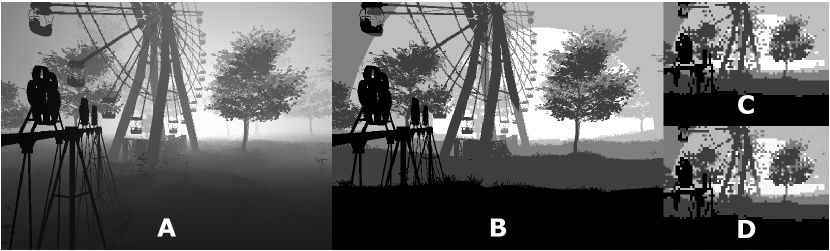
- 使用编码-解码器架构在以高分辨率 RGB 图像为输入、低分辨率深度图作为辅助输入的条件下预测高分辨率深度图。
- 利用预训练的骨干网络(如 Swin Transformer、DINOv2、DepthAnything),并通过条件化机制进行微调或自适应。
- 使用包含缩放的 SiLog 的损失函数以实现深度感知的优化。
- 使用 MAE 和 RMSE 评估方法,并报告模型规模(参数量)与 MACs。
- 提供基线和集成/条件化策略,以在压缩下提升深度上采样。
实验结果
研究问题
- RQ1在使用 RGB 指引和辅助深度信息的情况下,压缩的低分辨率深度能多好地重建高分辨率深度图?
- RQ2哪些架构和骨干网络在从图像领域模型迁移到压缩条件下的深度图重建时效果最好?
- RQ3在该任务中,当前方法在精度(MAE/RMSE)与计算成本(参数量、MACs)之间的权衡如何?
- RQ4在深度上采样设置中,对辅助低分辨率深度进行条件化能否提升重建质量?
主要发现
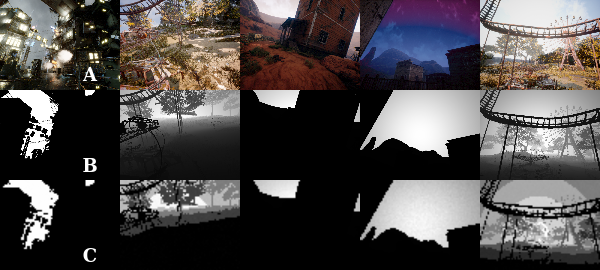
- 顶尖方法在以 RGB 引导的深度上采样中,以辅助的低分辨率深度作为条件,达到约 MAE 0.212、RMSE 0.375。
- 集成和数据增强策略与性能提升相关,而预训练骨干(Swin、DINOv2、DepthAnything)常被转用于深度任务。
- 简单基线(如 Bicubic)在压缩下表现较差,强调需要利用 RGB 上下文与深度先验的学习型上采样。
- 顶级方法在模型规模和 FLOPs 上存在较大差异,表明不同的设计选择在精度和效率之间做出权衡。
阅读本论文
在 Nubint 阅读器中打开原文,边读边就任意段落提问。
在 Nubint 中阅读本论文本解读由 AI 根据论文原文生成,引用前请核对原文。