
[论文解读] Computational Approaches for Integrating out Subjectivity in Cognate Synonym Selection
本文提出使用概率二值和多值字符矩阵来表示所有同源词的同义词数据,避免主观预选。通过 RAxML-NG 进行分析表明,同义词选择会显著改变系统发育树拓扑结构,且最优矩阵类型取决于数据集特异性属性(如速率异质性和推断难度),因此建议针对每个数据集评估全部三种矩阵类型。
Working with cognate data involves handling synonyms, that is, multiple words that describe the same concept in a language. In the early days of language phylogenetics it was recommended to select one synonym only. However, as we show here, binary character matrices, which are used as input for computational methods, do allow for representing the entire dataset including all synonyms. Here we address the question how one can and if one should include all synonyms or whether it is preferable to select synonyms a priori. To this end, we perform maximum likelihood tree inferences with the widely used RAxML-NG tool and show that it yields plausible trees when all synonyms are used as input. Furthermore, we show that a priori synonym selection can yield topologically substantially different trees and we therefore advise against doing so. To represent cognate data including all synonyms, we introduce two types of character matrices beyond the standard binary ones: probabilistic binary and probabilistic multi-valued character matrices. We further show that it is dataset-dependent for which character matrix type the inferred RAxML-NG tree is topologically closest to the gold standard. We also make available a Python interface for generating all of the above character matrix types for cognate data provided in CLDF format.
研究动机与目标
- 调查在同源词数据中手动选择同义词是否显著改变系统发育树拓扑结构。
- 评估概率字符矩阵是否能比标准二值矩阵更好地表示包含所有同义词的同源词数据。
- 确定字符矩阵类型的选择是否影响 RAxML-NG 推断的语言树拓扑准确性。
- 识别可预测哪种字符矩阵类型相对于金标准能产生最准确树拓扑的、数据集层面的属性。
- 提供一个实用的、开源的 Python 接口,用于从 CLDF 格式的同源词数据集中生成全部三种矩阵类型。
提出的方法
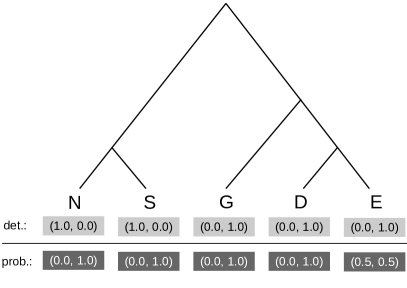
- 作者从 CLDF 格式的同源词数据中构建三种字符矩阵:标准二值矩阵(A^b)、概率二值矩阵(A^b*)和概率多值矩阵(A^m*)。
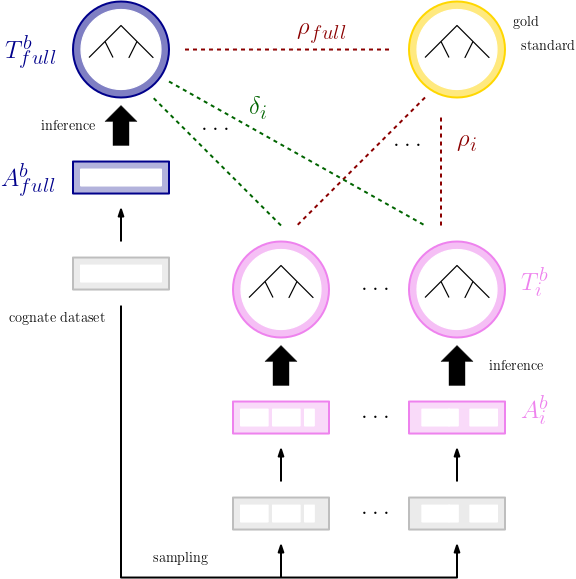
- 对 11 个具有已知金标准树的同源词数据集,使用 RAxML-NG 对每种矩阵类型进行最大似然树推断。
- 概率矩阵通过均匀概率分布编码同义词的存在,使 RAxML-NG 能够建模同义词使用中的不确定性。
- 使用 Robinson-Foulds 距离将每种矩阵类型的树拓扑与 Glottolog 金标准进行比较,以评估拓扑准确性。
- 分析模型参数(如伽马分布的 alpha 形状参数)和推断难度评分,以识别矩阵性能的预测特征。
- 开发并发布了一个 GitHub 上的 Python 软件包,用于自动化生成所有三种矩阵类型,输入为 CLDF 格式的同源词数据。
实验结果
研究问题
- RQ1在树推断前进行手动同义词选择,是否会导致与使用所有同义词所推断出的树拓扑结构不同?
- RQ2在与金标准比较时,哪种字符矩阵类型——标准二值、概率二值或概率多值——能产生最准确的树拓扑?
- RQ3是否可利用数据集特异性属性(如速率异质性(alpha 形状参数)或推断难度)来预测最佳性能的字符矩阵类型?
- RQ4在多样化同源词数据集中,概率矩阵是否始终相对于确定性二值矩阵具有优势?
- RQ5是否可以根据可观测的数据特征预测不同矩阵类型的性能,还是必须对每个数据集评估全部三种类型?
主要发现
- 手动同义词选择可能导致与使用所有同义词推断出的树拓扑差异高达 100%,表明此类选择会引入显著偏差。
- 概率多值矩阵(A^m*)在 11 个数据集中的 9 个表现最佳,尤其在速率异质性较高(alpha < 20)的数据集中,表明其更能捕捉同义词使用中的变异。
- 标准二值矩阵(A^b)在 11 个数据集中的 5 个表现最佳,尤其在推断难度中等至较低的情况下,表明当信号较强时,确定性表示可优于概率模型。
- 概率矩阵表现最佳的数据集平均难度得分较低(0.18),而二值矩阵表现最佳的数据集平均难度得分较高(0.45),表明概率模型在信号微弱时更有效。
- 在 11 个数据集中,有 9 个数据集的概率矩阵表现更优,其伽马分布的 alpha 形状参数低于 20,表明速率异质性是矩阵类型性能的关键预测因子。
- 由于缺乏足够数据训练预测模型,作者建议对每个新同源词数据集均评估全部三种矩阵类型,以确保获得最优的拓扑准确性。
阅读本论文
在 Nubint 阅读器中打开原文,边读边就任意段落提问。
在 Nubint 中阅读本论文本解读由 AI 根据论文原文生成,引用前请核对原文。