
[论文解读] Conclusive evidence for a population of water-worlds around M-dwarfs remains elusive
本研究表明,具有岩石核心和H/He大气层的亚海王星的质量-半径关系与1:1硅酸盐-冰比例的水世界存在退化关系,仅凭半径和质量无法区分其组成。作者得出结论,由于这种退化关系以及大气层逃逸过程对观测群体分布的强烈影响,目前仍无法得出关于M型恒星周围存在独立水世界种群的决定性证据。
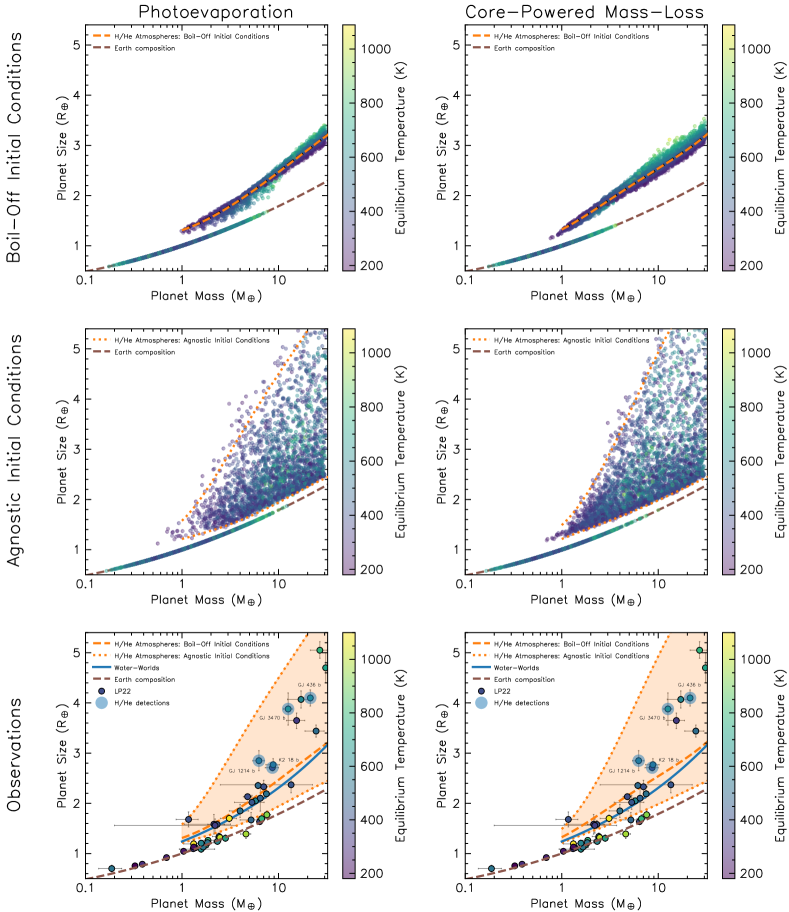
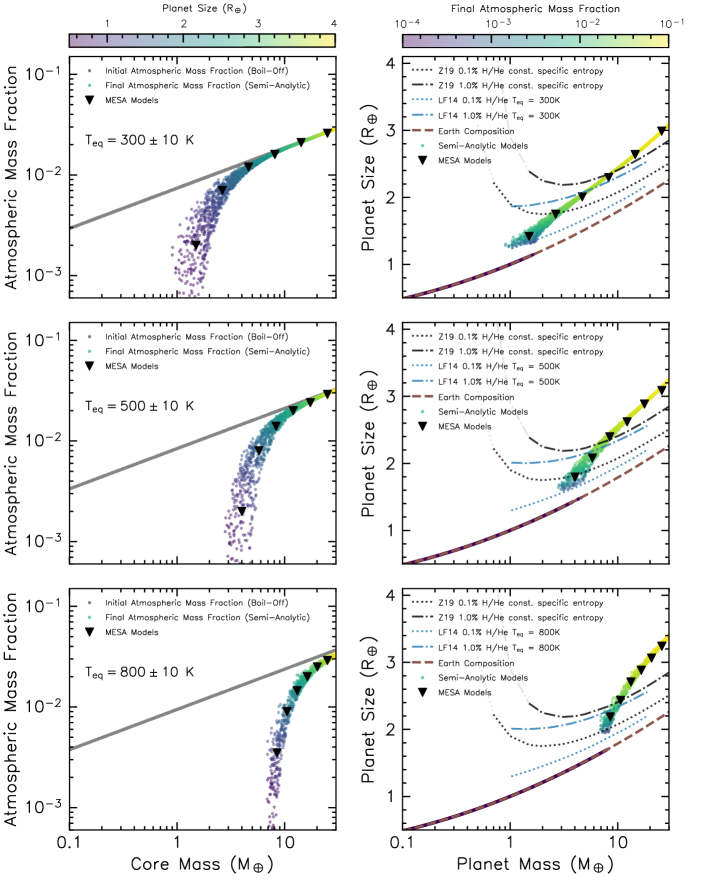
The population of small, close-in exoplanets is bifurcated into super-Earths and sub-Neptunes. We calculate physically motivated mass-radius relations for sub-Neptunes, with rocky cores and H/He dominated atmospheres, accounting for their thermal evolution, irradiation and mass-loss. For planets $\lesssim 10~$M$_\oplus$, we find that sub-Neptunes retain atmospheric mass fractions that scale with planet mass and show that the resulting mass-radius relations are degenerate with results for `water-worlds' consisting of a 1:1 silicate-to-ice composition ratio. We further demonstrate that our derived mass-radius relation is in excellent agreement with the observed exoplanet population orbiting M-dwarfs and that planet mass and radii alone are insufficient to determine the composition of some sub-Neptunes. Finally, we highlight that current exoplanet demographics show an increase in the ratio of super-Earths to sub-Neptunes with both stellar mass (and therefore luminosity) and age, which are both indicative of thermally driven atmospheric escape processes. Therefore, such processes should not be ignored when making compositional inferences in the mass-radius diagram.
研究动机与目标
- 评估围绕M型恒星运行的观测到的亚海王星是否最好由H/He大气层行星或1:1硅酸盐-冰组成的水世界来解释。
- 在物理模型下评估H/He主导的亚海王星与水世界之间质量-半径关系的退化性。
- 确定当前系外行星群体分布是否支持大气层逃逸作为超级地球/亚海王星双峰分异的驱动力。
- 检验观测到的超级地球/亚海王星比例随恒星质量与年龄的变化趋势是否与热逃逸模型一致。
- 评估仅通过质量和半径测量是否可行区分水世界与H/He主导的行星。
提出的方法
- 为具有岩石核心和H/He大气层的亚海王星开发了物理解释的质量-半径关系,整合了热演化、照射和质量损失过程。
- 计算了作为行星质量函数的大气层质量分数,其缩放关系与观测到的亚海王星半径一致。
- 将推导出的质量-半径关系与围绕M型恒星的观测系外行星群体进行比较,以检验一致性。
- 使用合成的质量-半径图评估H/He大气层模型与1:1硅酸盐-冰水世界模型之间的退化性。
- 分析了Petigura等人(2022年)的出现率趋势,以研究超级地球/亚海王星比例对恒星质量和年龄的依赖性。
- 评估XUV光致蒸发与核心驱动质量损失在塑造观测到的半径缺口和群体双峰分异中的作用。
实验结果
研究问题
- RQ1仅凭质量和半径能否区分H/He大气层亚海王星与1:1硅酸盐-冰比例的水世界?
- RQ2围绕M型恒星的亚海王星观测到的质量-半径关系在多大程度上与H/He大气层演化物理模型一致?
- RQ3随着恒星质量和年龄增加,观测到的超级地球/亚海王星比例上升,是否支持热驱动大气层逃逸作为主导演化机制?
- RQ4观测到的半径缺口对水富含行星的允许成分范围施加了何种约束?
- RQ5当前观测数据能否排除M型恒星周围存在显著的1:1硅酸盐-冰比例水世界种群?
主要发现
- 质量≤10 M⊕的H/He大气层亚海王星的质量-半径关系与1:1硅酸盐-冰比例的水世界存在退化关系。
- H/He主导的亚海王星推导出的质量-半径关系与围绕M型恒星观测到的系外行星群体表现出极佳的一致性。
- 由于与水世界模型的退化性,仅凭行星质量和半径不足以确定亚海王星的组成。
- 随着恒星质量和年龄增加,观测到的超级地球/亚海王星比例上升,这一趋势与热驱动大气层逃逸过程一致。
- 当前的系外行星群体分布并未提供关于1:1硅酸盐-冰比例水世界种群存在的决定性证据。
- 半径缺口区域缺乏行星限制了允许的成分范围,但如果水的质量分数被严格约束,仍不能排除水世界的存在。
阅读本论文
在 Nubint 阅读器中打开原文,边读边就任意段落提问。
在 Nubint 中阅读本论文本解读由 AI 根据论文原文生成,引用前请核对原文。