
[论文解读] Consistency-guided Prompt Learning for Vision-Language Models
CoPrompt 引入了一种一致性引导的微调框架,将提示和适配器与输入扰动相结合,在提升少-shot 下游性能的同时,保持视觉语言模型的零-shot泛化能力。它在11个数据集上实现了基线到新颖、跨数据集及领域泛化的 state-of-the-art 结果。
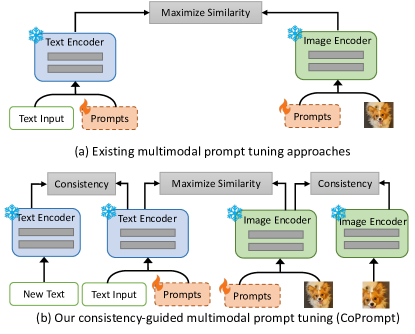
We propose Consistency-guided Prompt learning (CoPrompt), a new fine-tuning method for vision-language models. Our approach improves the generalization of large foundation models when fine-tuned on downstream tasks in a few-shot setting. The basic idea of CoPrompt is to enforce a consistency constraint in the prediction of the trainable and pre-trained models to prevent overfitting on the downstream task. Additionally, we introduce the following two components into our consistency constraint to further boost the performance: enforcing consistency on two perturbed inputs and combining two dominant paradigms of tuning, prompting and adapter. Enforcing consistency on perturbed input serves to further regularize the consistency constraint, thereby improving generalization. Moreover, the integration of adapters and prompts not only enhances performance on downstream tasks but also offers increased tuning flexibility in both input and output spaces. This facilitates more effective adaptation to downstream tasks in a few-shot learning setting. Experiments show that CoPrompt outperforms existing methods on a range of evaluation suites, including base-to-novel generalization, domain generalization, and cross-dataset evaluation. On generalization, CoPrompt improves the state-of-the-art on zero-shot tasks and the overall harmonic mean over 11 datasets. Detailed ablation studies show the effectiveness of each of the components in CoPrompt. We make our code available at https://github.com/ShuvenduRoy/CoPrompt.
研究动机与目标
- 在少样本设置下对大规模视觉-语言基础模型进行微调以缓解过拟合。
- 在文本和图像分支上强制训练模型与预训练模型的一致性。
- 通过对输入扰动和结合提示-适配器框架来增强一致性约束。
- 展示在基线与新颖泛化、跨数据集评估和领域泛化方面优于现有SOTA方法。
提出的方法
- 将 CLIP 作为视觉-语言骨干,并通过多模态提示进行扩展。
- 引入一个在文本和图像分支的可训练嵌入与预训练嵌入之间的余弦一致性损失。
- 使用输入扰动:文本分支的 GPT 生成的描述性文本和图像分支的图像增强。
- 在文本和图像分支上引入适配器以增加学习容量,同时应用一致性约束。
- 将一致性损失与监督损失结合成最终目标 L = L_ce + lambda * L_cc。
实验结果
研究问题
- RQ1一致性引导的微调方法在提升少-shot 下游性能的同时是否能保持零-shot 能力?
- RQ2对扰动输入强加跨模态一致性是否能改善对新颖类别和跨数据集的泛化?
- RQ3在一致性约束下,加入适配器和提示的统一框架会带来哪些影响?
- RQ4不同组件(文本一致性、图像一致性、扰动、适配器)对整体性能有何贡献?
主要发现
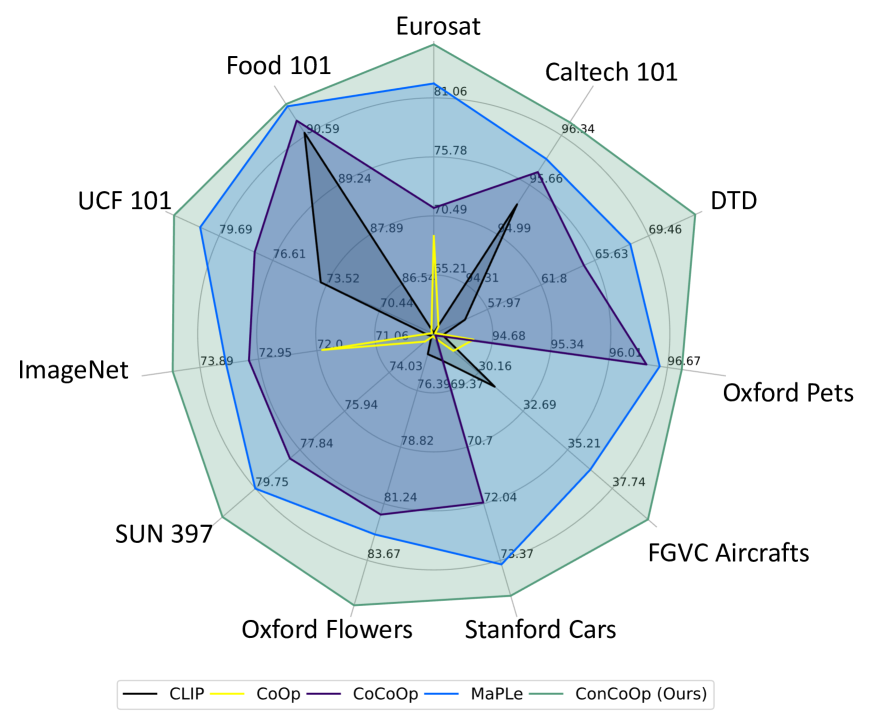
- CoPrompt 在基线到新颖泛化方面达到最先进水平,与先前的SOTA相比,新颖准确率提升了2.09个百分点。
- CoPrompt 在11个数据集上在调和均值上比MaPLe提升了1.93个百分点。
- 在所有数据集上,CoPrompt 在基线准确率上超越了先前方法,并在新颖准确率上保持或提高,缓解了基线与新颖之间的权衡。
- CoPrompt 展现出强劲的跨数据集和领域泛化,在 EuroSAT 和 DTD 等数据集上取得显著提升。
- 消融研究表明,适配器、输入扰动和一致性约束都对性能有贡献,其中文本一致性具有显著影响,余弦距离是有效的标准。
阅读本论文
在 Nubint 阅读器中打开原文,边读边就任意段落提问。
在 Nubint 中阅读本论文本解读由 AI 根据论文原文生成,引用前请核对原文。