
[论文解读] Consolidated Control Barrier Functions: Synthesis and Online Verification via Adaptation under Input Constraints
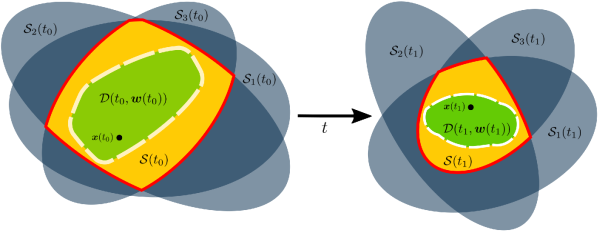
本文提出了一种新颖的自适应方法,将多个时变控制障碍函数(CBFs)整合为单一的综合控制障碍函数(C-CBF),采用预测-校正内点法自适应调整权重。该方法在输入约束下保证基于二次规划(QP)的控制律的可行性,确保非线性系统在存在多个时空约束时实现安全、平滑且全局可行的控制,即使在相对阶数较高时亦然。
In this paper, we develop a novel adaptation-based approach to constrained control design under multiple state and input constraints. Specifically, we introduce a method for synthesizing any number of time-varying candidate control barrier functions (CBF) into one consolidated CBF (C-CBF) candidate, and propose a predictor-corrector optimization-based adaptation law for the weights of the constituent constraint functions that certifies the C-CBF as valid for a class of nonlinear, control-affine systems. We prove this result by showing that the adapted weights are guaranteed to confer sufficient control authority to meet the new, adaptive C-CBF condition in perpetuity despite input constraints, which thereby permits its use in a quadratic program based control law. We then illustrate the performance of our controller on an academic example, and further highlight that it is successful even for constraint functions with higher or mixed relative-degree by simulating a reach-avoid problem for bicycle robots, which we use to demonstrate how our approach out-performs two baseline approaches.
研究动机与目标
- 解决在多重时变时空约束和输入限制下确保控制设计可行性与安全性的挑战。
- 克服现有CBF方法在多重约束下失效、或需人工调参或离线验证的局限性。
- 开发一种统一的自适应框架,将任意数量的CBF候选函数合成一个具有保证有效性的单一综合CBF(C-CBF)。
- 通过动态调整各CBF成分的权重,确保在输入约束下C-CBF条件的持续可行性。
- 在约束具有混合或高阶相对度时,实现鲁棒、平滑的控制动作,避免振荡或突变切换。
提出的方法
- 通过自适应权重的凸组合方式,将多个时变CBF候选函数整合为一类通用的综合CBF(C-CBF)。
- 设计一种基于预测-校正内点法的自适应律,实现实时更新各CBF成分的权重。
- 证明所调整的权重可始终确保足够的控制能力以满足C-CBF条件,即使在输入约束下亦然。
- 将C-CBF集成到基于二次规划(QP)的控制律中,确保在整个控制时域内保持可行性与安全性。
- 通过预测步估计未来权重动态,通过校正步强制满足原-对偶可行性,模拟内点优化过程。
- 将该方法应用于一维不稳定系统及包含八个约束(包括相对阶为二的约束)的自行车机器人避障问题。
实验结果
研究问题
- RQ1能否从多个时变CBF候选函数中构造出一个单一的综合CBF,使得所得函数在输入约束下仍能保证正不变性?
- RQ2能否设计一种自适应权重更新律,以确保在控制能力受限时,C-CBF条件的长期有效性?
- RQ3所提方法是否能在输入约束下保持基于QP的控制律可行性,同时确保平滑、无振荡的控制动作?
- RQ4该方法在具有混合或高阶相对度的约束系统中表现如何,特别是当C-CBF的导数仅依赖于高阶动态时?
- RQ5自适应C-CBF控制器在不同保守程度和输入约束条件下,是否能优于现有基线方法(如HO-CBF-QP和E-CBF-QP)?
主要发现
- 所提出的自适应C-CBF控制器成功引导自行车机器人在包含八个时变约束(其中六个为相对阶二)的避障问题中抵达目标。
- 与HO-CBF-QP控制器在四次模拟试验中全部因输入约束导致不可行不同,自适应C-CBF控制器始终保持可行性并成功抵达目标。
- E-CBF-QP控制器需专家调参且对增益选择敏感:过于保守的增益导致不可行,而激进的增益则引发碰撞。
- C-CBF权重随时间平滑变化(如图11所示),避免了突变切换,实现了无振荡行为的平滑控制输入。
- 所有八个约束函数在整个操作过程中均被满足,且C-CBF条件始终保持可行,尽管六个约束对H的一阶导数贡献为零。
- 控制器实现了安全、稳定且全局可行的控制,无需依赖离线验证或人工调参,展现出对动态环境和未知扰动的鲁棒性。
阅读本论文
在 Nubint 阅读器中打开原文,边读边就任意段落提问。
在 Nubint 中阅读本论文本解读由 AI 根据论文原文生成,引用前请核对原文。