
[论文解读] Constraining $f_{NL}$ using the Large-Scale Modulation of Small-Scale Statistics
该论文提出了一种计算高效的约束原初非高斯性($f_{NL}$)的方法,通过利用$N$-体模拟中大尺度对小尺度功率谱的调制。该方法结合了收缩三谱和坍缩四谱信息,采用最小偏差模型,从物质场中实现了对$f_{NL}$的强约束——尽管晕统计仅对两点函数本身带来微弱改进。
We implement a novel formalism to constrain primordial non-Gaussianity of the local type from the large-scale modulation of the small-scale power spectrum. Our approach combines information about primordial non-Gaussianity contained in the squeezed bispectrum and the collapsed trispectrum of large-scale structure together in a computationally amenable and consistent way, while avoiding the need to model complicated covariances of higher $N$-point functions. This work generalizes our recent work, which used a neural network estimate of local power, to the more conventional local power spectrum statistics, and explores using both matter field and halo catalogues from the Quijote simulations. We find that higher $N$-point functions of the matter field can provide strong constraints on $f_{NL}$, but higher $N$-point functions of the halo field, at the halo density of Quijote, only marginally improve constraints from the two-point function.
研究动机与目标
- 开发一种计算高效且一致的框架,利用大尺度结构的高阶统计量来约束$f_{NL}$。
- 通过使用捕捉$f_{NL} \neq 0$时$1/k^2$标度的最小偏差模型,避免对高阶$N$-点函数协方差进行复杂建模。
- 测试在真实模拟中,晕的三谱和四谱是否相比晕功率谱提供显著额外信息。
- 评估该方法在不同示踪场(物质 vs. 晷)和不同尺度范围(包括高度非线性模式)下的鲁棒性。
提出的方法
- 采用最小偏差模型,捕捉$f_{NL} \neq 0$宇宙中晕功率谱的$1/k^2$标度,无需对小尺度物理过程进行详细建模。
- 应用一种一致且计算可处理的似然框架,结合晕功率谱$P_{hh}$、收缩三谱$B_{hhh}$和坍缩四谱$T_{hhhh}$的信息。
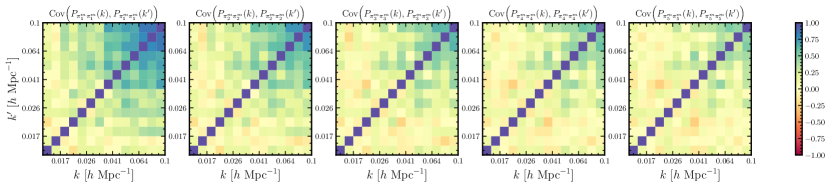
- 采用基于功率谱和高阶统计量协方差的似然函数,并通过MCMC采样对噪声参数进行边际化。
- 使用Quijote模拟进行端到端测试,确认在多种配置下均能无偏恢复$f_{NL}$。
- 将该方法扩展至其他大尺度示踪场,如重构的kSZ速度场,以实现潜在的样本方差抵消。
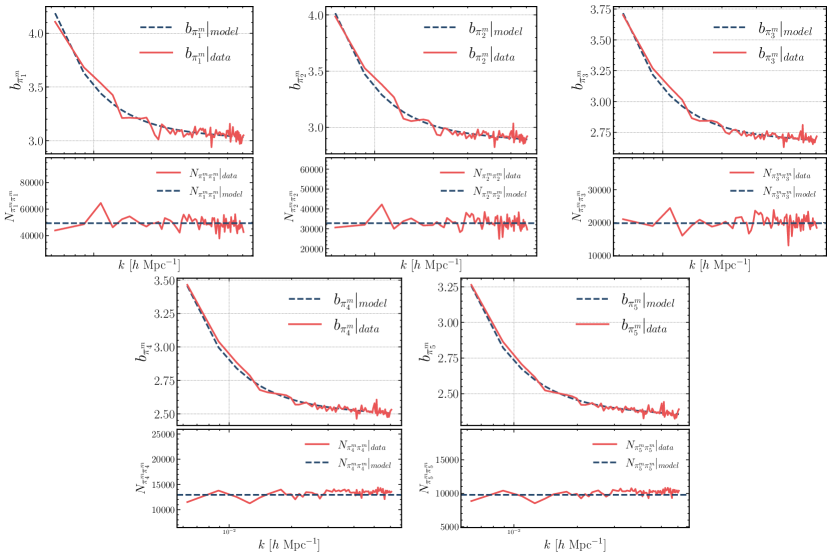
- 使用$N$-体模拟(Quijote)从第一性原理计算非高斯偏差$\beta_h$、$\beta_\pi$,假设已知以进行初始验证。
实验结果
研究问题
- RQ1在$f_{NL}$敏感的大尺度结构巡天中,收缩三谱与坍缩四谱统计的结合是否能超越两点函数提供更好的$f_{NL}$约束?
- RQ2与仅使用晕功率谱相比,晕三谱和四谱中包含多少额外的$f_{NL}$信息?
- RQ3当应用于晕时,该方法是否仍具有鲁棒性,尽管非线性偏置和有限的数密度可能抑制高阶信号?
- RQ4在不进行详细小尺度建模的情况下,高度非线性尺度(接近$k_{\rm nyquist}$)在多大程度上能为$f_{NL}$约束提供贡献?
- RQ5与基于模拟的方法(如Quijote-PNG)和解析三谱研究相比,该方法在$\sigma(f_{NL})$方面的表现如何?
主要发现
- 物质场的高阶$N$-点函数提供了对$f_{NL}$的强约束,$\sigma(f_{NL})$值略优于先前基于模拟研究的报告结果。
- 对于晕场,收缩三谱和坍缩四谱相比两点函数仅带来微弱改进,与Quijote-PNG合作团队的发现一致。
- 在端到端测试中,该方法实现了鲁棒的$f_{NL}$恢复,多种模拟实现下均无偏。
- 随着$k_{\rm max}$增大,$\sigma(f_{NL})$缓慢减小并最终饱和,表明该方法有效捕捉了高度非线性尺度的信息。
- 该方法计算高效,通过依赖最小偏差模型,避免了对高阶$N$-点函数协方差复杂建模的需要。
- 发现非高斯偏差$\beta_h$和$\beta_\pi$与$f_{NL}$存在退化,因此建模错误仅影响归一化,不影响虚假检测的可能性。
阅读本论文
在 Nubint 阅读器中打开原文,边读边就任意段落提问。
在 Nubint 中阅读本论文本解读由 AI 根据论文原文生成,引用前请核对原文。