
[论文解读] Constraining the onset density for the QCD phase transition with the neutrino signal from core-collapse supernovae
本文提出,未来银河系核心坍缩超新星的中微子信号可通过与强子-夸克物质相变相关的第二个、以电子反中微子为主的爆发,约束QCD相变的 onset 密度。利用具有三味玻尔兹曼中微子输运的球对称、广义相对论模拟以及微观强子-夸克混合方程态,作者识别出第二个爆发的光度与平均能量与 onset 密度之间的经验线性关系,为未来中微子观测提供探测致密物质性质的途径。
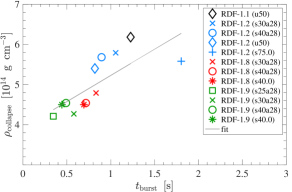
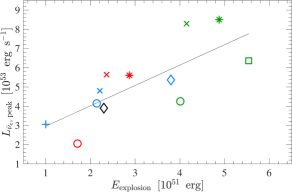
The occurrence of a first-order hadron-quark matter phase transition at high baryon densities is investigated in astrophysical simulations of core-collapse supernovae, to decipher yet incompletely understood properties of the dense matter equation of state (EOS) using neutrinos from such cosmic events. It is found that the emission of a nonstandard second neutrino burst, dominated by electron antineutrinos, is not only a measurable signal for the appearance of deconfined quark matter but also reveals information about the state of matter at extreme conditions encountered at the supernova (SN) interior. To this end, a large set of spherically symmetric SN models is investigated, studying the dependence on the EOS and the stellar progenitor. General relativistic neutrino-radiation hydrodynamics is employed featuring three-flavor Boltzmann neutrino transport and a microscopic hadron-quark hybrid matter EOS class. Therefore, the DD2 relativistic mean-field hadronic model is employed, and several variations of it, and the string-flip model for the description of deconfined quark matter. The resulting hybrid model covers a representative range of onset densities for the phase transition and latent heats. This facilitates the direct connection between intrinsic signatures of the neutrino signal and properties of the EOS. In particular, a set of linear relations has been found empirically. These potentially provide a constraint for the onset density of a possible QCD phase transition from the future neutrino observation of the next galactic core-collapse SN, if a millisecond electron anti-neutrino burst is present around or less than 1s.
研究动机与目标
- 研究一阶强子-夸克相变对核心坍缩超新星中微子辐射的影响。
- 确定与第二次激波穿过中微子球第二次穿越相关的第二个中微子爆发,是否能揭示QCD相变 onset 密度的信息。
- 建立可观测中微子爆发特性与强子-夸克混合方程态热力学参数之间的经验关系。
- 提供一种利用未来银河系超新星中微子探测约束QCD相变 onset 密度的方法。
提出的方法
- 采用具有三味玻尔兹曼中微子输运的球对称、广义相对论中微子辐射流体动力学模拟。
- 使用包含排斥性夸克相互作用和禁闭效应的微观强子-夸克混合方程态(RDF模型)。
- 系统性地改变方程态和前身星模型(初始质量函数为30–75 M⊙),以探索中微子信号对相变参数的依赖性。
- 在500 km半径处采样共动参考系中的中微子光度与平均能量,以分析爆发特性。
- 识别出第二个爆发的峰值光度与平均能量和相变 onset 密度之间的经验线性相关性。
- 通过大质量脉冲星和黑洞形成已知约束验证结果,并与先前模拟进行比较。
实验结果
研究问题
- RQ1核心坍缩超新星中的第二次中微子爆发能否作为QCD相变 onset 密度的探测工具?
- RQ2强子-夸克混合方程态的变化如何影响第二次中微子爆发的特性?
- RQ3可观测中微子爆发特征与相变热力学参数之间存在何种经验关系?
- RQ4未来来自银河系超新星的中微子观测在多大程度上能约束QCD相变的 onset 密度?
主要发现
- 以电子反中微子为主的第二个中微子爆发是强子-夸克相变的可观测特征,并携带有关 onset 密度的信息。
- 相变 onset 较早(密度较低)的模型表现出更高的峰值光度和更宽的第二个爆发,而较晚 onset 则导致更低光度和更窄的爆发。
- 发现第二个爆发的峰值光度与平均能量和相变 onset 密度之间存在经验线性关系,使未来观测可间接约束该密度。
- 第二个爆发的特性强烈受电子分数和中子简并度影响,由于高中子含量,$\bar{\nu}_e$ 的发射最强。
- 第一次与第二次中微子爆发之间的时间延迟与 onset 密度相关,较早相变导致延迟更短。
- 结果在不同前身星质量(30–75 M⊙)和混合方程态变体下均保持稳健,表明中微子信号与相变 onset 之间存在普遍关联。
阅读本论文
在 Nubint 阅读器中打开原文,边读边就任意段落提问。
在 Nubint 中阅读本论文本解读由 AI 根据论文原文生成,引用前请核对原文。