
[论文解读] Contextualization Distillation from Large Language Model for Knowledge Graph Completion
本文提出 Contextualization Distillation,一种使用 LLM 生成的上下文描述来训练较小的 KGC 模型的插件式方法,在 WN18RR 与 FB15k-237N 数据集上提升了判别式和生成式 KGC 的性能。
While textual information significantly enhances the performance of pre-trained language models (PLMs) in knowledge graph completion (KGC), the static and noisy nature of existing corpora collected from Wikipedia articles or synsets definitions often limits the potential of PLM-based KGC models. To surmount these challenges, we introduce the Contextualization Distillation strategy, a versatile plug-in-and-play approach compatible with both discriminative and generative KGC frameworks. Our method begins by instructing large language models (LLMs) to transform compact, structural triplets into context-rich segments. Subsequently, we introduce two tailored auxiliary tasks, reconstruction and contextualization, allowing smaller KGC models to assimilate insights from these enriched triplets. Comprehensive evaluations across diverse datasets and KGC techniques highlight the efficacy and adaptability of our approach, revealing consistent performance enhancements irrespective of underlying pipelines or architectures. Moreover, our analysis makes our method more explainable and provides insight into generating path selection, as well as the choosing of suitable distillation tasks. All the code and data in this work will be released at https://github.com/David-Li0406/Contextulization-Distillation
研究动机与目标
- 解决 KGC 中噪声性与静态文本语料对 PLM 性能的限制。
- 利用 LLM 将三元组转换为描述性上下文(实体描述和三元组描述)。
- 提出一个带辅助任务的多任务学习框架,在上下文化数据上训练较小的 KGC 模型。
- 证明 Contextualization Distillation 在多样化 KGC 流水线与架构上提升性能。
提出的方法
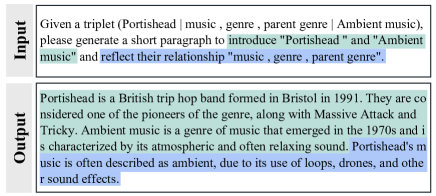
- 为每个三元组 curate prompts,以从 LLM 获取描述性上下文,输出实体描述和三元组描述。
- 探索多条生成路径(如 T -> ED、TD、RA、ED->TD、ED+TD),并选择一个稳健的单步路径(T -> (ED, TD))。
- 引入两个辅助任务:对于判别式模型的重构(基于 MLM)和生成式模型的上下文化(生成任务)。
- 用一个组合损失(kgc 损失 + alpha * 辅助损失)来训练较小的 KGC 模型,以将上下文知识迁移。
- 在标准基线上评估多种基于 PLM 的 KGC 模型(判别式和生成式)。
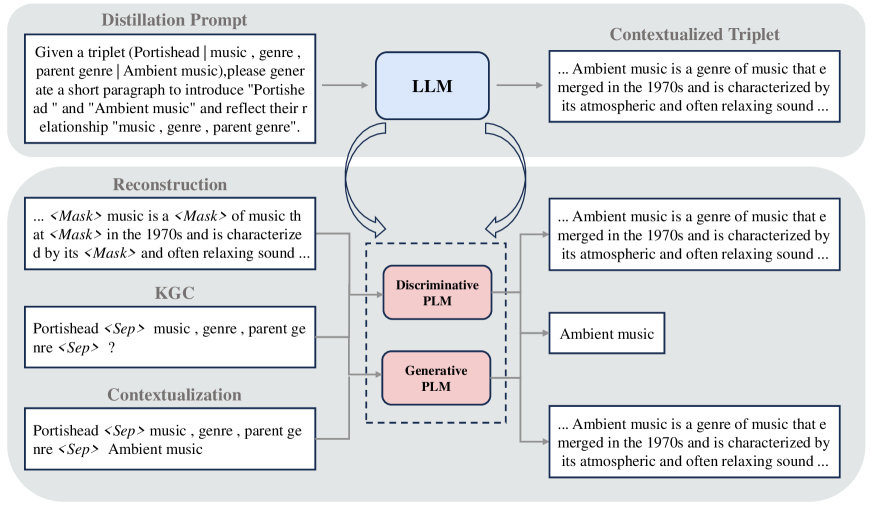
实验结果
研究问题
- RQ1LLM 生成的描述性上下文是否能够在不同模型类型之间稳定提升 KGC 性能?
- RQ2哪些生成路径和辅助任务对性能增益贡献最大?
- RQ3上下文化在 KGC 训练中的可控性、可解释性和收敛性有何影响?
主要发现
- Contextualization Distillation 在 WN18RR 和 FB15k-237N 上对基线 KGC 模型均有持续提升,无论架构是判别式还是生成式。
- 同时使用实体描述和三元组描述(T -> (ED, TD))的增益强于仅使用单一类型描述。
- 在生成式 KGC 模型中,上下文化通常优于仅进行重构,凸显连贯描述性上下文的价值。
- 消融分析显示,全面、连贯的描述性上下文使较小模型更有效地从 LLM 学习。
- 该方法在某些模型(如 CSProm-KG-CD)中加速收敛,并实现有竞争力的训练效率。
阅读本论文
在 Nubint 阅读器中打开原文,边读边就任意段落提问。
在 Nubint 中阅读本论文本解读由 AI 根据论文原文生成,引用前请核对原文。