
[论文解读] Continuously Learning, Adapting, and Improving: A Dual-Process Approach to Autonomous Driving
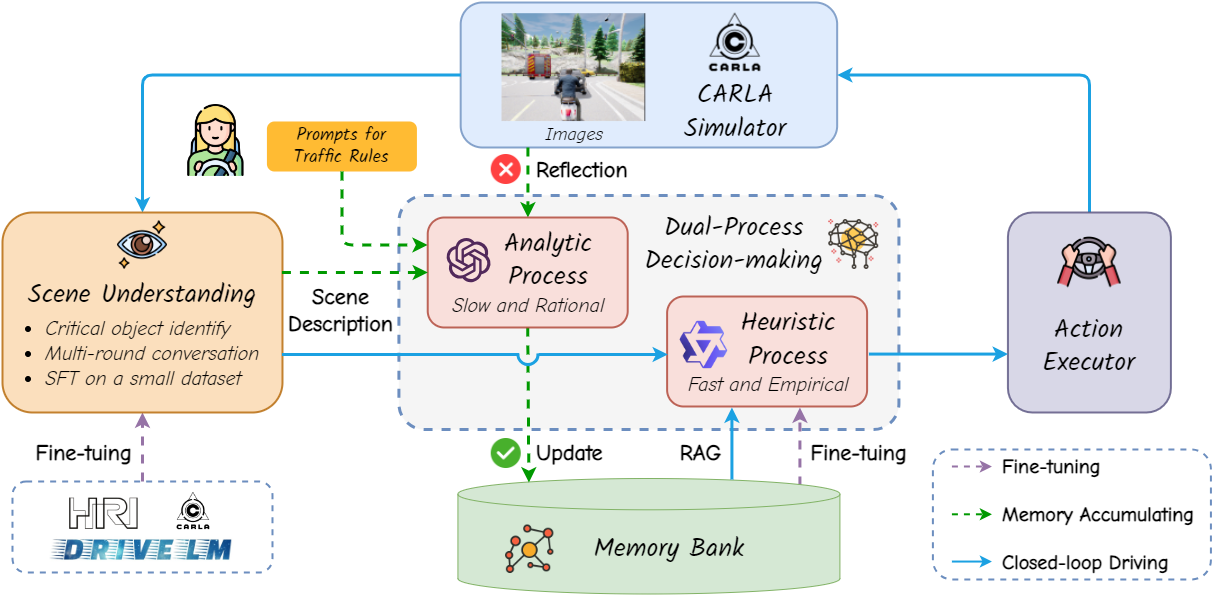
LeapAD 提出了一种受人类认知启发的双过程、闭环自主驾驶系统,采用快速的启发式过程(系统-I)和慢速的分析过程(系统-II)进行推理与决策。通过利用自我反思和不断增长的高质量驾驶经验记忆库,LeapAD 实现了持续改进,所需标注数据量比以往方法减少1–2个数量级,在CARLA仿真中实现了跨环境的强泛化能力。
Autonomous driving has advanced significantly due to sensors, machine learning, and artificial intelligence improvements. However, prevailing methods struggle with intricate scenarios and causal relationships, hindering adaptability and interpretability in varied environments. To address the above problems, we introduce LeapAD, a novel paradigm for autonomous driving inspired by the human cognitive process. Specifically, LeapAD emulates human attention by selecting critical objects relevant to driving decisions, simplifying environmental interpretation, and mitigating decision-making complexities. Additionally, LeapAD incorporates an innovative dual-process decision-making module, which consists of an Analytic Process (System-II) for thorough analysis and reasoning, along with a Heuristic Process (System-I) for swift and empirical processing. The Analytic Process leverages its logical reasoning to accumulate linguistic driving experience, which is then transferred to the Heuristic Process by supervised fine-tuning. Through reflection mechanisms and a growing memory bank, LeapAD continuously improves itself from past mistakes in a closed-loop environment. Closed-loop testing in CARLA shows that LeapAD outperforms all methods relying solely on camera input, requiring 1-2 orders of magnitude less labeled data. Experiments also demonstrate that as the memory bank expands, the Heuristic Process with only 1.8B parameters can inherit the knowledge from a GPT-4 powered Analytic Process and achieve continuous performance improvement. Project page: https://pjlab-adg.github.io/LeapAD.
研究动机与目标
- 解决当前数据驱动自主驾驶系统在处理未见场景、因果推理和可解释性方面的局限性。
- 通过闭环、类人认知框架,实现自动驾驶车辆的持续学习与自适应能力。
- 通过将大型分析过程的知识迁移至轻量化启发式过程,弥合高容量推理模型与轻量级实时推理之间的差距。
- 通过可迁移的记忆库与反思机制,提升在多样化驾驶环境中的泛化能力与鲁棒性。
- 开发一种兼容云-边架构的系统,支持真实世界部署。
提出的方法
- LeapAD 采用场景理解模块,应用类人注意力机制聚焦关键物体,从而简化环境输入以支持决策。
- 实施双过程决策架构:慢速、理性的分析过程(系统-II)用于逻辑推理,快速、经验性的启发式过程(系统-I)用于实时推理。
- 分析过程累积语言化驾驶经验并生成高质量决策轨迹,通过监督微调(SFT)将这些轨迹提炼为可迁移的记忆库。
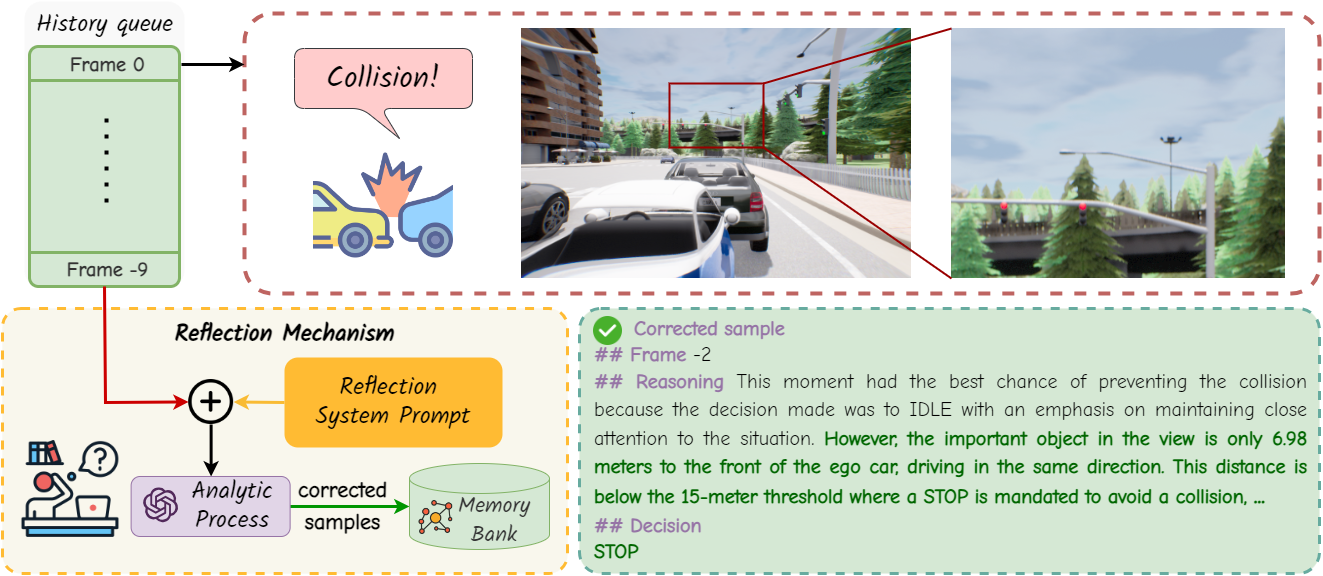
- 通过反思机制识别并分析交通事故,提取经验教训并更新记忆库,实现闭环环境下的自我改进。
- 启发式过程利用记忆库进行少样本提示(few-shot prompting),快速适应新场景,实现在边缘设备上的实时决策。
- 系统在闭环CARLA仿真环境中进行训练与评估,确保动态交互与反馈,区别于开环评估。
实验结果
研究问题
- RQ1双过程认知架构能否提升自主驾驶系统在持续学习与自适应能力方面的表现?
- RQ2轻量化启发式过程通过知识蒸馏从大型分析过程继承复杂推理能力的效率如何?
- RQ3基于反思的记忆库在多样化驾驶环境中在多大程度上提升了性能与泛化能力?
- RQ4LeapAD能否在显著减少标注数据量的前提下,实现优于现有纯摄像头方法的性能?
- RQ5当在记忆库收集阶段未见过的城镇进行测试时,系统在泛化能力方面表现如何?
主要发现
- LeapAD 在CARLA中的闭环评估中优于所有纯摄像头方法,实现了当前最先进性能。
- 由于高效的知识迁移与持续学习机制,系统所需标注数据量比以往方法减少1–2个数量级。
- 随着记忆库的增长,1.8B参数的启发式过程通过监督微调,其性能可与GPT-4驱动的分析过程相媲美。
- 反思机制显著提升了驾驶得分,多轮自我改进后在复杂路线上的平均性能持续提升。
- 记忆库展现出强大的泛化能力:LeapAD 在使用其他城镇收集的记忆时,于Town05表现优异,反之亦然,表明其具备稳健的跨环境迁移能力。
- 即使记忆库中包含低质量样本,系统仍能保持优异性能,表明其对噪声数据具有强鲁棒性。
阅读本论文
在 Nubint 阅读器中打开原文,边读边就任意段落提问。
在 Nubint 中阅读本论文本解读由 AI 根据论文原文生成,引用前请核对原文。