
[论文解读] Contrastive Learning based Semantic Communication for Wireless Image Transmission
本文提出了一种基于对比学习(CL)的语义通信框架,用于无线图像传输,将信道引起的图像退化视为数据增强手段,以增强原始图像与重建图像之间的语义相似性。通过联合优化两阶段训练过程与对比损失,该方法在1/48带宽压缩比下,使CIFAR-10数据集的准确率最高提升56%,同时保持了良好的图像重建质量。
Recently, semantic communication has been widely applied in wireless image transmission systems as it can prioritize the preservation of meaningful semantic information in images over the accuracy of transmitted symbols, leading to improved communication efficiency. However, existing semantic communication approaches still face limitations in achieving considerable inference performance in downstream AI tasks like image recognition, or balancing the inference performance with the quality of the reconstructed image at the receiver. Therefore, this paper proposes a contrastive learning (CL)-based semantic communication approach to overcome these limitations. Specifically, we regard the image corruption during transmission as a form of data augmentation in CL and leverage CL to reduce the semantic distance between the original and the corrupted reconstruction while maintaining the semantic distance among irrelevant images for better discrimination in downstream tasks. Moreover, we design a two-stage training procedure and the corresponding loss functions for jointly optimizing the semantic encoder and decoder to achieve a good trade-off between the performance of image recognition in the downstream task and reconstructed quality. Simulations are finally conducted to demonstrate the superiority of the proposed method over the competitive approaches. In particular, the proposed method can achieve up to 56\% accuracy gain on the CIFAR10 dataset when the bandwidth compression ratio is 1/48.
研究动机与目标
- 为解决现有语义通信系统在带宽受限条件下难以平衡图像重建质量与下游推理性能的问题。
- 通过利用传输过程中的图像退化作为数据增强形式,提升无线图像传输中的语义表征学习能力。
- 设计一种两阶段训练流程,联合优化语义编码器与解码器,以实现语义保真度与重建质量之间的更好权衡。
- 在低信噪比(SNR)和低带宽场景下实现鲁棒性能,尤其针对图像分类等下游AI任务。
提出的方法
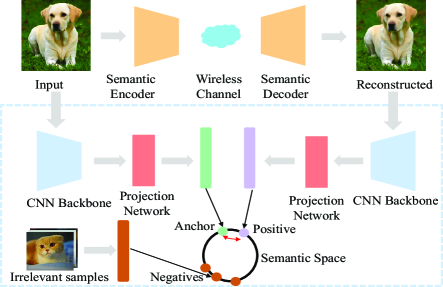
- 将无线传输过程中的图像退化视为对比学习(CL)中的数据增强形式,提升原始图像与重建图像之间的语义相似性。
- 提出一种语义对比编码机制,最小化原始图像与受损-重建图像之间的语义距离,同时最大化与语义无关图像之间的语义距离。
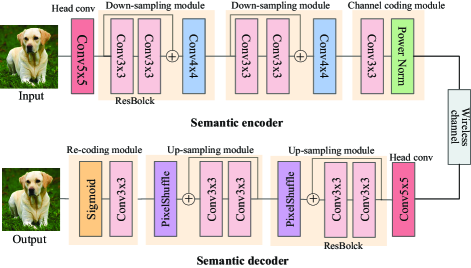
- 采用两阶段训练流程:首先使用对比损失对语义编码器与解码器进行预训练,然后通过联合源-信道编码目标进行微调。
- 使用对比损失函数,促使正样本对(原始图像与重建图像)之间的语义距离较小,而负样本对(语义不相似图像)之间的语义距离较大。
- 对编码信号应用功率归一化,以满足发射端的平均功率约束。
- 将无线信道建模为加性白高斯噪声(AWGN)信道,接收信号受噪声污染,接收端使用解码器重建图像。
实验结果
研究问题
- RQ1在对比学习中将信道引起的图像退化视为数据增强,是否能提升无线图像传输中的语义表征?
- RQ2所提出的两阶段训练流程在带宽受限条件下,如何平衡语义保真度与图像重建质量?
- RQ3在低压缩比下,与现有DeepJSCC和DeepSC方法相比,该CL框架在下游图像分类准确率方面有何性能提升?
- RQ4该方法在低信噪比(SNR)环境下的鲁棒性如何,特别是在带宽严重受限时?
主要发现
- 在1/48带宽压缩比下,所提方法在CIFAR-10数据集上的准确率最高较DeepJSCC提升56%,显著提升了下游图像分类性能。
- 在1/48带宽压缩比下,该方法达到87.65%的测试准确率,较DeepSC高出1%,较DeepJSCC高出56%。
- 在1/2.5压缩比下,该方法保持38.75 dB的PSNR,接近DeepJSCC的39.27 dB,表明在带宽充足时具备出色的重建质量。
- 即使在低信噪比(5 dB)条件下,该方法的准确率仍优于DeepJSCC、DeepJSCC-ft和DeepSC,显示出在恶劣信道条件下的鲁棒性。
- Kodak数据集上的可视化结果表明,该方法能有效抑制冗余背景信息,同时保留关键语义内容,减少显著图像区域的退化。
- 该方法在PSNR和MS-SSIM方面与DeepJSCC和DeepJSCC-ft相当,证实其在优先保留语义信息的同时,仍能有效保持感知图像质量。
阅读本论文
在 Nubint 阅读器中打开原文,边读边就任意段落提问。
在 Nubint 中阅读本论文本解读由 AI 根据论文原文生成,引用前请核对原文。