
[论文解读] Contrastive Learning for Compact Single Image Dehazing
本文提出AECR-Net,一种紧凑的单图像去雾框架,通过对比正则化(CR)提升去雾性能,使恢复图像在表征空间中更贴近清晰图像(正样本),同时远离雾图(负样本)。该方法结合自编码器式架构、自适应混合(mixup)与动态特征增强,以显著更少的参数量实现最先进性能,在合成与真实世界基准测试中均优于现有模型。
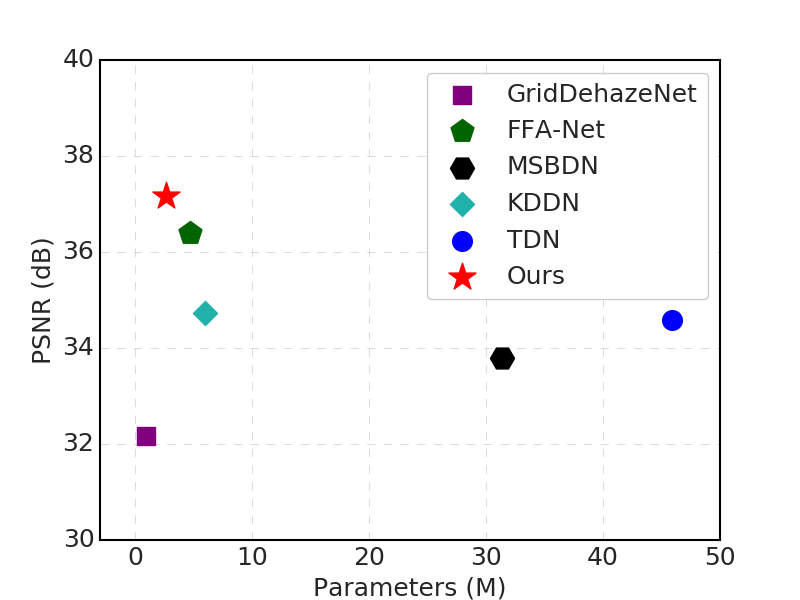
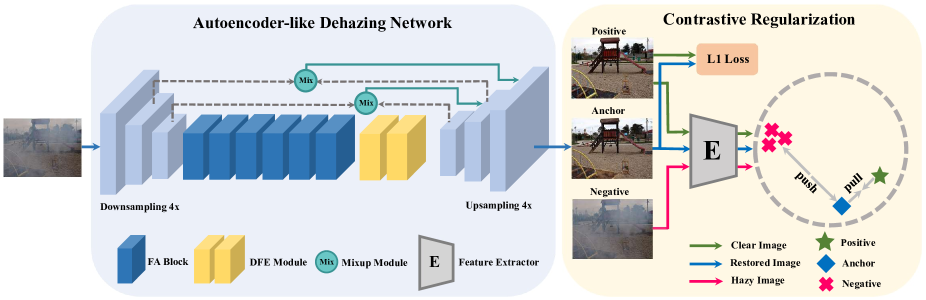
Single image dehazing is a challenging ill-posed problem due to the severe information degeneration. However, existing deep learning based dehazing methods only adopt clear images as positive samples to guide the training of dehazing network while negative information is unexploited. Moreover, most of them focus on strengthening the dehazing network with an increase of depth and width, leading to a significant requirement of computation and memory. In this paper, we propose a novel contrastive regularization (CR) built upon contrastive learning to exploit both the information of hazy images and clear images as negative and positive samples, respectively. CR ensures that the restored image is pulled to closer to the clear image and pushed to far away from the hazy image in the representation space. Furthermore, considering trade-off between performance and memory storage, we develop a compact dehazing network based on autoencoder-like (AE) framework. It involves an adaptive mixup operation and a dynamic feature enhancement module, which can benefit from preserving information flow adaptively and expanding the receptive field to improve the network's transformation capability, respectively. We term our dehazing network with autoencoder and contrastive regularization as AECR-Net. The extensive experiments on synthetic and real-world datasets demonstrate that our AECR-Net surpass the state-of-the-art approaches. The code is released in https://github.com/GlassyWu/AECR-Net.
研究动机与目标
- 通过在表征空间中利用正样本(清晰图像)与负样本(雾图)来解决单图像去雾问题的病态性。
- 在不损失性能的前提下,降低深度去雾网络的计算与内存开销。
- 开发一种紧凑且高效的去雾网络,同时保持强大的特征表征与转换能力。
- 引入一种与模型无关的对比正则化模块,以提升各类架构的性能。
提出的方法
- 提出对比正则化(CR),将清晰图像视为正样本,雾图视为负样本,约束网络在表征空间中使预测结果向正样本靠近、远离负样本。
- 设计一种参数量更少、深度更浅的自编码器式(AE)去雾网络,以最小化内存与计算成本。
- 引入自适应混合(adaptive mixup)操作,实现浅层特征向深层网络的自适应流动,从而在全网络中保持特征信息。
- 采用受可变形卷积启发的动态特征增强(DFE)模块,扩大感受野并提升空间特征融合能力。
- 使用对比损失进行网络训练,将恢复图像(锚点)的表征与对应清晰图像(正样本)和雾图(负样本)的表征进行比较。
- 在推理阶段可移除CR模块,确保测试时无额外计算或参数开销。
实验结果
研究问题
- RQ1对比学习能否通过在表征空间中同时利用正样本与负样本,有效提升去雾性能?
- RQ2如何在减少模型参数与计算成本的同时,使紧凑的去雾网络维持高性能?
- RQ3在对比正则化中,正样本与负样本的最优比例配置为何?
- RQ4所提出的对比正则化是否可普遍应用于提升现有最先进去雾模型的性能?
主要发现
- 在RESIDE数据集上,AECR-Net的PSNR达到37.17 dB,较基础模型(含DFE与mixup)提升0.71 dB。
- 当CR中正负样本比例为1:10时性能最佳(PSNR达37.41 dB),但训练时间增加至约200小时。
- 将CR应用于现有SOTA模型(如FFA-Net与KDDN)后,PSNR分别提升最高0.35 dB与0.46 dB,证明其模型无关的有效性。
- 当动态特征增强(DFE)模块置于深层网络之后时性能最佳,显著提升特征表征与整体恢复质量。
- 自适应混合操作通过促进浅层到深层特征的信息流动,增强了特征保留能力。
- 对比正则化模块可在推理阶段移除,不引入任何计算或参数开销。
阅读本论文
在 Nubint 阅读器中打开原文,边读边就任意段落提问。
在 Nubint 中阅读本论文本解读由 AI 根据论文原文生成,引用前请核对原文。