
[论文解读] Control and Readout of a 13-level Trapped Ion Qudit
本工作展示了在 Ba-137+ 中的 13 级被困离子量子多态(qudit)的态制备与单次读取,且方案可扩展到 25 级,并分析 SPAM 保真度与误差来源。
To implement useful quantum algorithms which demonstrate quantum advantage, we must scale currently demonstrated quantum computers up significantly. Leading platforms such as trapped ions face physical challenges in including more information carriers. A less explored avenue for scaling up the computational space involves utilizing the rich energy level structure of a trapped ion to encode multi-level qudits rather than two-level qubits. Here we show control and single-shot readout of qudits with up to 13 computational states, using protocols which can be extended directly to manipulate qudits of up to 25 levels in our chosen information host, $^{137} ext{Ba}^{+}$. This represents more than twice as many computational states per qudit compared with prior work in trapped ions. In addition to the preparation and readout protocols we demonstrate, universal quantum computation requires other quantum logic primitives such as entangling gates. These primitives have been demonstrated for lower qudit dimensions and can be directly generalized to the higher dimensions we employ. Hence, our advance opens an avenue towards using high-dimensional qudits for large-scale quantum computation. We anticipate efficiently utilizing available energy states in a trapped ion to play a significant and complementary role in tackling the challenge in scaling up the computational space of a trapped ion quantum computer. A qudit architecture also offers other practical benefits, which include affording relaxed fault tolerance thresholds for quantum error correction, providing an avenue for efficient quantum simulation of higher spin systems, and more efficient qubit gates.
研究动机与目标
- 通过在被困离子中使用高维 qudit 来增加每个离子的信息容量,激励量子计算机的扩展。
- 展示在 Ba-137+ 能级中编码的 13 级 qudit 的态制备与测量(SPAM)。
- 证明在高维 qudit 编码中可以实现 SPAM 保真度,并识别主要的误差来源。
- 为在 Ba-137+ 中将 qudit 编码扩展到 13 级以上、朝向 25 级提供途径。
提出的方法
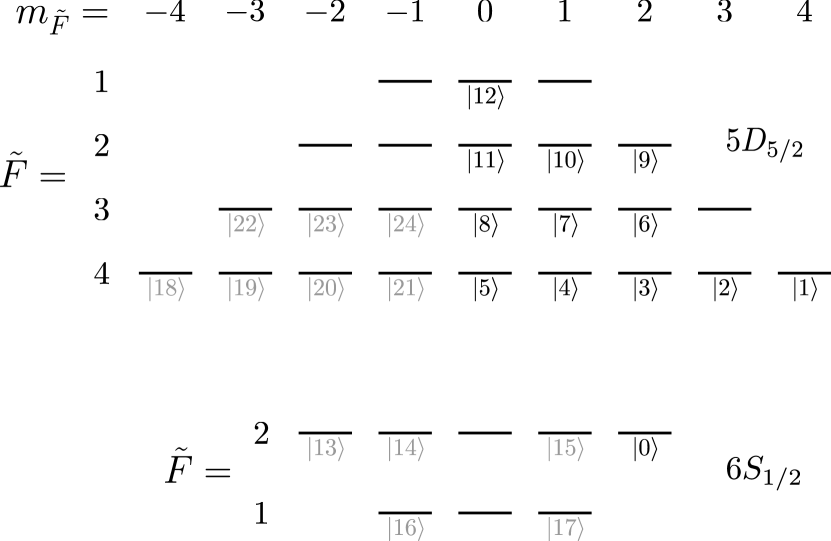
- 使用 6S1/2 F=2,mF=2 与选定的 5D5/2 准稳态,通过 1762 nm 的跃迁,在 Ba-137+ 中编码 13 级 qudit。
- 通过把非目标态搁置到 5D5/2 实现单次 SPAM,然后再进行出壳与荧光检测以识别所制备的态。
- 利用后选测量表征 SPAM 保真度,并用磁场噪声和 π-pulse 误差来建模误差。
- 在中等磁场下,通过经验标定跃迁频率并建模跃迁强度。
- 使用滤波函数理论估计误差贡献,将 SPAM 误差与磁场噪声及 π 脉冲持续时间相关联。
实验结果
研究问题
- RQ1被困的 Ba-137+ 离子能否为 13 级 qudit 提供高保真度的可靠 SPAM?
- RQ2高维 qudit SPAM 的主要误差来源是什么,它们如何随 qudit 维数变化?
- RQ3是否可行在 Ba-137+ 中使用所提出的方案将 qudit 编码扩展到 13 级以上?
- RQ4有限磁场中的跃迁强度与能级混合如何影响对高维 qudit 的控制?
主要发现
- 在 13 级 qudit 上实现了平均后选 SPAM 保真度 91.7±0.3% 的结果。
- 对于 13 级 qudit,观测到平均后选 SPAM 误差 8.3±0.3%,原始 SPAM 误差 13.1±0.3%。
- 将磁场噪声识别为 SPAM 误差的主要来源,误差按他们的模型随着 κ^2 τ_π^2 进行缩放。
- 证明对某些方案,SPAM 参数的标定时间不会随 qudit 维数增加。
- 在改进的磁噪声控制条件下,认为在 Ba-137+ 中使用所提出的控制与读出方案,编码达到 25 级是可行的。
- 表明在使用最优的 qudit 状态选择时,qudit 维数的扩展并不会本质性地限制 SPAM 保真度。
阅读本论文
在 Nubint 阅读器中打开原文,边读边就任意段落提问。
在 Nubint 中阅读本论文本解读由 AI 根据论文原文生成,引用前请核对原文。