
[论文解读] Cooperative Data Collection with Multiple UAVs for Information Freshness in the Internet of Things
本文提出了一种用于物联网网络的协作多无人机数据采集框架,通过基于QMIX的多智能体深度强化学习算法实现集中训练、分散执行,以最小化信息年龄(Age of Information, AoI)。该方法联合优化了在运动学、能量、碰撞避免及轨迹约束下的无人机轨迹与传感器调度,总平均AoI达到140,显著低于基线方法,同时通过动作掩码强制执行约束并加速收敛。
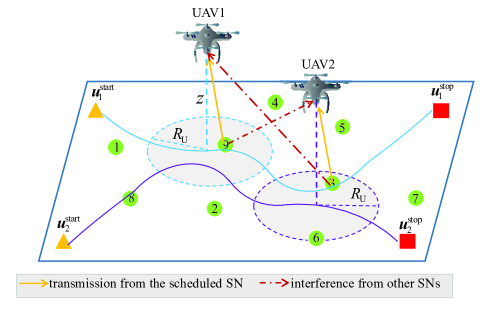
Maintaining the freshness of information in the Internet of Things (IoT) is a critical yet challenging problem. In this paper, we study cooperative data collection using multiple Unmanned Aerial Vehicles (UAVs) with the objective of minimizing the total average Age of Information (AoI). We consider various constraints of the UAVs, including kinematic, energy, trajectory, and collision avoidance, in order to optimize the data collection process. Specifically, each UAV, which has limited on-board energy, takes off from its initial location and flies over sensor nodes to collect update packets in cooperation with the other UAVs. The UAVs must land at their final destinations with non-negative residual energy after the specified time duration to ensure they have enough energy to complete their missions. It is crucial to design the trajectories of the UAVs and the transmission scheduling of the sensor nodes to enhance information freshness. We model the multi-UAV data collection problem as a Decentralized Partially Observable Markov Decision Process (Dec-POMDP), as each UAV is unaware of the dynamics of the environment and can only observe a part of the sensors. To address the challenges of this problem, we propose a multi-agent Deep Reinforcement Learning (DRL)-based algorithm with centralized learning and decentralized execution. In addition to the reward shaping, we use action masks to filter out invalid actions and ensure that the constraints are met. Simulation results demonstrate that the proposed algorithms can significantly reduce the total average AoI compared to the baseline algorithms, and the use of the action mask method can improve the convergence speed of the proposed algorithm.
研究动机与目标
- 为解决在有限机载能量和动态环境下的无人机辅助物联网网络中保持信息新鲜度的挑战。
- 在运动学、能量、轨迹及碰撞避免约束下,最小化多无人机协作数据采集的总平均信息年龄(AoI)。
- 在部分可观测环境下实现无人机的分散化运行,每个无人机基于局部观测和有限的全局协调进行决策。
- 设计一种可扩展且符合约束的强化学习框架,确保可行的轨迹与传输调度。
- 评估增加无人机数量与相互干扰之间的权衡,以优化AoI。
提出的方法
- 由于状态部分可观测且环境非平稳,将多无人机数据采集问题建模为去中心化部分可观测马尔可夫决策过程(Dec-POMDP)。
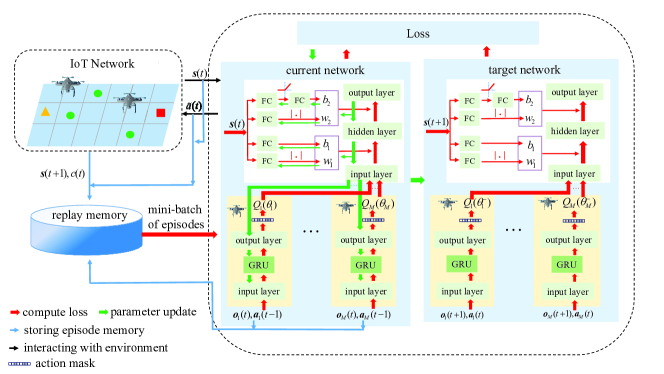
- 提出一种基于QMIX的多智能体深度强化学习算法,采用集中式训练与分散式执行,联合优化无人机轨迹与传感器调度。
- 引入动作掩码以过滤掉无效动作(如违反能量或碰撞约束),确保可行策略的学习。
- 采用奖励塑造方法引导智能体最小化AoI并提升收敛速度。
- 在训练过程中使用全局价值函数协调多智能体策略,同时支持基于局部观测的个体执行。
- 采用基于时隙的模型,无人机在离散时间步内移动并采集数据,每时隙对能量与速度约束进行建模。
实验结果
研究问题
- RQ1在能量与运动学约束下,如何实现多架无人机协作从物联网传感器收集数据,以最小化总平均信息年龄(AoI)?
- RQ2相互干扰与碰撞避免对协作数据采集中无人机轨迹规划与传输调度有何影响?
- RQ3在部分可观测、非平稳的多智能体无人机系统中,集中式训练与分散式执行如何提升性能?
- RQ4动作掩码与奖励塑造在多无人机轨迹优化中在多大程度上提升学习收敛性与约束满足度?
- RQ5为最小化AoI,最优的无人机数量是多少?需在增加数据采集机会与更高干扰之间取得平衡。
主要发现
- 所提出的基于QMIX的算法实现了140的总平均AoI,显著优于基线方法,如基于聚类的(168.1)、最近调度的(208)和基于IDQN的(233)。
- 动作掩码的使用通过在学习过程中强制执行约束,显著提升了QMIX算法的收敛速度,避免了无效动作。
- 仿真结果表明,QMIX方法中的无人机能有效分配工作负载,甚至可协同从同一传感器节点采集数据。
- 存在一个最优的无人机数量,可使总平均AoI最小化,这是由于增加了传输机会与更高相互干扰之间的权衡所致。
- 该算法在所有仿真中均成功维持了所有无人机在任务结束时非负的剩余能量,满足了能量约束。
- 理论分析证实,与年龄相关的状态变量φₘ(t)和ψₘ(t)不会下降过快,确保了在最坏机动情况下的AoI增长具有有界性。
阅读本论文
在 Nubint 阅读器中打开原文,边读边就任意段落提问。
在 Nubint 中阅读本论文本解读由 AI 根据论文原文生成,引用前请核对原文。